


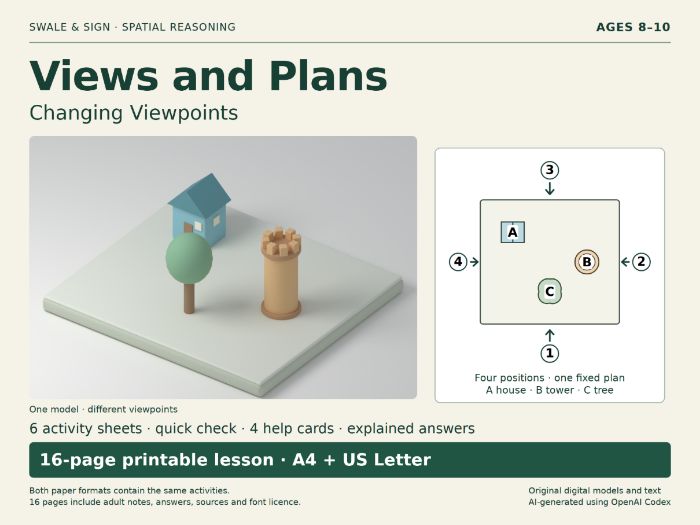
Where is the tree when you look from the other side? These printable spatial-reasoning activities help children connect views of one model to an overhead plan, describe left and right from a stated position, and explain why one clue may not identify a whole plan.
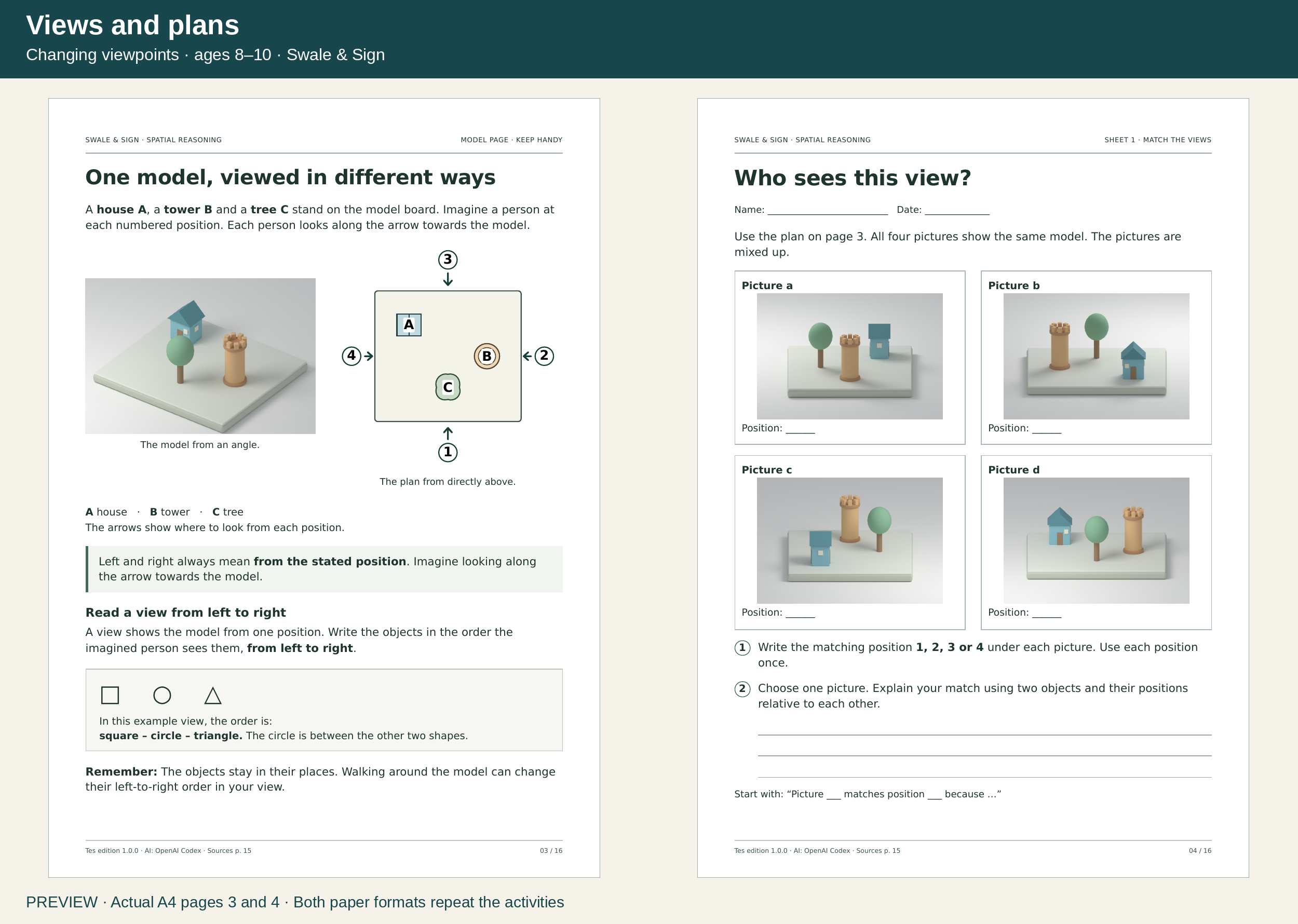
The same house, tower and tree appear throughout the main sequence. Numbered positions and arrows make the observer’s reference point explicit. Pupils explain their reasoning rather than only write a direction word. The pictures show original digital models seen from a little above; the plan shows positions from directly overhead.
Six activity sheets develop the reasoning:
- Match four mixed-up model views to four observer positions and justify one match.
- Describe relationships from specified positions and explain how left and right can change while objects stay still.
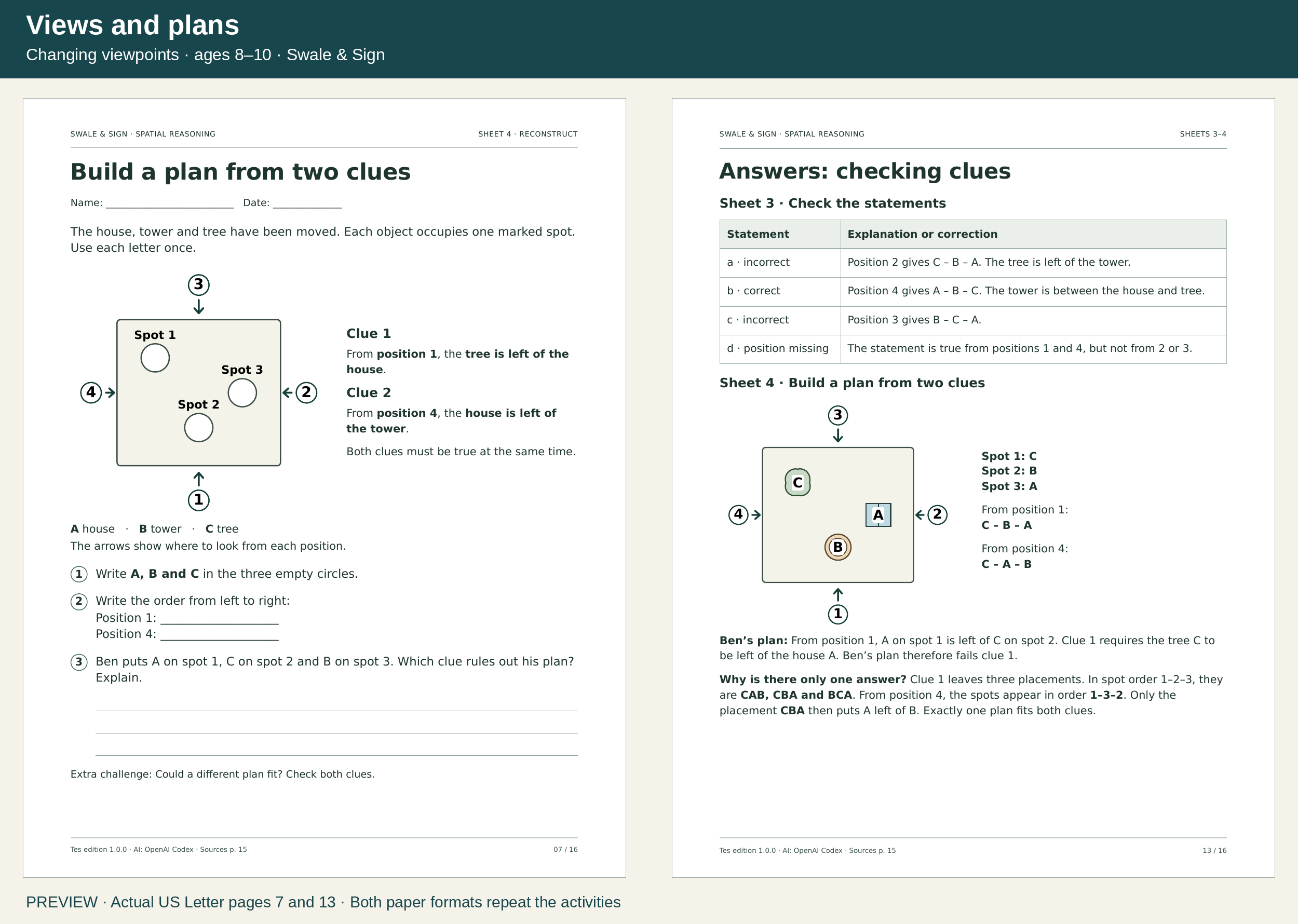
- Check or correct statements, including one with a missing observer position.
- Reconstruct a plan from two simultaneous clues and explain why a proposed plan fails.
- Compare two different plans with the same horizontal order from one position, then add information that distinguishes them.
- Create two valid plans on a nine-position grid, check both clues and write a further distinguishing clue. This final design task is an extension with several correct answers.
A separate quick check uses a new arrangement. Four help cards support naming the viewpoint, following the arrow, keeping track of order and checking clues. Three explained answer pages include worked plans and guidance on accepting other valid solutions.
Suggested ages 8–10, after children can use left/right and read a simple plan. The adult notes suggest a teaching sequence and questions to listen for. Select activities according to prior understanding. This is a focused reasoning sequence, not a complete geometry course or standardized test. It includes no scale, height, cube-counting or compass-direction calculations.
Each 16-page PDF contains a title page, adult notes, model reference, six activity sheets, one quick check, one page of four help cards, three answer pages, sources/credits and the complete font licence. Two paper sizes are included: A4 and US Letter. They repeat the same activities, so print one format. A pencil and printed reference page are sufficient; no digital device or cutting is required. Shapes and A/B/C labels carry the meaning in grayscale. The PDFs are not editable worksheet templates.
Repetition: this Tes edition repeats Swale & Sign’s English “Changing Viewpoints” activities and German “Standpunkte wechseln” sequence, including the model and arrangements. It adds no exercises for owners of either edition. A4 and Letter are alternative paper formats, not two different packs.
AI disclosure: text, tasks, diagrams, answers and original digital model images were generated using OpenAI Codex. Geometry, answers and PDF layout have been checked digitally. No classroom or physical-printer test is claimed.
Something went wrong, please try again later.
This resource hasn't been reviewed yet
To ensure quality for our reviews, only customers who have purchased this resource can review it
Report this resourceto let us know if it violates our terms and conditions.
Our customer service team will review your report and will be in touch.
£3.00