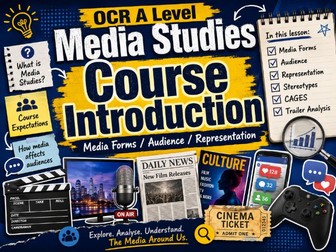
A complete OCR A-Level Media Studies introduction lesson covering media forms, expectations, representation, audiences and trailer analysis.
This fully editable PowerPoint (.pptx) lesson is designed as an opening lesson for OCR A-Level Media Studies students beginning the course. It introduces students to what Media Studies is, why it matters, key types of media, basic terminology and how media affects audiences.
The lesson includes a clear introduction to classroom expectations, independent learning, discussion norms and the demands of A-Level Media Studies, before moving into key Media Studies concepts such as media forms, audiences, representation, stereotypes, anti-stereotypes and CAGES.
Students complete a media mind map, discuss how media influences daily life, review the OCR A-Level Media Studies course content and apply basic media language through a trailer analysis task. The lesson also includes teacher feedback/model answer slides to support classroom discussion and student understanding.
This lesson covers:
OCR A-Level Media Studies
Introduction to Media Studies
Media forms
Audiences
Representation
Stereotypes
Anti-stereotypes
CAGES: Class, Age, Gender, Ethnicity, Sexuality
Media influence
Film, TV, video games, internet and social media
Trailer analysis
Target audience
Genre
Big-budget film marketing
BBFC age rating
Marvel / superhero film analysis
Classroom expectations and course routines
What is included:
Fully editable PowerPoint (.pptx) lesson
Do Now task on students’ summer media use
Teacher feedback/model answer slide
Introduction to what Media Studies is
Classroom expectations and steps to success
Independent learning expectations
Discussion expectations for sensitive media topics
Lesson objectives
Media mind map task
Teacher feedback slide on media forms
OCR A-Level Media Studies course overview
Representation key terms
Stereotypes vs anti-stereotypes explanation
CAGES representation framework
Turn and talk discussion tasks
Trailer analysis task
Model answers for trailer analysis
BBFC 12A rating discussion question
Plenary with WWW and EBI reflection
This resource can be used as:
A first lesson for OCR A-Level Media Studies
A Year 12 induction lesson
A course introduction lesson
A media basics lesson
A representation and audience introduction lesson
A transition lesson from GCSE to A-Level Media Studies
A cover lesson for new A-Level Media Studies students
This resource is provided as a fully editable PowerPoint (.pptx) file.
This resource is independently created and is not endorsed by OCR.
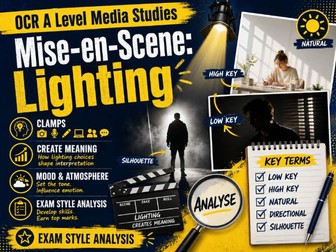
A complete A-Level Media Studies lesson introducing mise-en-scène lighting, key terminology and exam-style analysis.
This fully editable PowerPoint (.pptx) lesson focuses on lighting as part of mise-en-scène, helping students understand how directors use lighting to create meaning, mood, genre and audience response.
The lesson introduces and develops key lighting terminology including low-key lighting, high-key lighting, natural lighting, directional lighting and silhouette. Students recap wider media language terminology before applying lighting analysis to an extract from Harry Potter and the Goblet of Fire, focusing on how lighting constructs tension, fear, danger, hope, symbolism and conflict.
The lesson includes retrieval practice, key definitions, image-based terminology tasks, scaffolded analysis tables, model answers, sentence starters, an exam-style response task and peer/self-assessment criteria. It is ideal as part of an opening Media Language / Media Basics sequence for OCR A-Level Media Studies students.
This lesson covers:
OCR A-Level Media Studies
Media language
Mise-en-scène
CLAMPS
Lighting
Low-key lighting
High-key lighting
Natural lighting
Directional lighting
Silhouette
Shadows and contrast
Connotation and meaning
Genre
Audience response
Action/adventure and fantasy genre
Extract analysis
Exam-style written response
PEE paragraph structure
What is included:
Fully editable PowerPoint (.pptx) lesson
Do Now knowledge retrieval task
Teacher feedback/model answer slide
Recap of CLAMPS and mise-en-scène
Lesson objectives
Lighting terminology image-matching task
Feedback slide identifying lighting types
Mini plenary to assess lighting knowledge
Key definitions for lighting terminology
Printable lighting terminology table
Extract analysis task using Harry Potter and the Goblet of Fire
Scaffolded lighting analysis tables
Word banks for lighting effects and connotations
Teacher feedback slides with completed examples
Exam-style question on lighting and meaning
Sentence starters for analytical writing
Full model response
Peer/self-assessment criteria
WWW and EBI reflection task
Key word plenary on wider media terms
This resource can be used as:
A full A-Level lesson on mise-en-scène lighting
A media language introduction lesson
A Media Basics lesson for Year 12
A lesson on connotation and visual meaning
A film extract analysis lesson
A GCSE-to-A-Level transition lesson
A revision lesson on lighting terminology
A scaffolded exam-style writing lesson
This resource is provided as a fully editable PowerPoint (.pptx) file.
This resource is independently created and is not endorsed by OCR.
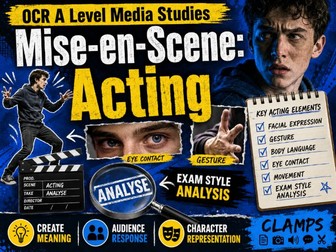
A complete A-Level Media Studies lesson introducing acting as part of mise-en-scène, with terminology, extract analysis and exam-style practice.
This fully editable PowerPoint (.pptx) lesson focuses on acting as part of mise-en-scène, helping students understand how performance choices create meaning, shape character representation and influence audience response.
The lesson introduces key acting terminology including facial expression, gesture, body language, eye contact and movement. Students recap lighting terminology from previous media language lessons before applying acting analysis to an extract from Inglourious Basterds, focusing on power, fear, intimidation, authority, vulnerability and tension.
The lesson includes retrieval practice, key definitions, image-based terminology tasks, scaffolded analysis tables, model answers, sentence starters, an exam-style response task and peer/self-assessment criteria. It works well as part of an opening Media Language / Media Basics / CLAMPS sequence for OCR A-Level Media Studies students.
This lesson covers:
OCR A-Level Media Studies
Media language
Mise-en-scène
CLAMPS
Acting
Facial expression
Gesture
Body language
Eye contact
Movement
Posture
Tone of voice
Delivery
Character representation
Power and authority
Vulnerability and tension
Connotation and meaning
Film extract analysis
Exam-style written response
PEE paragraph structure
What is included:
Fully editable PowerPoint (.pptx) lesson
Do Now knowledge retrieval task on lighting terminology
Teacher feedback/model answer slide
Lesson objectives
Acting terminology image-matching task
Feedback slide identifying acting techniques
Key definitions for acting terminology
Printable acting terminology table
Extract analysis task using Inglourious Basterds
Scaffolded acting analysis tables
Word banks for acting techniques, emotions and connotations
Teacher feedback slides with completed examples
Extended analysis table for facial expression, body language, eye contact and movement
Exam-style question on acting and meaning
Sentence starters for analytical writing
Full model response
Peer/self-assessment criteria
WWW and EBI reflection task
Key word plenary on wider media terms
This resource can be used as:
A full A-Level lesson on mise-en-scène acting
A media language introduction lesson
A Media Basics lesson for Year 12
A CLAMPS lesson focused on acting
A lesson on connotation and character representation
A film extract analysis lesson
A GCSE-to-A-Level transition lesson
A revision lesson on acting terminology
A scaffolded exam-style writing lesson
This resource is provided as a fully editable PowerPoint (.pptx) file.
This resource is independently created and is not endorsed by OCR.
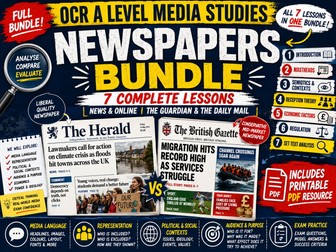
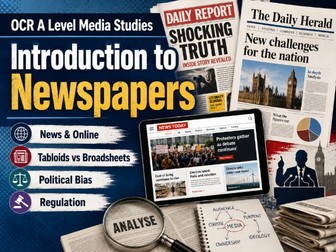
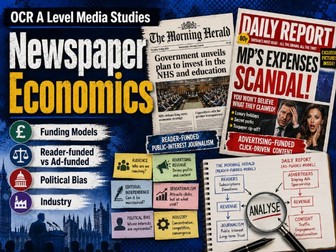
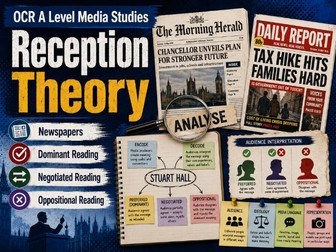
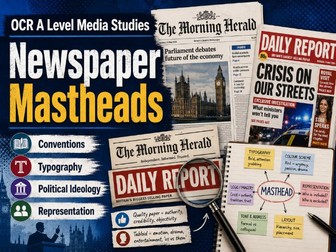
A complete OCR A-Level Media Studies Newspapers bundle covering News & Online, newspaper forms, mastheads, theory, contexts, economics, regulation and set text analysis.
This bundle contains 7 fully editable PowerPoint lessons for the OCR A-Level Media Studies News & Online / Newspapers topic for Paper 1 Section A. The lessons are designed to build students’ knowledge step-by-step, beginning with an introduction to newspapers and ending with detailed set text analysis of The Guardian and The Daily Mail.
The bundle supports students in understanding newspaper forms, tabloid and broadsheet conventions, mastheads, political bias, semiotics, audience interpretation, economic factors, regulation, press freedom and OCR set text analysis. It is suitable for Year 12 or Year 13 A-Level Media Studies and can be used as a full sequence of lessons, revision unit, intervention pack or exam preparation resource.
The lessons include structured classroom tasks, retrieval practice, teacher feedback slides, model answers, sentence starters, exam-style questions, printable analysis resources and scaffolded writing support.
Suggested teaching order
Lesson 1: Introduction to Newspapers
Introduces the OCR A-Level Newspapers / News & Online topic. Students explore newspaper types, tabloids, broadsheets, political affiliation, regulation, online news and the role of newspapers in shaping public opinion.
Lesson 2: Newspaper Mastheads
Focuses on newspaper front page conventions and masthead analysis. Students explore how mastheads communicate brand identity, audience positioning, political ideology and representation through typography, colour, logo, tone and layout.
Lesson 3: Semiotics & Social Contexts
Applies Barthes’ semiotics to newspaper front pages. Students analyse signs, denotation, connotation, anchorage and myth, while linking newspaper media language to political and social contexts.
Lesson 4: Stuart Hall and Reception Theory
Explores Hall’s Reception Theory and applies dominant/preferred, negotiated and oppositional readings to newspapers. Students consider how audiences decode political messages differently depending on values, identity and ideology.
Lesson 5: Economic Factors
Compares the funding models of The Guardian and The Daily Mail. Students explore reader-funded journalism, advertising revenue, editorial independence, click-driven content, sensationalism and public-interest reporting.
Lesson 6: Newspaper Regulation
Explores newspaper regulation, press freedom, IPSO, Ofcom, Leveson, phone hacking, Hillsborough reporting, MPs’ expenses and Edward Snowden/WikiLeaks. Students evaluate whether newspapers need greater regulation to protect the public.
Lesson 7: Newspaper Set Text Analysis
Final lesson in the sequence, focusing directly on OCR set text analysis of The Guardian and The Daily Mail. Students apply knowledge of media language, representation, political/social contexts, audience, purpose, ownership and political bias. This lesson also includes a printable PDF front page analysis resource.
What is included?
7 fully editable PowerPoint (.pptx) lessons
Printable PDF front page analysis resource
Do Now retrieval activities
Teacher feedback/model answer slides
Lesson objectives
Key terminology explanations
Tabloid and broadsheet comparison
Newspaper convention tasks
Masthead analysis activities
Political affiliation tasks
Semiotics and Barthes theory application
Reception Theory and Stuart Hall application
Dominant, negotiated and oppositional reading tasks
Economic factors and funding model comparison
Reader-funded vs advertising-funded journalism tasks
Regulation and press freedom case studies
IPSO, Ofcom and Leveson content
Case-study evidence for phone hacking, Hillsborough, MPs’ expenses and Snowden/WikiLeaks
Source analysis tasks
Sentence starters and writing frames
Exam-style questions
Model paragraphs and extended model responses
Mini plenaries and self-assessment tasks
Key topics covered
OCR A-Level Media Studies
Paper 1 Section A: News & Online
Newspapers
The Guardian
Daily Mail
Newspaper set texts
Tabloids and broadsheets
Red-top tabloids
Mid-market tabloids
Quality newspapers
Newspaper mastheads
Media language
Representation
Political context
Social context
Audience and purpose
Political bias
Ideology
Barthes’ semiotics
Stuart Hall’s Reception Theory
Denotation and connotation
Myth and anchorage
Dominant/preferred reading
Negotiated reading
Oppositional reading
Economic factors
Funding models
Reader-funded journalism
Advertising revenue
Editorial independence
Sensationalism
Newspaper regulation
Press freedom
IPSO
Ofcom
Leveson Inquiry
Phone hacking scandal
Hillsborough reporting
MPs’ expenses scandal
Edward Snowden/WikiLeaks
OCR exam preparation
This bundle can be used as:
A complete A-Level Newspapers teaching sequence
A Paper 1 Section A: News & Online unit
A revision bundle for The Guardian and The Daily Mail
A Year 12 or Year 13 newspaper topic pack
A theory application sequence
A media language and representation unit
A media industries and regulation revision pack
A structured OCR exam preparation resource
A cover or intervention sequence for A-Level Media Studies
This bundle includes fully editable PowerPoint (.pptx) lessons and a printable PDF front page analysis resource.
This resource is independently created and is not endorsed by OCR.
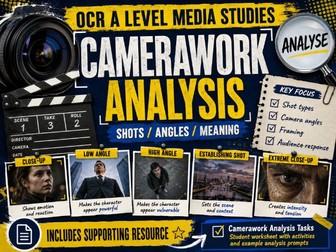
A complete A-Level Media Studies camerawork lesson introducing camera shots, angles, connotations and film analysis.
This fully editable PowerPoint (.pptx) lesson introduces students to camerawork and camera connotations, helping them understand how framing, shot types and camera angles shape audience interpretation.
The lesson explores how camerawork can influence meaning, power, vulnerability, fear, dominance, genre and audience response. Students begin by analysing how framing can change perception, before identifying key camerawork techniques and applying them to film/TV examples, including horror close-up analysis and an action/adventure extract.
The lesson includes a supporting camerawork resource document with camerawork terminology and a structured camerawork analysis task, allowing students to record examples and explain effects using scaffolded writing prompts.
Students practise using terminology such as establishing shot, close-up, extreme close-up, medium shot, long shot, low angle, high angle, eye level, tilt angle and point-of-view shot. They then apply these terms to an exam-style analysis task focused on how camerawork creates meaning and shapes the audience’s understanding of character motivation.
This lesson covers:
OCR A-Level Media Studies
Media language
Camerawork
Camera shots
Camera angles
Framing
Close-up
Extreme close-up
Medium shot
Long shot
Establishing shot
Low angle
High angle
Eye-level shot
Tilt angle
Point-of-view shot
Camerawork connotations
Audience response
Power and vulnerability
Genre conventions
Horror analysis
Action/adventure analysis
Film extract analysis
Exam-style written response
What is included:
Fully editable PowerPoint (.pptx) lesson
Camerawork terminology/resource document
Camerawork analysis task resource
Do Now task on framing and perception
Teacher feedback/model answer slide
Lesson objectives
Camerawork terminology identification task
Establishing shot discussion question
Horror close-up analysis task
Teacher feedback on close-up and horror conventions
Camerawork connotation task
Low angle, high angle and extreme close-up analysis
Multiple understanding check slides
Main movie analysis task
Structured writing frame
Camerawork note-taking sheet
Model paragraph response
Exit ticket plenary
Green pen reflection task
This resource can be used as:
A full A-Level lesson on camerawork
A Media Language / Media Basics lesson
A Year 12 introduction to camera shots and angles
A GCSE-to-A-Level transition lesson
A film or TV extract analysis lesson
A revision lesson on camerawork terminology
A scaffolded writing lesson for exam-style media analysis
A cover lesson for OCR A-Level Media Studies
This resource is provided as a fully editable PowerPoint (.pptx) file and includes a supporting camerawork resource document for terminology and analysis practice.
This resource is independently created and is not endorsed by OCR.
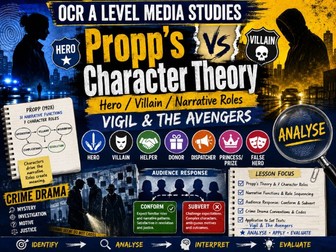
A complete OCR A-Level Media Studies lesson introducing Propp’s character theory and applying it to crime drama set texts.
This fully editable PowerPoint (.pptx) lesson focuses on Propp’s character theory, helping students understand how character roles shape narrative, audience response and meaning in media texts.
The lesson introduces key Proppian character types including hero, villain, princess/prize, donor, dispatcher, helper and false hero. Students explore how characters can conform to or subvert typical narrative expectations before applying the theory to Vigil and The Avengers.
The lesson includes a strong focus on how characters such as Amy Silva, Kirsten Longacre, John Steed and Emma Peel challenge or conform to the stereotypical Proppian hero. Students are supported with word banks, sentence starters, worksheet-style tasks, discussion activities and model feedback slides.
This lesson covers:
OCR A-Level Media Studies
Audience theory
Character theory
Propp’s theory
Proppian character types
Hero
Villain
Princess/prize
Donor
Dispatcher
Helper
False hero
Conform and subvert
Narrative roles
Audience response
Crime drama
Vigil
The Avengers
Amy Silva
Kirsten Longacre
John Steed
Emma Peel
Gender representation
Heroism
Character stereotypes
What is included:
Fully editable PowerPoint (.pptx) lesson
Do Now task on villain characters
Teacher feedback/model answer slide
Lesson objectives
Key definitions for conform and subvert
Propp character theory recap task
Printable Propp character type matching task
Teacher feedback slide with Proppian character types
Lion King mini plenary to embed character roles
Hero vs villain characteristics sorting task
Word bank for character traits
Teacher feedback slide for hero/villain traits
Application task on Amy Silva and Kirsten Longacre in Vigil
Model feedback on how Vigil challenges the stereotypical hero
Application task on John Steed and Emma Peel in The Avengers
Model feedback on how The Avengers conforms to and challenges Proppian hero roles
Audience theory plenary comparing Vigil and The Avengers
This resource can be used as:
A full A-Level lesson on Propp’s character theory
An OCR Media Studies audience theory lesson
A crime drama theory application lesson
A lesson preparing students to analyse Vigil and The Avengers
A GCSE-to-A-Level transition lesson on narrative and character
A revision lesson on Proppian character roles
A scaffolded discussion and writing lesson
A Year 12 or Year 13 Media Studies lesson
This resource is provided as a fully editable PowerPoint (.pptx) file.
This resource is independently created and is not endorsed by OCR.
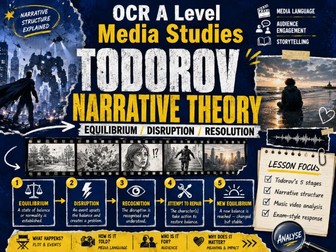
A complete OCR A-Level Media Studies lesson introducing Todorov’s narrative theory and applying it to music video analysis.
This fully editable PowerPoint (.pptx) lesson focuses on Todorov’s narrative theory, helping students understand how narratives are structured and how storytelling creates audience engagement.
The lesson introduces Todorov’s five-part narrative structure: equilibrium, disruption, recognition of disruption, attempt to repair and new equilibrium. Students also recap Propp’s character theory before applying narrative theory to examples including Black Panther and the Lewis Capaldi – Before You Go music video.
Students complete matching tasks, sequencing activities, printable narrative structure tasks, discussion questions, model analysis and an exam-style written response. The lesson supports students in linking narrative theory to media language, audience response, emotion, conflict and resolution.
This lesson covers:
OCR A-Level Media Studies
Narrative theory
Todorov
Propp recap
Equilibrium
Disruption
Recognition of disruption
Attempt to repair
New equilibrium
Character types
Storytelling
Audience engagement
Music video analysis
Lewis Capaldi – Before You Go
Black Panther
Media language
Editing
Lighting
Sound
Camera shots
Emotion and meaning
Exam-style written response
What is included:
Fully editable PowerPoint (.pptx) lesson
Do Now task on storytelling and audience engagement
Teacher feedback/model answer slide
Lesson objectives
Propp character theory matching task
Printable Propp character type resource
Mini plenary on Propp’s character theory
Todorov narrative structure sequencing task
Printable Todorov theory task
Teacher feedback on Todorov’s five-part structure
Black Panther narrative structure model
Lewis Capaldi music video narrative analysis task
Printable narrative structure worksheet
Lewis Capaldi model narrative structure
Exam-style question applying Todorov to music video
Word bank including narrative and media language terminology
Sentence starters for written response
Full model response
Final plenary summarising Todorov’s theory
This resource can be used as:
A full A-Level lesson on Todorov’s narrative theory
An OCR Media Studies theory lesson
A Media Language / Media Basics lesson
A music video analysis lesson
A GCSE-to-A-Level transition lesson on narrative
A revision lesson on narrative structure
A scaffolded exam-style writing lesson
A Year 12 or Year 13 Media Studies lesson
This resource is provided as a fully editable PowerPoint (.pptx) file.
This resource is independently created and is not endorsed by OCR.
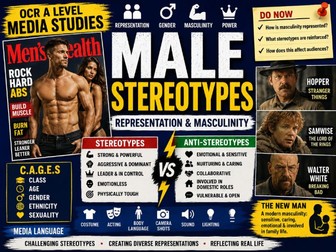
A complete OCR A-Level Media Studies lesson exploring male representation, stereotypes and anti-stereotypes in media texts.
This fully editable PowerPoint (.pptx) lesson focuses on representation of masculinity in the media, helping students understand how male characters can reinforce or challenge stereotypes through media language.
The lesson introduces key representation concepts including CAGES, stereotypes, anti-stereotypes, “The New Man” and male identity. Students analyse how masculinity is constructed through body shape, costume, dominance, physical strength, emotional control and gender roles, before applying these ideas to a range of male characters.
Students explore examples including Hopper from Stranger Things, Samwise from The Lord of the Rings, Walter White from Breaking Bad, and the boys and adult male characters in Stranger Things Season 1 Episode 1. The lesson supports students in considering how male characters may be represented as strong, dominant, emotional, vulnerable, nurturing, passive, powerful or anti-stereotypical.
The lesson includes retrieval practice, discussion tasks, printable analysis tables, word banks, sentence starters, model answers and an extended model response.
This lesson covers:
OCR A-Level Media Studies
Representation
Male stereotypes
Male anti-stereotypes
Gender representation
Masculinity
CAGES
“The New Man”
Gauntlett
Media language
Costume
Acting
Body language
Facial expression
Camera shots
Audience response
Stranger Things
Hopper
Samwise
Walter White
Generational masculinity
Stereotype and anti-stereotype analysis
What is included:
Fully editable PowerPoint (.pptx) lesson
Do Now analysis task on masculinity and magazine representation
Teacher feedback/model answer slide
CAGES recap task
Lesson objectives
Key definitions of stereotype and anti-stereotype
Active talk task on male stereotypes in media
Male stereotypes and anti-stereotypes mind map task
Teacher feedback slides
“The New Man” key term explanation
Character analysis tasks for Hopper, Samwise and Walter White
Printable stereotype vs anti-stereotype analysis table
Teacher feedback/model analysis for all three characters
Main activity on male representation in Stranger Things
Word bank for gender representation analysis
Sentence starters for structured written response
Model response on boys, men and generational masculinity in Stranger Things
Mini plenary on stereotype vs anti-stereotype
Extra stereotype fact file activity
This resource can be used as:
A full A-Level lesson on male representation
An OCR Media Studies representation lesson
A Media Basics lesson on stereotypes and anti-stereotypes
A gender representation lesson
A set-text support lesson for Stranger Things
A GCSE-to-A-Level transition lesson
A scaffolded analytical writing lesson
A Year 12 or Year 13 Media Studies lesson
This resource is provided as a fully editable PowerPoint (.pptx) file.
This resource is independently created and is not endorsed by OCR.
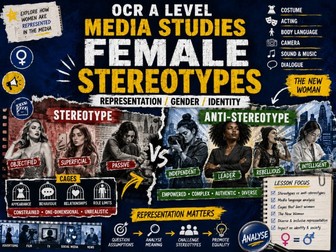
A complete OCR A-Level Media Studies lesson exploring female representation, stereotypes and anti-stereotypes in media texts.
This fully editable PowerPoint (.pptx) lesson focuses on representation of women in the media, helping students understand how female characters can reinforce or challenge stereotypes through media language.
The lesson introduces key representation concepts including CAGES, stereotypes, anti-stereotypes, “The New Woman” and female identity. Students analyse how femininity is constructed through body shape, costume, central placement, leadership, sexualisation and empowerment before applying these ideas to a range of female characters.
The lesson includes analysis of Wonder Woman, Joyce from Stranger Things, Claire from Lupin, Katniss Everdeen from The Hunger Games and Wednesday Addams, with students considering how female characters may be represented as passive, powerful, nurturing, sexualised, rebellious, independent or anti-stereotypical.
The lesson includes retrieval practice, discussion tasks, printable analysis tables, word banks, sentence starters, model answers and an exam-style written response.
This lesson covers:
OCR A-Level Media Studies
Representation
Female stereotypes
Female anti-stereotypes
Gender representation
CAGES
Femininity
Sexualisation
Empowerment
“The New Woman”
Van Zoonen
Media language
Costume
Acting
Body language
Camera shots
Audience response
Wonder Woman
Stranger Things
Lupin
The Hunger Games
Wednesday
What is included:
Fully editable PowerPoint (.pptx) lesson
Do Now analysis task on Wonder Woman
Teacher feedback/model answer slide
CAGES recap task
Lesson objectives
Key definitions of stereotype and anti-stereotype
Female stereotypes and anti-stereotypes mind map task
Teacher feedback slides
“The New Woman” key term explanation
Character analysis tasks for Joyce, Claire and Katniss Everdeen
Printable stereotype vs anti-stereotype analysis table
Teacher feedback/model analysis for all three characters
Main activity on female representation in Wednesday
Word bank for gender representation analysis
Sentence starters for structured written response
Model response on Wednesday as an anti-stereotypical female character
Mini plenary on stereotype vs anti-stereotype
This resource can be used as:
A full A-Level lesson on female representation
An OCR Media Studies representation lesson
A Media Basics lesson on stereotypes and anti-stereotypes
A gender representation lesson
A set-text support lesson for Stranger Things and Lupin
A GCSE-to-A-Level transition lesson
A scaffolded analytical writing lesson
A Year 12 or Year 13 Media Studies lesson
This resource is provided as a fully editable PowerPoint (.pptx) file.
This resource is independently created and is not endorsed by OCR.
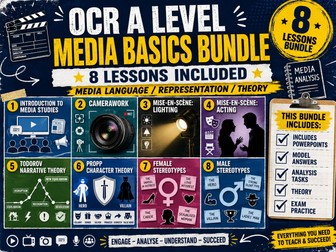
A complete OCR A-Level Media Studies introductory bundle covering media basics, media language, representation, stereotypes, camerawork, mise-en-scène and key theory.
This bundle contains 8 fully editable PowerPoint (.pptx) lessons designed for students beginning OCR A-Level Media Studies. The lessons introduce students to the foundations of Media Studies, including key terminology, media forms, audience, representation, stereotypes, mise-en-scène, camerawork, narrative theory and character theory.
The bundle is ideal for the opening weeks of Year 12, GCSE-to-A-Level transition, early course induction, revision or intervention. Lessons include retrieval practice, discussion tasks, terminology activities, printable worksheets/resources, model answers, sentence starters and scaffolded exam-style writing tasks.
The sequence builds students’ confidence with the essential analytical vocabulary needed for OCR A-Level Media Studies before moving into set texts.
Suggested teaching order
Lesson 1: OCR A-Level Media Studies Introduction
Introduces students to the course, classroom expectations, media forms, audiences, representation, stereotypes, anti-stereotypes, CAGES and trailer analysis. This works best as the first lesson because it gives students a broad overview of the subject and establishes key routines.
Lesson 2: Camerawork Analysis
Introduces key camera shots, angles, framing and connotations. Students explore how camerawork shapes audience response, power, vulnerability, fear and meaning. This should come early because camerawork is one of the core building blocks of media language.
Lesson 3: Mise-en-Scène: Lighting
Develops students’ understanding of mise-en-scène through lighting terminology, including low-key lighting, high-key lighting, natural lighting, directional lighting and silhouette. Students apply this to film extract analysis.
Lesson 4: Mise-en-Scène: Acting
Continues the CLAMPS/media language sequence by focusing on acting, including facial expression, gesture, body language, eye contact and movement. Students apply acting terminology to extract analysis and exam-style writing.
Lesson 5: Todorov Narrative Theory
Introduces narrative structure through Todorov’s five stages: equilibrium, disruption, recognition, attempt to repair and new equilibrium. Students apply the theory to music video and film examples.
Lesson 6: Propp’s Character Theory
Builds on narrative by introducing Proppian character roles, including hero, villain, donor, dispatcher, helper, princess/prize and false hero. Students apply character theory to crime drama examples including Vigil and The Avengers.
Lesson 7: Female Stereotypes
Introduces gender representation with a focus on female stereotypes, anti-stereotypes, CAGES, “The New Woman” and media language analysis. Students analyse examples from Wonder Woman, Stranger Things, Lupin, The Hunger Games and Wednesday.
Lesson 8: Male Stereotypes
Completes the introductory representation sequence by focusing on masculinity, male stereotypes, anti-stereotypes, “The New Man” and generational masculinity. Students analyse examples from Stranger Things, The Lord of the Rings and Breaking Bad.
What is included?
8 fully editable PowerPoint (.pptx) lessons
Introductory OCR A-Level Media Studies lesson
Camerawork analysis lesson
Mise-en-scène lighting lesson
Mise-en-scène acting lesson
Todorov narrative theory lesson
Propp character theory lesson
Female stereotypes and representation lesson
Male stereotypes and representation lesson
Printable worksheet/resource slides
Camerawork resource document and analysis task
Retrieval practice tasks
Key terminology slides
Teacher feedback/model answer slides
Sentence starters
Word banks
Analytical writing frames
Exam-style questions
Model responses
Peer/self-assessment criteria
Plenary and reflection tasks
Key topics covered
OCR A-Level Media Studies
Media Studies introduction
Media basics
Media language
Representation
Audience
CAGES
Stereotypes
Anti-stereotypes
Gender representation
Male representation
Female representation
The New Man
The New Woman
Mise-en-scène
CLAMPS
Lighting
Acting
Camerawork
Camera shots
Camera angles
Connotation
Denotation
Narrative
Todorov
Propp
Character theory
Audience response
Film analysis
Music video analysis
Extract analysis
Exam-style writing
This bundle can be used as:
An opening OCR A-Level Media Studies unit
A Year 12 induction sequence
A Media Basics teaching pack
A Media Language introduction bundle
A Representation introduction bundle
A GCSE-to-A-Level transition unit
A revision or intervention pack
A theory introduction sequence
A set-text preparation unit before moving into OCR texts
This bundle includes fully editable PowerPoint (.pptx) lessons and supporting printable/resource materials.
This resource is independently created and is not endorsed by OCR.
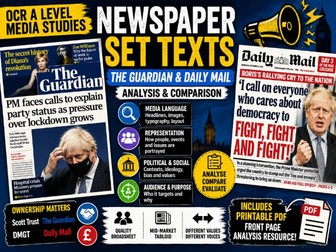
A complete OCR A-Level Media Studies lesson analysing The Guardian and Daily Mail set newspaper texts, with a printable PDF resource.
This fully editable PowerPoint (.pptx) lesson focuses on the OCR A-Level Media Studies News & Online / Newspapers set texts for Paper 1 Section A, supporting students in analysing The Guardian and The Daily Mail front pages.
The lesson recaps key newspaper knowledge, including newspaper type, ownership, political alignment and editorial influence, before guiding students into a detailed analysis of the set texts. Students consider how media language, representation, political and social contexts, audience and purpose shape meaning across the two newspapers.
The lesson uses an I Do / We Do / You Do structure to model analysis before students complete their own front page analysis. It includes teacher modelling on the Daily Mail, focusing on headline construction, typography, authority, urgency and political bias. Students are then guided to apply the same approach to both set texts.
This resource includes a printable PDF front page analysis resource, allowing students to annotate, structure and develop their analysis of the OCR newspaper set products.
This lesson covers:
OCR A-Level Media Studies
Paper 1 Section A: News & Online
Newspapers
The Guardian
Daily Mail
OCR set texts
Newspaper front page analysis
Media language
Representation
Political context
Social context
Audience and purpose
Ownership
Scott Trust Limited
DMGT
Political alignment
Left-wing and right-wing newspapers
Newspaper ideology
Headline analysis
Typography
Layout and composition
Political bias
Set product revision
A-Level exam preparation
What is included:
Fully editable PowerPoint (.pptx) lesson
Printable PDF front page analysis resource
Do Now retrieval task on The Guardian and Daily Mail
Teacher feedback/model answer slide
Lesson objectives
Recap of OCR A-Level newspaper set texts
Ownership recap for The Guardian and Daily Mail
Political alignment recap
I Do / We Do / You Do set text analysis structure
Model analysis of Daily Mail headline construction
Model analysis of typography, capitalisation and authority
Political bias analysis task
Model analysis of Boris Johnson framing in the Daily Mail
Student analysis task for The Guardian and Daily Mail set texts
Prompts for media language, representation, political/social contexts, audience and purpose
Theorist link prompts
Political alignment mini plenary
This resource can be used as:
A full A-Level lesson on OCR newspaper set text analysis
A Paper 1 Section A: News & Online lesson
A lesson comparing The Guardian and Daily Mail
A revision lesson for OCR A-Level newspaper set products
A front page annotation and analysis lesson
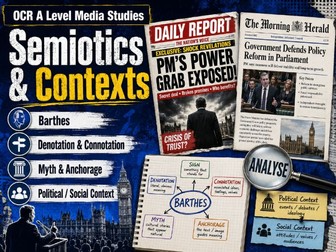
A complete OCR A-Level Media Studies lesson applying Barthes’ semiotics to newspaper front pages and political/social contexts.
This fully editable PowerPoint (.pptx) lesson focuses on newspaper semiotics, media language and contexts, supporting students in applying Roland Barthes’ theory of semiotics to the OCR A-Level Media Studies News & Online / Newspapers topic for Paper 1 Section A.
The lesson helps students analyse how newspaper front pages use signs, denotation, connotation, anchorage and myth to construct political meanings. It also supports students in understanding how political and social contexts shape newspaper production, circulation, audience targeting and ideological framing.
Students compare two newspaper sources, considering how headlines, images, colour, typography, layout, facial expression, body language and anchorage create meaning. The lesson also includes a statement-sorting task on how social contexts influence The Guardian and the Daily Mail, helping students understand how different newspapers target audiences and reflect values, ideology and commercial pressures.
The lesson includes retrieval practice, teacher explanations, source analysis, printable sorting statements, scaffolded writing frames, success criteria and extended model responses to support accurate A-Level analysis.
This lesson covers:
OCR A-Level Media Studies
Paper 1 Section A: News & Online
Newspapers
Roland Barthes
Semiotics
Denotation
Connotation
Sign
Signifier and signified
Myth
Anchorage
Media language
Political context
Social context
Ideology
Framing
Newspaper front page analysis
The Guardian
Daily Mail
Audience targeting
Production and circulation
Newspaper representation
Political meanings
Comparative source analysis
What is included:
Fully editable PowerPoint (.pptx) lesson
Do Now retrieval task on Barthes, context, mastheads, newspaper forms and target audience
Teacher feedback/model answer slide
Lesson objectives
Key definitions for Barthes, political context and social context
Clear explanation of Roland Barthes’ semiotics
Explanation of denotation, connotation and myth
Turn and talk task on how newspapers shape political meanings
Source analysis task comparing Daily Mail and Guardian front pages
Teacher-modelled analysis table
Feedback table covering denotation, connotation, key signs, political meaning and myth
Statement placement task: The Guardian / Daily Mail / Both
Printable statement-sorting task
Feedback on social contexts, production, circulation and audience targeting
Main exam-style activity on semiotics and political contexts
Word bank for semiotic and contextual analysis
Sentence starters for structured written responses
“How to” support slide for the main activity
Extended model response applying Barthes to Source A
Extended model response comparing Source A and Source B
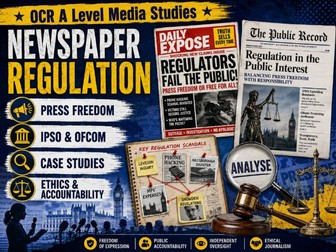
A complete OCR A-Level Media Studies lesson exploring newspaper regulation, press freedom, IPSO, Leveson and key case studies.
This fully editable PowerPoint (.pptx) lesson focuses on newspaper regulation for the OCR A-Level Media Studies News & Online / Newspapers topic for Paper 1 Section A.
The lesson explores why newspapers are regulated, how regulation works in the UK, and how regulation must balance freedom of the press with public protection, privacy, ethics and accountability. Students consider whether the newspaper industry needs greater regulation, using examples linked to The Guardian, The Daily Mail, IPSO, Ofcom and major press case studies.
Students are guided through retrieval practice, key terminology, freedom of the press, UK regulation, global press freedom and case-study evidence. The lesson then builds towards an exam-style evaluative response on whether newspapers need regulation to protect the public.
The lesson includes structured tasks, teacher feedback/model answers, information sheets, case-study prompts, a detailed word bank, sentence starters and a full model response.
This lesson covers:
OCR A-Level Media Studies
Paper 1 Section A: News & Online
Newspapers
Newspaper regulation
Press freedom
Freedom of expression
Public interest
Privacy
Ethics
Accountability
Self-regulation
Statutory regulation
IPSO
Editors’ Code of Practice
Ofcom
Leveson Inquiry
Phone hacking scandal
News of the World
Milly Dowler
Hillsborough reporting
MPs’ expenses scandal
Edward Snowden / WikiLeaks
Investigative journalism
Democracy
Trust in the press
The Guardian
The Daily Mail
What is included:
Fully editable PowerPoint (.pptx) lesson
Do Now retrieval task on hard news, soft news, tabloid newspapers, ideology and regulation
Teacher feedback/model answer slide
Lesson objectives
Key definition of newspaper regulation
Active talk task on online newspaper regulation
Freedom of the press task
Model answers on press freedom and democracy
UK regulation task comparing The Guardian and The Daily Mail
Fact sheet on The Guardian and Daily Mail regulation/ownership
Feedback on self-regulation and press freedom
Global freedom of press task
Model answers on press freedom, democracy and censorship
Case-study research task with seven sections
Information sheets on:
Leveson Inquiry
Edward Snowden / WikiLeaks
MPs’ Expenses Scandal
IPSO
Ofcom
Phone Hacking Scandal
Hillsborough reporting
Exam-style question on newspaper regulation
Detailed word bank for regulation and press freedom
Sentence starters for evaluative written responses
Full model response
Self-assessment mini plenary
This resource can be used as:
A full A-Level lesson on newspaper regulation
A Paper 1 Section A: News & Online lesson
A lesson on press freedom and public protection
A case-study lesson on Leveson, IPSO, phone hacking and Hillsborough
A revision lesson on regulation and newspaper industry contexts
An exam
A complete OCR A-Level Media Studies newspaper lesson introducing News & Online, tabloid/broadsheet conventions and political bias.
This fully editable PowerPoint (.pptx) lesson introduces students to the OCR A-Level Media Studies Newspapers / News & Online topic for Paper 1 Section A.
The lesson is designed as an introductory A-Level lesson for students beginning the newspaper unit, but it could also be used as a revision or recap lesson before applying knowledge to set newspaper texts such as The Guardian, The Daily Mail and The Observer.
Students are introduced to key newspaper forms, including red-top tabloids, mid-market tabloids, quality tabloids and quality broadsheets, before developing their understanding of political bias, newspaper regulation, the decline of print circulation and the shift towards online news.
The resource includes a clear sequence of timed classroom tasks, teacher feedback slides and model answers to support discussion, questioning and student understanding. Students are encouraged to analyse how the form and political stance of a newspaper can influence the selection, construction and representation of news stories.
This lesson covers:
OCR A-Level Media Studies
Paper 1 Section A: News & Online
Newspaper types
Tabloid and broadsheet conventions
Red-top tabloids
Mid-market tabloids
Quality newspapers
Political bias and ideology
Left-leaning, centre/neutral and right-leaning newspapers
Newspaper regulation
IPSO
Leveson Inquiry
Decline of print newspapers
Online news
Media language
Representation
Audience
Industry contexts
Political contexts
What is included:
Fully editable PowerPoint (.pptx) lesson
Do Now starter on newspaper types
Teacher feedback/model answer slides
Lesson objectives
OCR Paper 1 Section A: News & Online introduction
Key terminology task
Definitions of red-top tabloids, mid-market tabloids, quality tabloids and quality broadsheets
Tabloid vs broadsheet classification activity
Model answers on tabloid and broadsheet conventions
Discussion task on the historical role and influence of newspapers
Context task on regulation, IPSO, the Leveson Inquiry and online news
Political affiliation definitions
Newspaper political stance research task
Main newspaper front cover analysis activity
Analytical prompts linked to media language, representation, audience, ideology and industry
Mini plenary on political positioning
This resource can be used as:
An introductory A-Level lesson on Newspapers / News & Online
A revision lesson before analysing OCR set newspaper texts
A bridge into The Guardian, The Daily Mail or The Observer
A lesson preparing students for ideological and political analysis
A cover lesson for Year 12 or Year 13 Media Studies
A discussion-based lesson on news values, political stance and representation
This resource is provided as a fully editable PowerPoint (.pptx) file.
*This resource is independently created and is not endorsed by OCR.
A complete OCR A-Level Media Studies lesson looking at how economic factors influence The Guardian and The Daily Mail.
This fully editable PowerPoint (.pptx) lesson focuses on economic factors in the newspaper industry, specifically comparing how the funding models of The Guardian and The Daily Mail shape content, presentation, political bias and editorial priorities.
Designed for OCR A-Level Media Studies Paper 1 Section A: News & Online, the lesson supports students in understanding how media industries and economic pressures influence the construction of newspaper content. It explores the differences between reader-funded journalism and advertising-funded journalism, linking these models to audience appeal, sensationalism, editorial independence and public-interest reporting.
Students compare the economic models of The Guardian and The Daily Mail, complete a newspaper budgeting scenario, evaluate headline choices and plan an exam-style response.
The lesson includes structured discussion tasks, model answers, planning prompts, exam-style scaffolding and full model paragraphs for both The Guardian and The Daily Mail.
This lesson covers:
OCR A-Level Media Studies
Paper 1 Section A: News & Online
Newspapers
Economic factors
Newspaper funding models
The Guardian
The Daily Mail
Reader-funded journalism
Advertising revenue
Newspaper sales
Digital strategies
Click-driven journalism
Editorial independence
Political bias
Sensationalism
Public-interest journalism
Media industries
Audience targeting
Newspaper presentation
Exam-style 10-mark response practice
What is included:
Fully editable PowerPoint (.pptx) lesson
Do Now debate task on economic pressures and newspaper influence
Teacher feedback/model answer slide
Learning objectives
Comparison of The Guardian and The Daily Mail funding models
Key information table on funding differences
Newspaper editor budgeting scenario
Guardian-style reader-funded model facts
Daily Mail-style advertising-funded model facts
Model budget allocations for both newspaper models
Headline sorting task linked to funding models and economic pressures
Teacher feedback/model answers for headline analysis
Exam-style planning task comparing The Guardian and The Daily Mail
Planning prompts for Daily Mail front cover analysis
Planning prompts for Guardian front cover analysis
Model evidence and analysis for both newspapers
PEEL/PEE-style paragraph structure
Full model paragraph for The Guardian
Full model paragraph for The Daily Mail
Mini plenary true/false economic check with answers
A complete OCR A-Level Media Studies lesson applying Stuart Hall’s Reception Theory to newspapers, ideology and audience readings.
This fully editable PowerPoint (.pptx) lesson introduces students to Stuart Hall’s Reception Theory and applies it directly to the OCR A-Level Media Studies News & Online / Newspapers topic for Paper 1 Section A.
The lesson explores how media producers encode messages and how audiences decode them through dominant/preferred, negotiated and oppositional readings. Students are guided through examples from wider media before applying Hall’s theory to newspaper analysis, with a particular focus on political ideology, audience positioning and the framing of news stories.
The lesson includes clear teacher explanations, structured discussion tasks, I Do / We Do / You Do modelling, sentence starters and extended model responses. It supports students in applying media theory to newspaper front pages and developing more sophisticated A-Level analysis.
This lesson covers:
OCR A-Level Media Studies
Paper 1 Section A: News & Online
Newspapers
Stuart Hall
Reception Theory
Encoding and decoding
Dominant/preferred reading
Negotiated reading
Oppositional reading
Audience interpretation
Political ideology
The Daily Mail
The Guardian
Newspaper framing
Media language
Representation
Audience positioning
Theory application
Exam-style newspaper analysis
What is included:
Fully editable PowerPoint (.pptx) lesson
Do Now retrieval task on Barthes, Todorov, ideology and semiotics
Teacher feedback/model answer slide
Lesson objectives
Introduction to Stuart Hall’s Reception Theory
Explanation of encoding and decoding
Definitions of dominant/preferred, negotiated and oppositional readings
Matching task on Hall’s decoding methods
I Do model applying dominant reading
We Do model applying negotiated reading
You Do task applying oppositional reading
Discussion task on how The Daily Mail and The Guardian frame stories through ideology
Exam-style task applying Hall’s Reception Theory to a Daily Mail front page
Sentence starters for A-Level theory application
Model response for preferred/dominant reading
Model response for negotiated reading
Model response for oppositional reading
Printable exam-style analysis task
Mini plenary applying Reception Theory to advertising
This resource can be used as:
A full A-Level lesson on Stuart Hall and Reception Theory
A theory application lesson for OCR Newspapers / News & Online
A revision lesson on audience theory and political ideology
A scaffolded exam practice lesson for Year 12 or Year 13
A bridge between audience theory and newspaper front page analysis
A cover lesson for A-Level Media Studies
A lesson to support students with applying theory to unseen or set newspaper products
This resource is provided as a fully editable PowerPoint (.pptx) file.
This resource is independently created and is not endorsed by OCR.
A complete OCR A-Level Media Studies lesson on newspaper mastheads, front page conventions, political ideology and representation.
This fully editable PowerPoint (.pptx) lesson introduces students to the importance of newspaper mastheads as part of the OCR A-Level Media Studies News & Online / Newspapers topic for Paper 1 Section A.
The lesson explores how mastheads communicate brand identity, political ideology, audience positioning and newspaper values. Students recap the differences between tabloids and broadsheets before identifying front page conventions and analysing the connotations of masthead design.
The lesson includes a strong focus on The Guardian and the Daily Mail, encouraging students to analyse how typography, colour scheme, logo/imagery, tone, layout and representation communicate meaning. It also links clearly to political affiliation, ideology, media language and representation.
The resource includes structured timed tasks, discussion prompts, printable analysis tables and teacher feedback/model answer slides to support high-quality A-Level analysis.
This lesson covers:
OCR A-Level Media Studies
Paper 1 Section A: News & Online
Newspapers
Newspaper mastheads
Newspaper front page conventions
Tabloids and broadsheets
Red-top tabloids
Quality newspapers
The Guardian
Daily Mail
Political affiliation
Political ideology
Media language
Representation
Typography
Colour connotations
Logo and imagery
Tone and address
Layout
Audience positioning
What is included:
Fully editable PowerPoint (.pptx) lesson
Do Now activity analysing a red-top tabloid front cover
Teacher feedback/model answer slides
Lesson objectives
Recap of tabloid and broadsheet forms
Key terminology on newspaper conventions
Front page conventions task
Tabloid and broadsheet feedback slides
Masthead definition task
Main masthead analysis activity
Printable masthead analysis tables
Model answer analysis for The Guardian masthead
Model answer analysis for Daily Mail masthead
Political affiliation mini plenary
Key terms recap for left-leaning, centre/neutral and right-leaning newspapers
This resource can be used as:
A full A-Level lesson on newspaper mastheads
A follow-up lesson after introducing the Newspapers / News & Online topic
A preparation lesson before detailed analysis of The Guardian and Daily Mail
A revision lesson on media language, representation and ideology
A cover lesson for Year 12 or Year 13 Media Studies
A scaffolded analysis lesson for developing A-Level written responses
This resource is provided as a fully editable PowerPoint (.pptx) file.
This resource is independently created and is not endorsed by OCR.
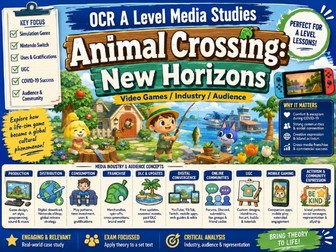
A complete OCR A-Level Media Studies introduction lesson for Animal Crossing: New Horizons, covering video game genres, industry, audience and research.
This fully editable PowerPoint (.pptx) lesson introduces students to Animal Crossing: New Horizons as the OCR A-Level Media Studies video game set text. Animal Crossing applies to Paper 2: Evolving Media, Section A – Media Industries and Audiences, where video games are studied through media industries and media audiences. OCR’s specification lists Animal Crossing: New Horizons as the set video game product, with focus on economic and social contexts, ownership, technology, production, distribution and audience engagement.
The lesson introduces the simulation genre, video game terminology, digital convergence, production, distribution, consumption and franchise concepts before students independently research key areas of Animal Crossing: New Horizons. Students explore Nintendo, the Switch, COVID-19 success, DLC, customisation, audience appeal, online communities, user-generated content, mobile gaming and activism.
The lesson includes retrieval practice, terminology matching, stop-and-jot questions, review questions, independent research prompts and peer feedback. It is ideal as the first lesson in an OCR A-Level video games unit.
This lesson covers:
OCR A-Level Media Studies
Paper 2: Evolving Media
Section A: Media Industries and Audiences
Video games
Animal Crossing: New Horizons
Nintendo
Nintendo Switch
Simulation genre
Production
Distribution
Consumption
Franchise
Digital convergence
DLC
Audience appeal
Uses and Gratifications
COVID-19 context
Customisation
Online communities
User-generated content
Let’s Plays and walkthroughs
Mobile gaming
Animal Crossing: Pocket Camp
Black Lives Matter and activism
What is included:
Fully editable PowerPoint (.pptx) lesson
Do Now video game genre matching task
Teacher feedback/model answer slide
Lesson objectives
Definition of simulation genre
Key terminology task for video games
Definitions of digitally convergent media, distribution, franchise, consumption and production
Stop-and-jot questions on Animal Crossing: New Horizons
Teacher feedback/model answers
Review task on gameplay, customisation, game clock and player types
Uses and Gratifications discussion question
Independent research task with seven focus areas
Research questions on design, platform, culture, audience, community, UGC, mobile gaming and activism
Peer feedback task with WWW and EBI prompts
This resource can be used as:
A first lesson on Animal Crossing: New Horizons
An OCR A-Level video games introduction lesson
A Paper 2: Evolving Media lesson
A media industries and audiences lesson
A lesson on digital convergence and video game audiences
A research-based lesson for Year 12 or Year 13
A revision or cover lesson for the video games set text
This resource is provided as a fully editable PowerPoint (.pptx) file.
This resource is independently created and is not endorsed by OCR.
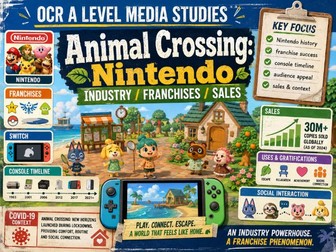
A complete OCR A-Level Media Studies lesson exploring Nintendo, video game franchises and the industry context of Animal Crossing: New Horizons.
This fully editable PowerPoint (.pptx) lesson focuses on Animal Crossing: New Horizons as the OCR A-Level Media Studies video game set text for Paper 2: Evolving Media, Section A – Media Industries and Audiences.
The lesson introduces students to the industry context behind Animal Crossing: New Horizons, with a focus on Nintendo, franchise success, console development, social interaction, audience appeal and the impact of COVID-19 on the game’s popularity. Students explore how Nintendo’s long-running franchises, console design and family-friendly brand identity have helped shape the success of Animal Crossing: New Horizons.
The lesson includes a supporting article resource document, allowing students to develop their understanding of Nintendo, franchise history, vertical integration, audience engagement and the wider video game industry.
Students begin by identifying major Nintendo franchises, before researching Nintendo’s most successful video game franchises and creating a timeline of Nintendo consoles. The lesson then builds towards a written introduction to Animal Crossing: New Horizons, encouraging students to connect Nintendo, sales, social context, Uses and Gratifications and the COVID-19 pandemic.
This lesson covers:
OCR A-Level Media Studies
Paper 2: Evolving Media
Section A: Media Industries and Audiences
Animal Crossing: New Horizons
Nintendo
Nintendo Switch
Video game industry
Video game franchises
Franchise success
Console development
Production and distribution
Audience engagement
Uses and Gratifications
Simulation genre
Social interaction
Entertainment
COVID-19 context
Animal Crossing sales
Nintendo brand identity
Gaming history
Media industries
What is included:
Fully editable PowerPoint (.pptx) lesson
Supporting article resource document
Do Now task on Nintendo franchise games
Teacher feedback/model answer slide
Lesson objectives
Nintendo franchise identification task
Research task on Nintendo’s most successful franchises
Teacher feedback on top Nintendo franchises and sales
Key information on Nintendo and video game franchises
Nintendo console timeline task
Animal Crossing release dates and sales information
Main written task introducing Animal Crossing: New Horizons
Prompt linking Uses and Gratifications to Nintendo console design
Model response on Animal Crossing: New Horizons, Nintendo, COVID-19 and sales
Plenary task using key terms including Nintendo, Uses and Gratifications, Animal Crossing, sales and social contexts
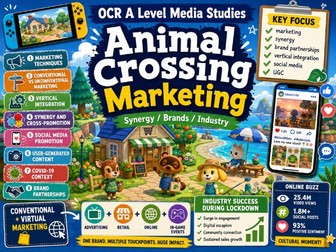
A complete OCR A-Level Media Studies lesson exploring Animal Crossing: New Horizons, Nintendo, marketing, synergy and industry context.
This fully editable PowerPoint (.pptx) lesson focuses on Animal Crossing: New Horizons as the OCR A-Level Media Studies video game set text for Paper 2: Evolving Media, Section A – Media Industries and Audiences.
The lesson explores how Animal Crossing: New Horizons was marketed using both conventional and unconventional marketing techniques, including trailers, reviews, articles, online advertising, launch promotion, social media, brand partnerships, user-generated content and virtual marketing during the COVID-19 pandemic.
Students develop their understanding of key industry concepts including production, distribution, consumption, franchise, sandbox games, vertical integration, synergy, cross-promotion and brand partnerships. The lesson also examines how Nintendo’s control over development, publishing, hardware, marketing and distribution strengthens its brand identity and commercial power.
This resource includes a supporting article resource document for students to use when analysing marketing, virtual partnerships and the rise of in-game advertising around Animal Crossing: New Horizons.
The lesson includes discussion tasks, key term definitions, marketing analysis, social media statistics, brand partnership examples, exam-style writing and a model response.
This lesson covers:
OCR A-Level Media Studies
Paper 2: Evolving Media
Section A: Media Industries and Audiences
Animal Crossing: New Horizons
Nintendo
Video game marketing
Conventional marketing
Unconventional marketing
Virtual marketing
Social media marketing
User-generated content
Brand partnerships
Synergy
Cross-promotion
Vertical integration
Production
Distribution
Consumption
Franchise
Sandbox games
COVID-19 context
KFC island
Gucci
Valentino
Marc Jacobs
100 Thieves
H&M
Highsnobiety
Alexandria Ocasio-Cortez
TikTok, Twitter and Reddit engagement
Uses and Gratifications
What is included:
Fully editable PowerPoint (.pptx) lesson
Supporting article resource document
Do Now task on production, distribution, consumption and franchise
Teacher feedback/model answer slide
Lesson objectives
Key term explanation for sandbox video games
Key term explanation for vertical integration
Benefits of
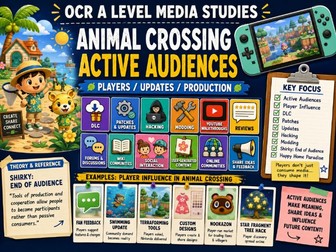
A complete OCR A-Level Media Studies lesson exploring active audiences, player influence, hacking, modding, updates and production in Animal Crossing: New Horizons.
This fully editable PowerPoint (.pptx) lesson focuses on Animal Crossing: New Horizons as the OCR A-Level Media Studies video game set text for Paper 2: Evolving Media, Section A – Media Industries and Audiences.
The lesson explores how Animal Crossing: New Horizons audiences are active rather than passive, focusing on how players influence meaning, online culture, social interaction, community engagement and video game production. Students consider how DLC, patches, updates, hacking, modding, forums, YouTube walkthroughs, YouTube Shorts, reviews and wiki communities show that modern video game audiences are highly participatory.
The lesson applies Shirky’s End of Audience theory to Animal Crossing: New Horizons, showing how players create, share, review, modify and influence content rather than simply consuming the game. Students also use the accompanying article resource document to explore how audience behaviour has influenced production, including feedback around Happy Home Paradise, terraforming tools, swimming updates, fan-made content, brand collaborations, star fragment tree hacks, in-game protests and fan economies such as Nookazon.
The lesson includes retrieval practice, active audience definitions, article annotation, theory application, exam-style writing, model paragraphs, peer assessment and key terminology review.
This lesson covers:
OCR A-Level Media Studies
Paper 2: Evolving Media
Section A: Media Industries and Audiences
Animal Crossing: New Horizons
Active audiences
Audience influence
Shirky’s End of Audience theory
DLC
Patches
Updates
Hacking
Modding
Forums
YouTube walkthroughs
YouTube Shorts
Reviews
Wiki communities
User-generated content
Happy Home Paradise DLC
Fan feedback
Player communities
Online social interaction
Video game production
Nintendo updates
Star fragment tree hack
Swimming update
Terraforming tools
Nookazon
In-game activism
Fan economies
What is included:
Fully editable PowerPoint (.pptx) lesson
Supporting article resource document
Do Now task on DLC, patches and updates
Printable gap-fill task on DLC, patches and updates
Teacher feedback/model answer slide
Lesson objectives
Definition of active audience
Think/write/pair/share task on active audiences and social interaction
Online content analysis table
Printable active audience worksheet
Feedback table on YouTube walkthroughs, YouTube Shorts, reviews, forums and wiki communities
Theory application to Shirky’s End of Audience
Article annotation task using three hacking/production articles
Feedback on how audiences influence production
Exam-style question on how players influenced Animal Crossing: New Horizons


 Quick View