

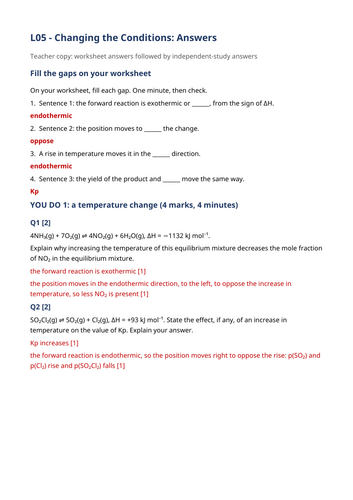

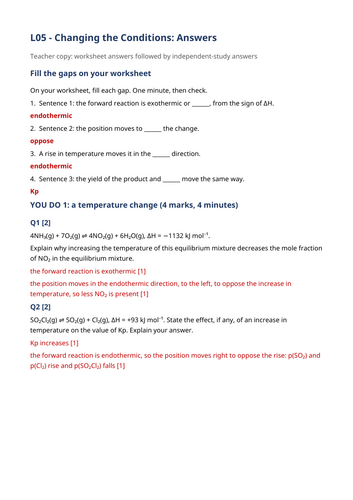
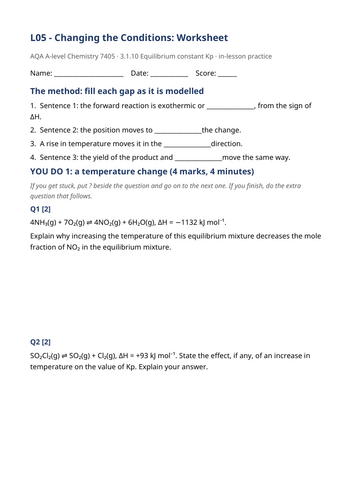
Explain how temperature, pressure and catalysts affect equilibrium position and Kp in three clear sentences. Complete AQA A Level lesson with answers.
Lesson 5 of an eight-lesson sequence on Kp. Pupils learn a three-sentence answer for a temperature change (the sign of ΔH, the shift and its reason, the effect on yield and Kp), then why pressure and volume move the position but leave Kp unchanged, and why a catalyst changes neither.
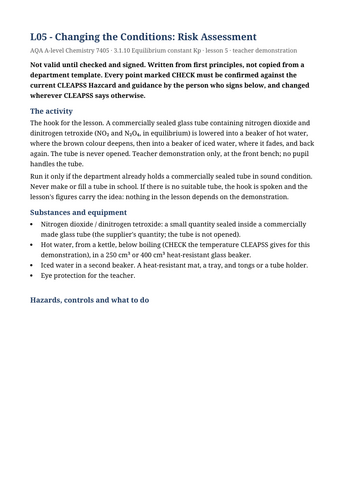
Graphs show Kp against temperature for exothermic and endothermic reactions, and how the NO₂ mole fraction falls with pressure while Kp stays fixed. Includes a predict-then-check task using measured Kp values, and an optional NO₂/N₂O₄ sealed-tube demonstration (follow your own CLEAPSS guidance and risk assessment; none is included).
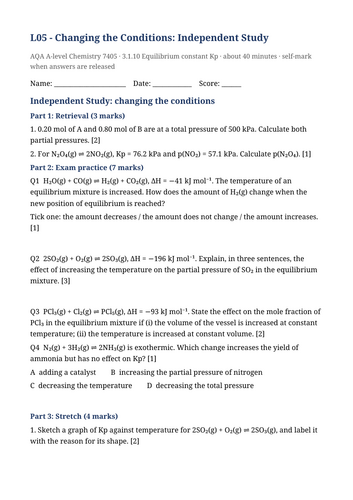
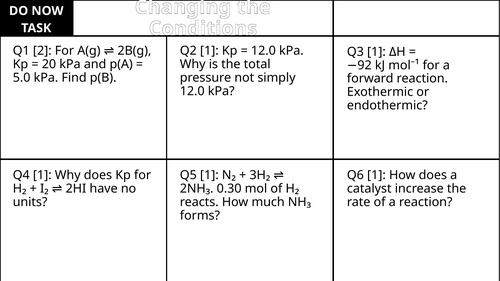
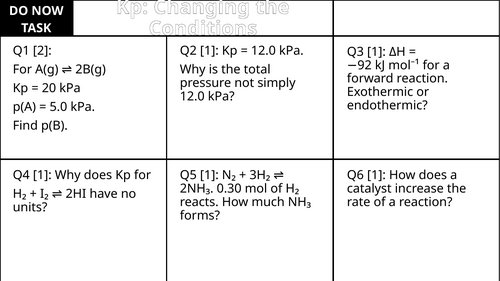
What’s included: a teacher PowerPoint with answers revealed on click and full speaker notes (timings, what to look for, what each wrong answer means); a pupil PowerPoint with the answers removed; a printable worksheet; a full answer document; and optional independent-study practice with answers. Everything is editable, set in Century Gothic, and every calculation is worked one step to a line.
Specification: AQA A Level Chemistry 7405, 3.1.10 Equilibrium constant Kp for homogeneous systems (A level only). Built for 55-minute lessons; adaptable to other boards that teach Kp.
Something went wrong, please try again later.
This resource hasn't been reviewed yet
To ensure quality for our reviews, only customers who have purchased this resource can review it
Report this resourceto let us know if it violates our terms and conditions.
Our customer service team will review your report and will be in touch.
£4.00