


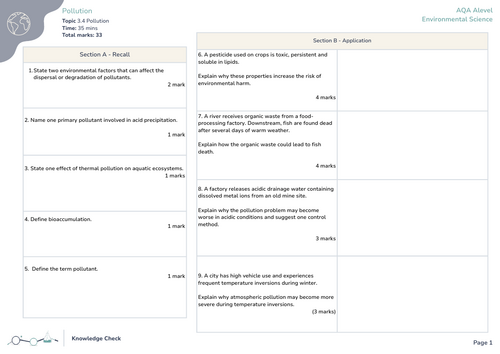
This resource is a diagnostic knowledge check for the Pollution unit of the AQA A-level Environmental Science specification.
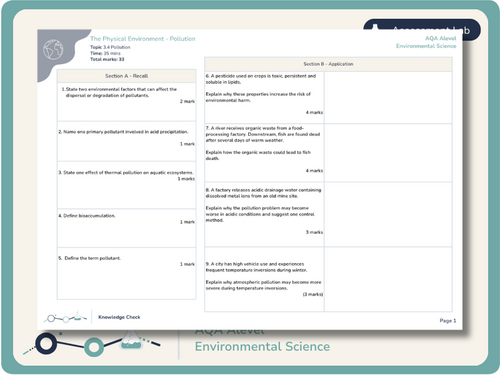
It is designed to help students and teachers identify gaps in understanding across the Pollution topic. The questions are original and structured to assess recall, application and skills/data analysis.
The knowledge check covers:
• pollutant properties, including toxicity, persistence, solubility, bioaccumulation and biomagnification
• how environmental features affect the severity of pollution
• dispersal by air and water currents
• factors affecting degradation, including temperature, light, oxygen, pH and temperature inversions
• principles of pollutant control, including Critical Pathway Analysis and Critical Group Monitoring
• atmospheric pollutants, including PM10, acid precipitation, NOx, hydrocarbons and carbon monoxide
• thermal pollution and dissolved oxygen
• oil pollution and clean-up strategies
• pesticides and their environmental impacts
• nutrient pollution, eutrophication and organic waste treatment
• acid mine drainage and heavy metals
• solid wastes, radioactive waste, asbestos and cyanide
• noise pollution and control strategies
• ionising radiation, exposure control and environmental monitoring
• new pollution control technologies, including phytoremediation and bioremediation
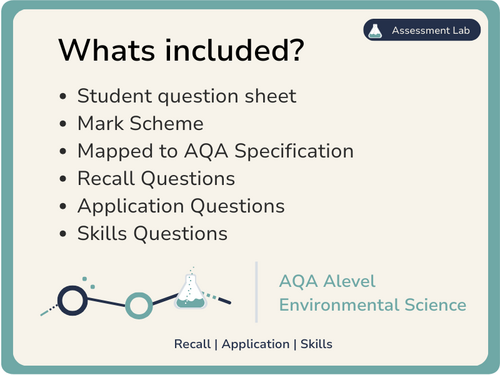
The resource includes:
• Section A: Recall questions
• Section B: Application questions
• Section C: Skills and data analysis
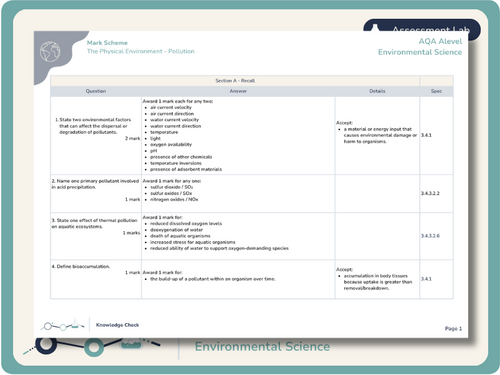
• full teacher mark scheme
• specification point mapping for each question
• maths, practical and working scientifically links where relevant
• diagnostic notes for teachers
This resource is suitable for:
• AQA A-level Environmental Science students
• end-of-unit review
• retrieval practice
• diagnostic assessment
• Paper 1 revision
• identifying misconceptions and gaps before assessment
• structured homework or independent revision
The mark scheme is designed to support teacher feedback and student self-assessment. It includes acceptable answers, specification links, skills links and guidance on common areas where students may lose marks.
Something went wrong, please try again later.
This resource hasn't been reviewed yet
To ensure quality for our reviews, only customers who have purchased this resource can review it
Report this resourceto let us know if it violates our terms and conditions.
Our customer service team will review your report and will be in touch.
£3.00