


This is a lesson designed for a mixed ability year 9 class studying the AQA GCSE Chemistry syllabus.
This lesson is from the unit on bonding, and covers models for covalent molecules.
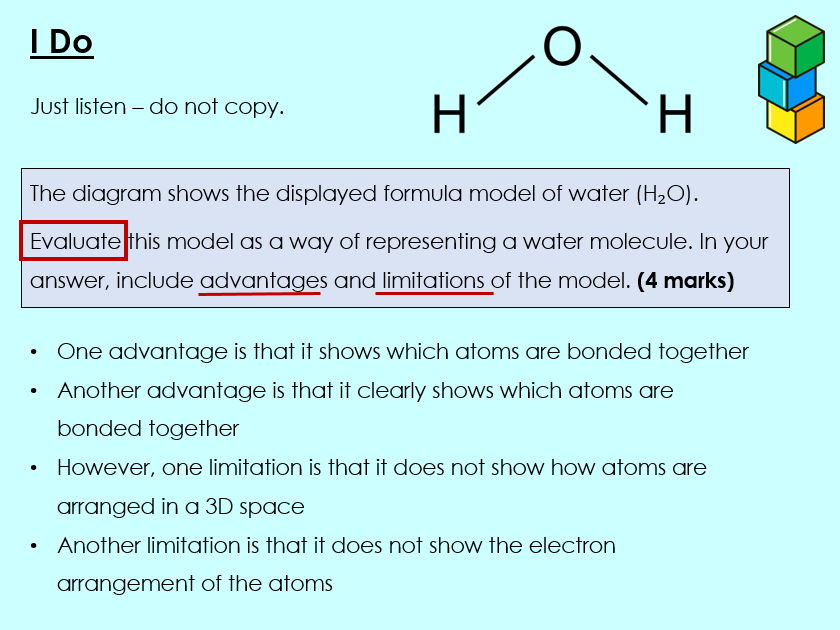
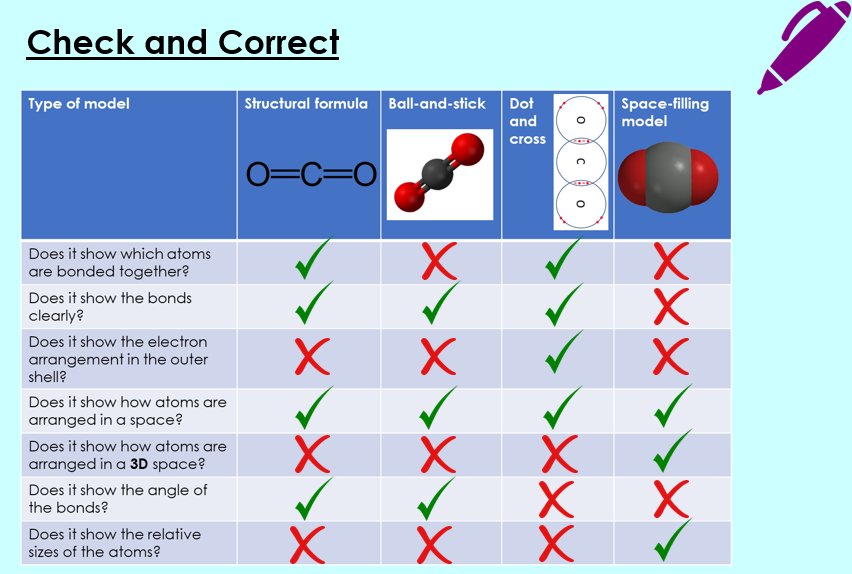
Students will consider the advantages and disadvantages of different types of model for covalent molecules (2D structural formulae, ball-and-stick models, dot-and-cross diagrams, and space filling models).
Students will complete a comparison table, and then answer evaluate exam questions in an ‘I do, we do, you do’ format.
From this lesson, students should be able to:
- Define the term ‘model’
- Give examples of different models for covalent molecules (2D structural formula, ball-and-stick, dot-and-cross diagrams, and space-filling models)
- Describe the advantages and disadvantages of each type of model
- Compare the different types of model
- Evaluate each type of model
All of my lessons contain:
- A 5-in-5 retrieval-style starter
- An interesting lesson hook, careers link, or retrieval practice to start the lesson
- Teacher input slides with dual coding and reduced cognitive load
- Teacher models
- Regular ‘check for understanding’ slides, such as hand signals quizzes and whiteboard quizzes
- Regular student independent practice slides, with optional scaffolds, challenges and answer slides
- A plenary task
Something went wrong, please try again later.
This resource hasn't been reviewed yet
To ensure quality for our reviews, only customers who have purchased this resource can review it
Report this resourceto let us know if it violates our terms and conditions.
Our customer service team will review your report and will be in touch.
£3.00