


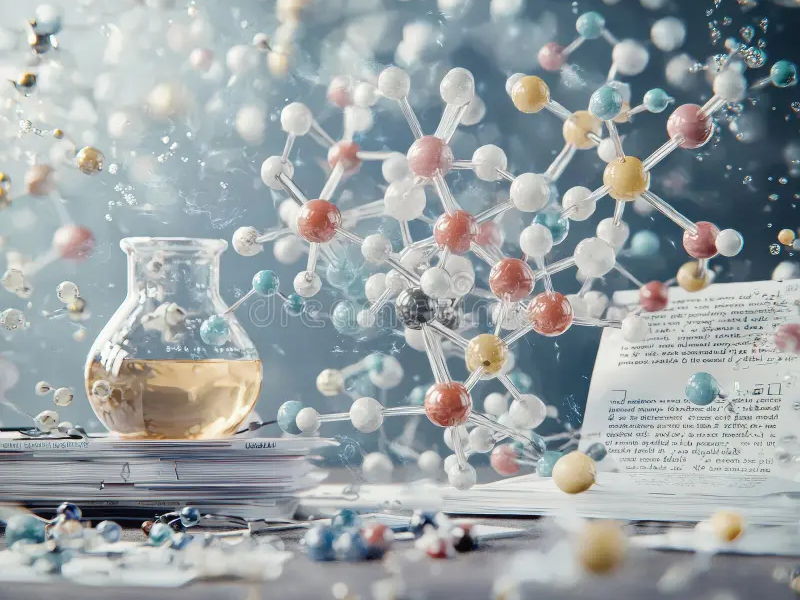
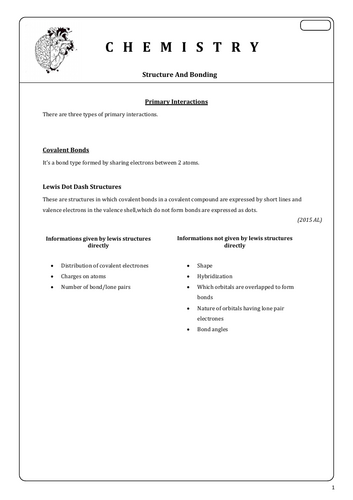
Chemical bonding is the process that holds atoms or ions together to form substances, and the smallest repeating particle that represents each type of bonding is called a unit. In ionic compounds, atoms transfer electrons, forming positively charged cations and negatively charged anions, which are held together by electrostatic attraction. The smallest unit here is called a formula unit, showing the simplest ratio of ions (e.g., NaCl for sodium chloride). In covalent compounds, atoms share electrons to form molecules, and the smallest unit is the molecule itself (e.g., H₂O). In metallic bonding, metal atoms are arranged in a lattice surrounded by a “sea of electrons,” and the repeating lattice unit represents the structure. Thus, ionic compounds are built from formula units, covalent compounds from molecules, and metals from lattice units.
Something went wrong, please try again later.
This resource hasn't been reviewed yet
To ensure quality for our reviews, only customers who have purchased this resource can review it
Report this resourceto let us know if it violates our terms and conditions.
Our customer service team will review your report and will be in touch.
£20.00