


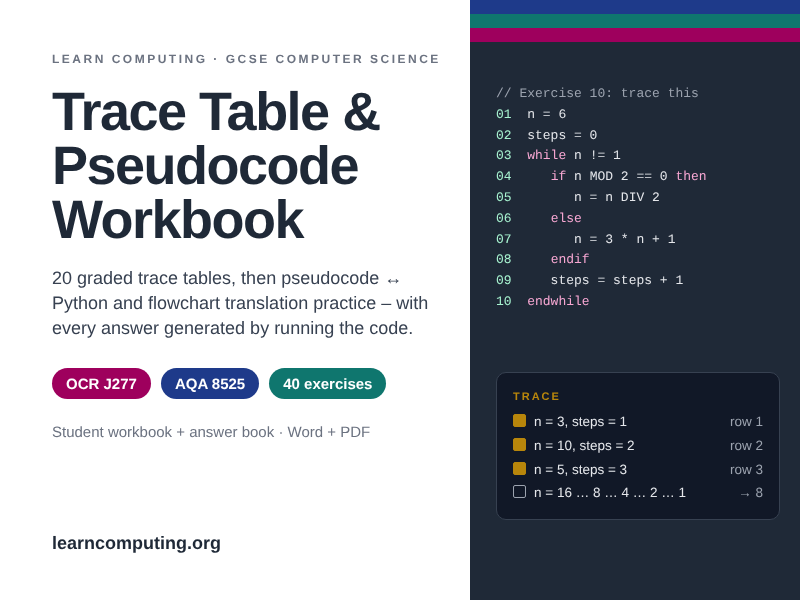
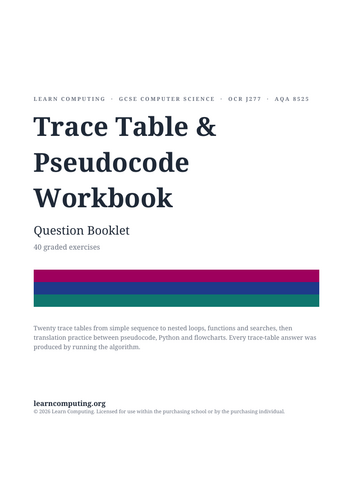
20 graded trace tables plus pseudocode, Python and flowchart translation practice; every answer generated by running the code. OCR J277 / AQA 8525.
The two skills that cost GCSE students the most marks on the algorithms paper, practised properly. Section A: twenty trace tables that build one idea at a time — sequence, count- and condition-controlled loops, selection, MOD and DIV, strings, finding the smallest, nested loops, a function call, a Boolean flag, do-until, 2D arrays, inputs, the Fibonacci sequence, one pass of a bubble sort, counting comparisons in a search, and a PIN check with attempts. Section B: eight pseudocode-to-Python translations. Section C: eight Python-to-pseudocode translations. Section D: four flowchart-to-pseudocode exercises, with the flowcharts drawn.
You get: student workbook (26-page PDF + editable Word) with every exercise’s blank trace table or code box, no answers; answer book (30-page PDF + editable Word) with completed trace tables, mark points and a model answer for every translation. 162 marks in total. Every trace table in the answer book was produced by running the algorithm, and every Python model answer was run against the stated inputs. Pseudocode follows OCR Exam Reference Language; AQA equivalents are accepted. Use it as a term of lesson starters, an intervention booklet for students who freeze on trace questions, or homework. More at learncomputing.org.
Something went wrong, please try again later.
This resource hasn't been reviewed yet
To ensure quality for our reviews, only customers who have purchased this resource can review it
Report this resourceto let us know if it violates our terms and conditions.
Our customer service team will review your report and will be in touch.
£4.00