


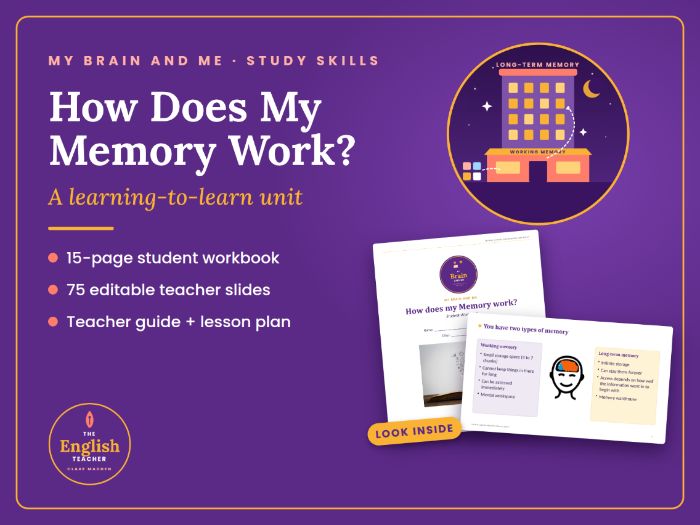
Students think they know how good their memory is, until they test it. In this hands-on learning-to-learn unit, students learn how memory works, predict their own strengths and weaknesses, then put their memory through nine tests. They see how their predictions compare with reality.
Created by Clare Madden, a secondary teacher with 15 years’ experience who has a special interest in how students learn, and author of the My Brain and Me programme.
What’s included
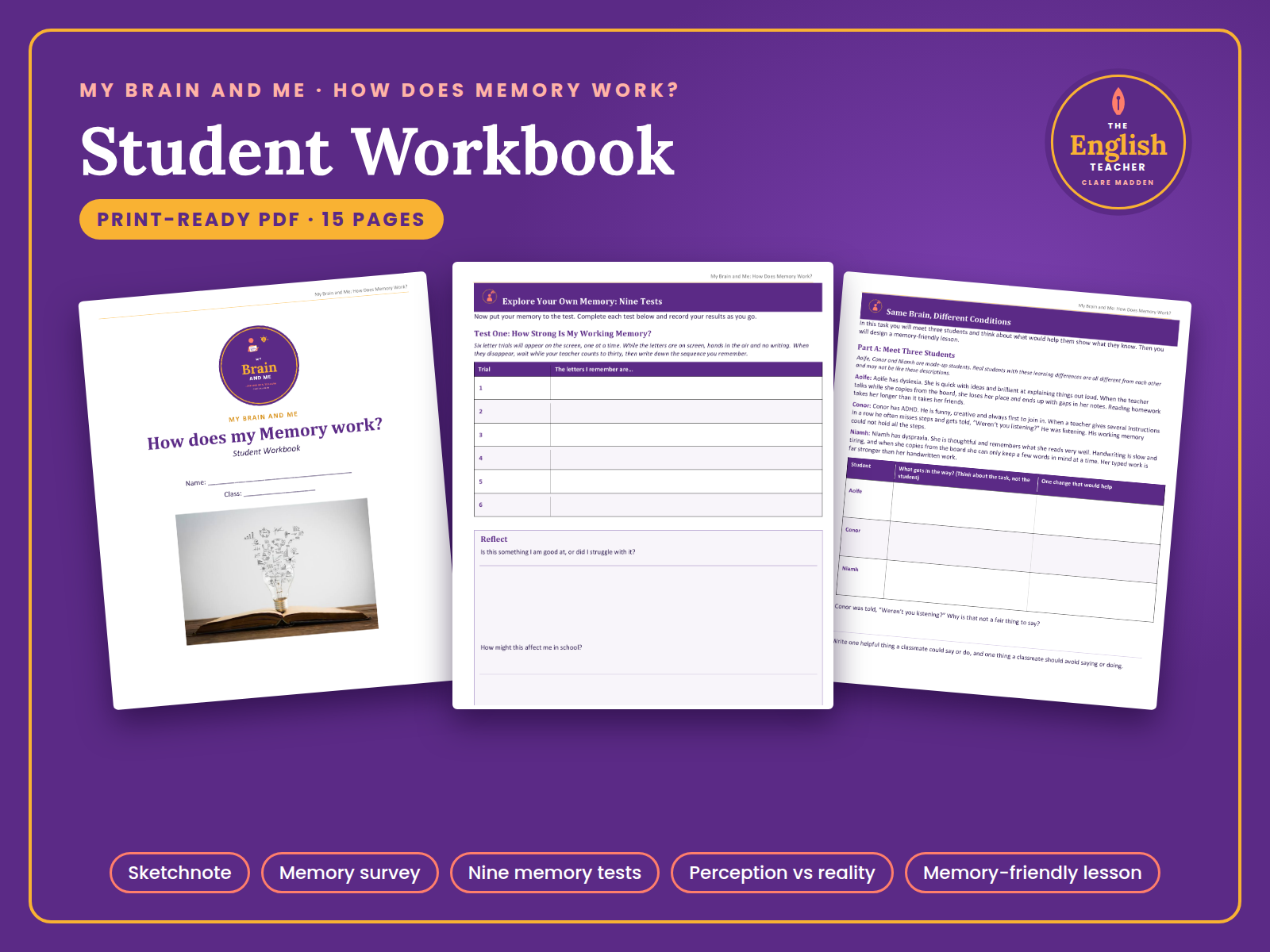
Student Workbook (15-page PDF): a sketchnote task, a memory survey, recording space for all nine tests with Reflect boxes, a perception-versus-reality reflection, and a reading and task on memory and additional educational needs.
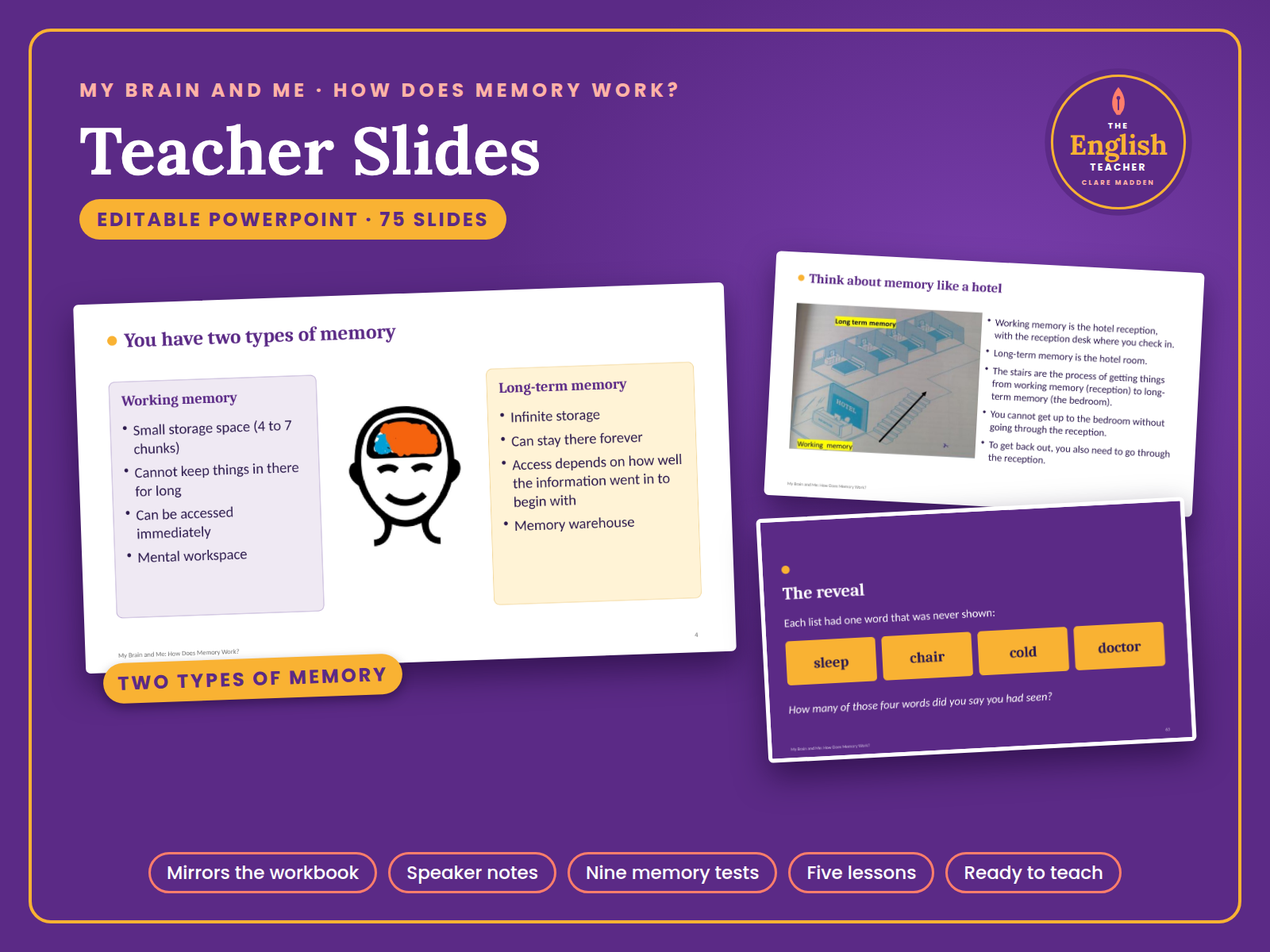
Teacher Slides (75 editable PowerPoint slides): these mirror the workbook, with word lists, picture tests, reveals and speaker notes built in.
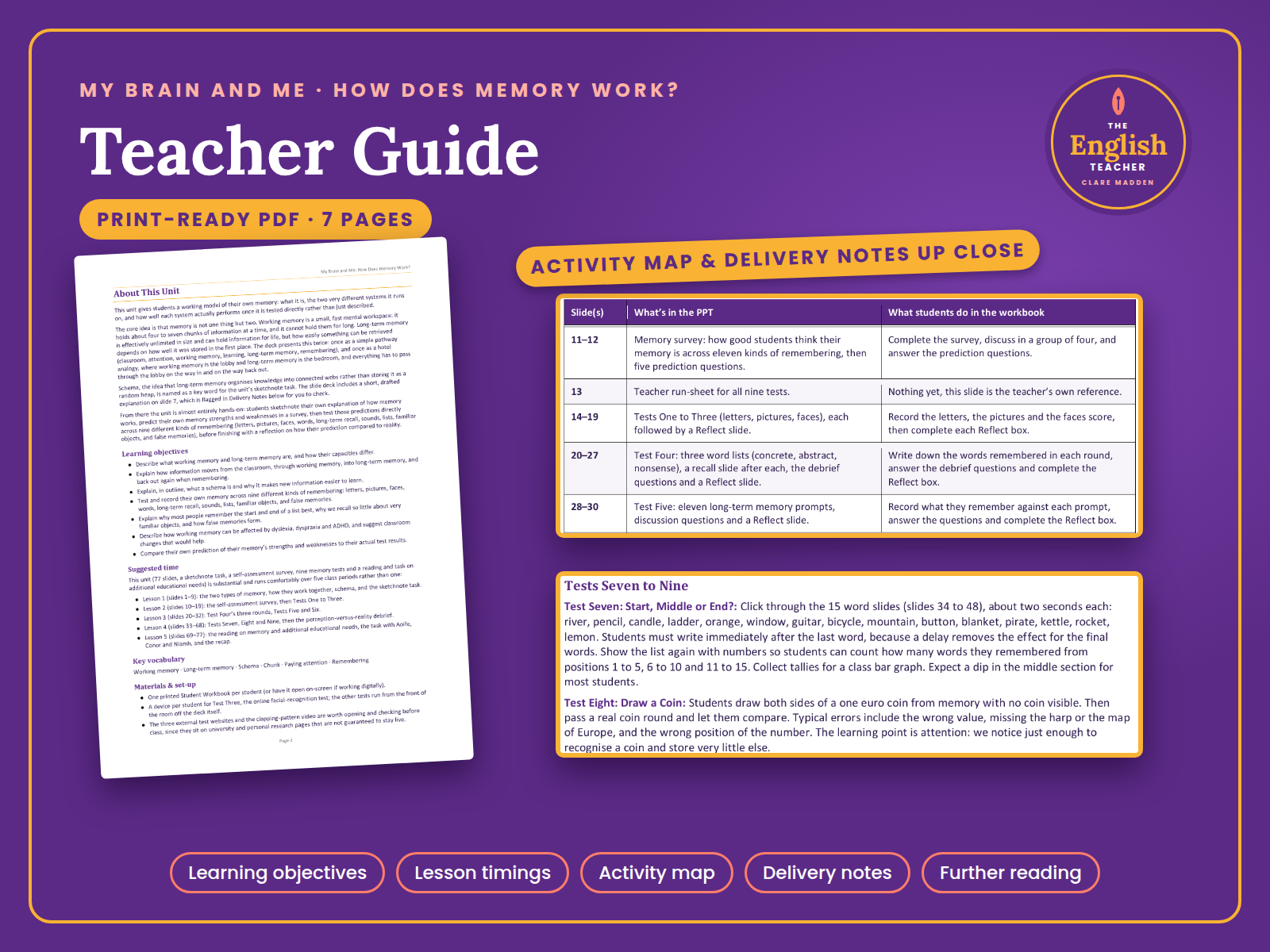
Teacher Guide (7-page PDF): learning objectives, lesson timings for five lessons, key vocabulary, materials and set-up, an activity map linking slides to workbook pages, delivery notes with answers, and further reading.
How the unit works
How does memory work? Students learn the difference between working memory (a small mental workspace) and long-term memory (a huge store). They follow how information moves between the two, using a simple pathway and a memorable hotel analogy, and meet the idea of schema. They then make a sketchnote explaining how memory works.
Explore your own memory: nine tests. Students predict how good their memory is, then test it on letters, pictures, faces, words (concrete, abstract and nonsense), long-term recall, sounds, the start, middle and end of a list, drawing a familiar coin from memory, and a false-memory challenge. Many will be sure they saw a word that was never there. They finish by comparing their predictions with their actual results.
Memory and additional educational needs. A short reading explains how working memory can be affected by dyslexia, dyspraxia and ADHD. Students then meet three fictional students, think about what would help each one, and design a poster called “Five Ways to Make a Lesson Easier on Working Memory”. The activity focuses on empathy, strengths and removing barriers in the classroom.
Why teachers use it
Students discover how their memory works by testing it themselves, instead of being told
The false-memory and coin tests always get a reaction and lead to great discussion
Builds understanding of classmates with learning differences, without simulations
Ready to teach in five lessons; most tests run straight from the slides
Suitable for ages 12–16 (lower to middle secondary). Test Three uses a free online test, so students need a device. Test Eight uses a one euro coin, but any familiar coin works. Files: PowerPoint and PDF.
Something went wrong, please try again later.
This resource hasn't been reviewed yet
To ensure quality for our reviews, only customers who have purchased this resource can review it
Report this resourceto let us know if it violates our terms and conditions.
Our customer service team will review your report and will be in touch.
£4.00