

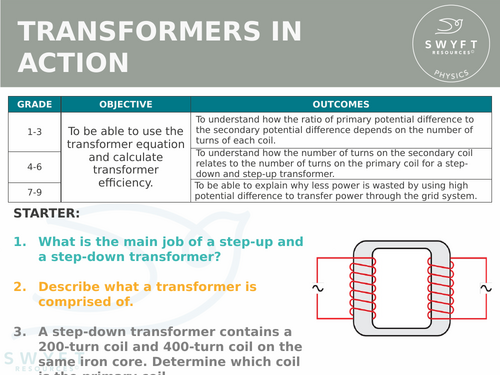

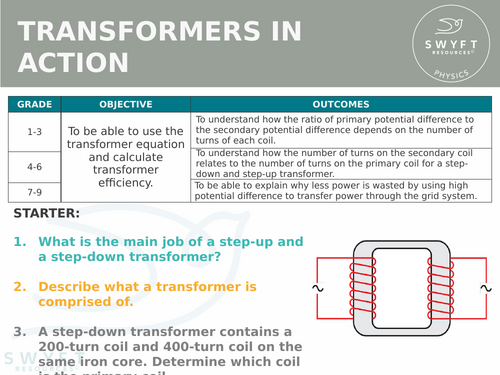
This lesson is designed for the NEW AQA Physics GCSE, particularly the ‘Electromagnets’ SoW.
For more lessons designed to meet specification points for the NEW AQA Trilogy specifications for Biology, Chemistry and Physics please see my shop: https://www.tes.com/teaching-resources/shop/SWiftScience
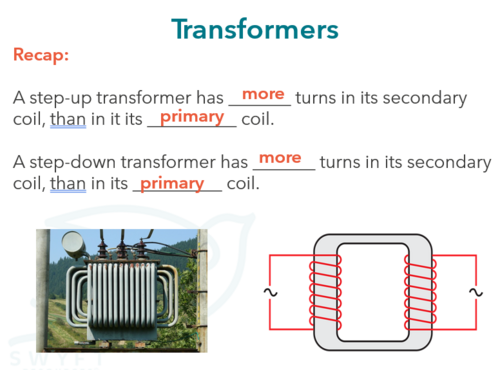
The lesson begins with a recap on transformers, students will need to complete a fill-in-the blank task to summarise the roles of a step-up and step-down transformer.
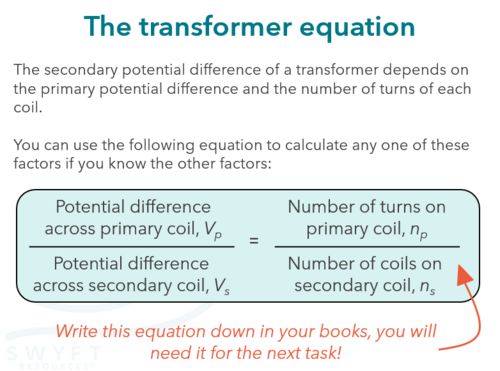
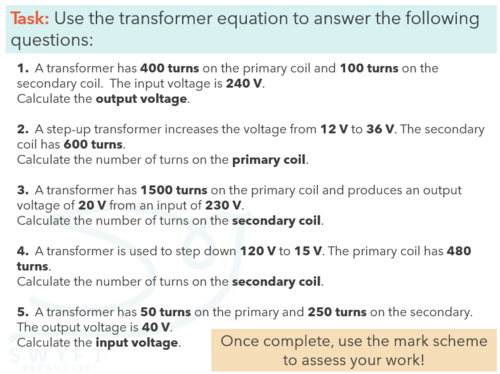
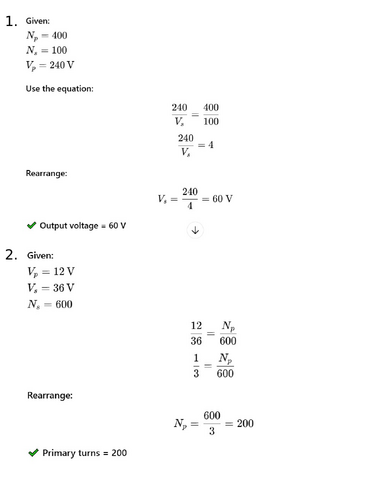
Next, students are introduced to the transformer equation, whereby the the secondary potential difference of a transformer depends on the primary potential difference and the number of turns of each coil. Students will then need to complete a set of questions where they will need to use this equation, they can answer these in their books (showing all their working!) and the mark scheme is included in the resources for students to assess their work.
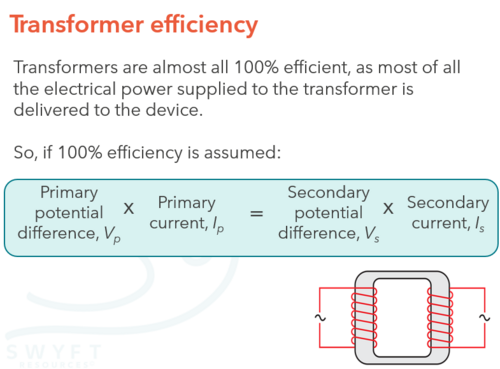
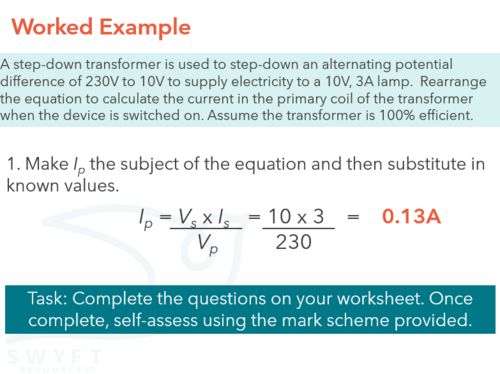
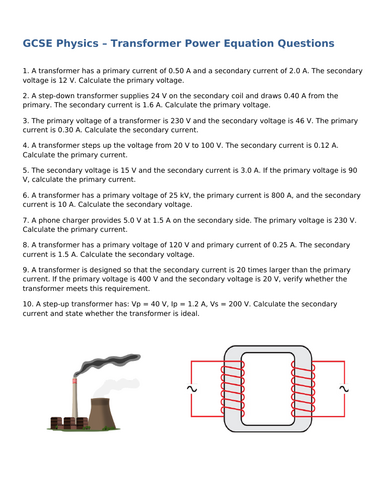
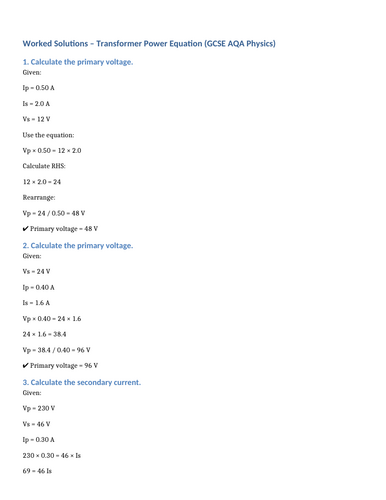
The next part of the lesson focuses on transformer efficiency, transformers are almost always 100% efficient and as such we can use a simple equation to calculate the current or potential difference in either the primary or secondary coil. Students will be provided with the equation, and shown a worked example of how to rearrange the equation when needed. Following this, they will be provided with a worksheet of questions, they can answer in their books, then either self-assess or peer-assess their work using the answers provided.
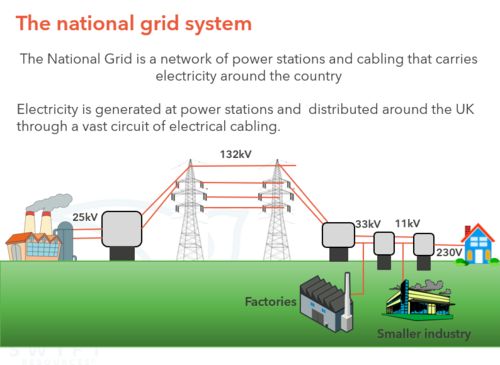
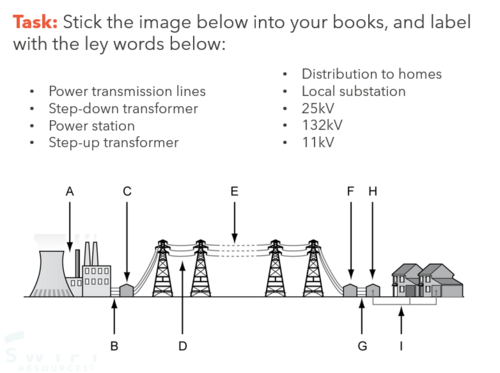
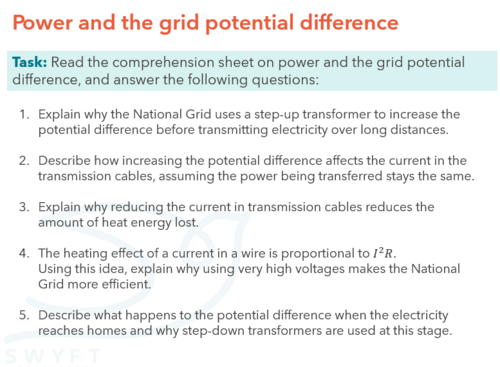
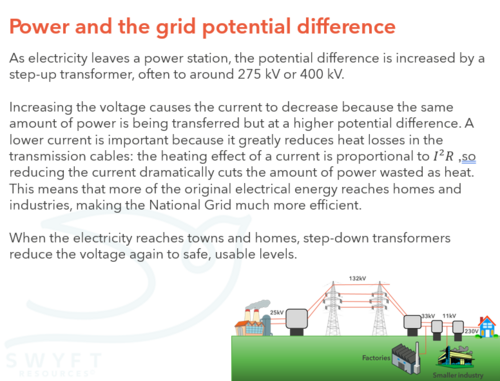
Lastly, the lesson focus will be on the National Grid network and the potential difference changes which occur due to step-up and step-down transformers. Firstly, students are shown a labeled diagram of the National Grid network and then will need to label their own diagram of the National Gird, which can be stuck in their books. Lastly, students will be provided with a comprehension sheet on ‘Power and the grid potential difference’, they will be asked to answer a series of questions based on this information. This task can be marked using the answers on the next slide.
The plenary task is a series of ‘answers’, students need to come up with a question for each one, this task can be discussed in pairs.
All resources are included. Thanks for looking, if you have any questions please let me know at swyftresources@gmail.com.
Get this resource as part of a bundle and save up to 44%
A bundle is a package of resources grouped together to teach a particular topic, or a series of lessons, in one place.
Something went wrong, please try again later.
This resource hasn't been reviewed yet
To ensure quality for our reviews, only customers who have purchased this resource can review it
Report this resourceto let us know if it violates our terms and conditions.
Our customer service team will review your report and will be in touch.
£3.00