


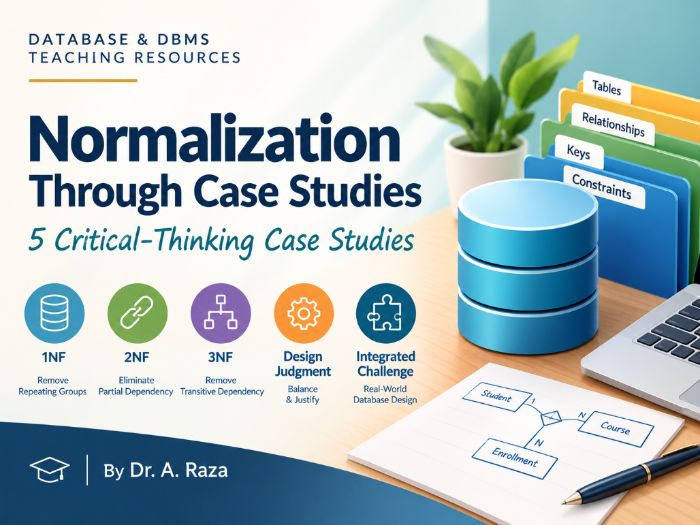
Help students develop a deeper understanding of database normalization through 5 realistic, critical-thinking case studies.
Rather than simply asking students to define 1NF, 2NF, and 3NF, these activities require students to examine flawed database designs, identify dependencies and anomalies, evaluate decomposition choices, and justify their reasoning.
Students explore:
• Identifying repeating groups and normalization problems
• Recognizing update, insertion, and deletion anomalies
• Understanding partial dependencies and 2NF
• Identifying transitive dependencies and 3NF
• Evaluating normalization and database-design trade-offs
• Applying normalization concepts to a realistic hospital appointment database
• Explaining why a valid primary key does not automatically mean a table is well normalized
The resource includes:
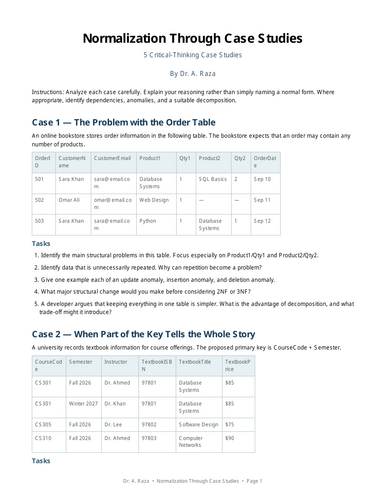
• 5 student case studies with realistic scenarios
• Critical-thinking questions requiring students to explain and justify their decisions
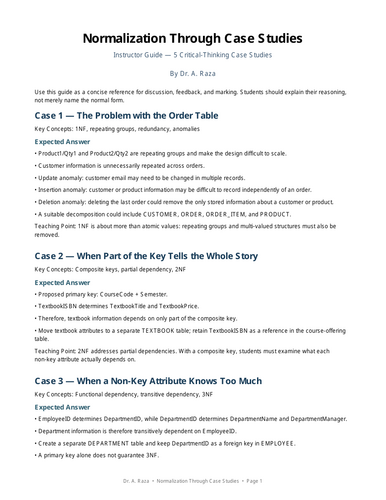
• A concise instructor guide with suggested answers and key teaching points
• Activities designed to develop logical reasoning rather than memorization or SQL implementation
The cases progress from 1NF and repeating groups through 2NF and 3NF, before moving into broader design judgment and an integrated real-world challenge.
Suitable for Computer Science, Computing, Database Systems, DBMS, and introductory Database Design courses.
Something went wrong, please try again later.
This resource hasn't been reviewed yet
To ensure quality for our reviews, only customers who have purchased this resource can review it
Report this resourceto let us know if it violates our terms and conditions.
Our customer service team will review your report and will be in touch.
£5.00