zip, 109.79 KB
zip, 109.79 KB

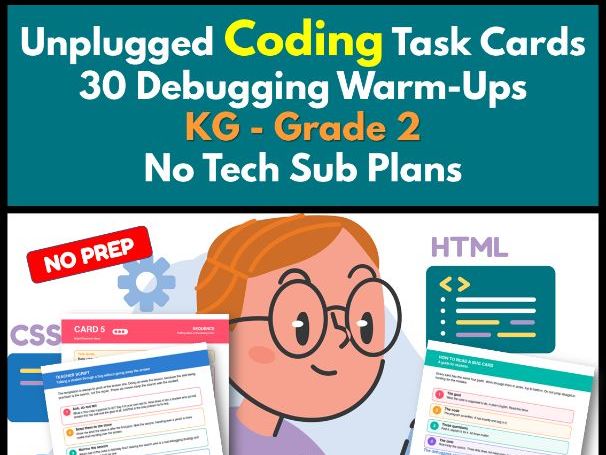
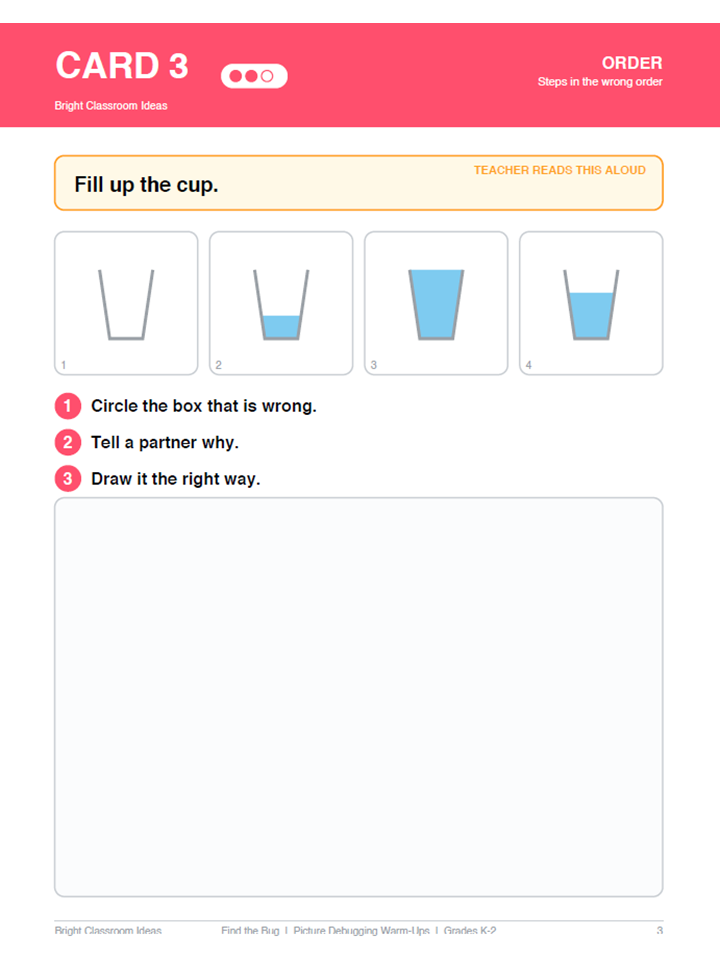
Find the Bug: Picture Debugging Warm-Ups for Grades K–2 is an unplugged computer science resource featuring 30 visual debugging challenges designed to make early computational thinking accessible to young learners. Students do not need to read independently or use devices. Instead, they examine pictures, identify what does not fit, explain their reasoning, and draw a possible correction.

The resource includes a six-page Teacher Guide with directions, implementation ideas, teacher questioning strategies, standards alignment, scope and sequence, and a two-week pacing plan. A two-page Student Reference introduces the LOOK–POINT–SAY–FIND–FIX debugging routine, while two Recording Pages provide draw-the-fix responses and progress tracking. The 30 Picture Cards cover six bug types across three difficulty levels, supported by an eight-page Answer Key explaining correct answers, suggested fixes, misconceptions, teacher conferencing notes, and alternate solutions. A Terms & Credits section is also included.

The six bug types are Order, Patterns, Robot Path, Count It, Sort It, and Match It. Together, they develop foundational skills in sequencing, pattern recognition, directional reasoning, quantity and counting, classification, and matching.

Cards can be used as five-to-eight-minute bell-ringers, approximately 15-minute station rotations, whole-group carpet activities, partner discussions, or substitute plans. Teachers read the goal aloud while students perform the visual problem solving. Importantly, students must explain why something is wrong, making verbal reasoning an integral part of the activity rather than simply asking children to identify an incorrect picture.

The resource develops early computational thinking by having students evaluate sequences, recognize patterns, follow precise directions, connect numbers with quantities, sort according to rules, match objects by attributes, and communicate their reasoning. It aligns with selected CSTA standards, including 1A-AP-08, 1A-AP-09, 1A-AP-10, 1A-AP-11, and 1A-AP-14, as well as relevant Common Core math and speaking/listening standards.

A major strength is its misconception-focused Answer Key, which helps teachers understand why students may make particular mistakes. The three difficulty levels provide built-in differentiation, progressing from obvious errors to challenges requiring tracing, testing, or checking multiple rules.

Because the cards are visual and teacher-read, they are accessible to pre-readers, emerging readers, and English learners. Original illustrations, mathematical reasoning, partner talk, and a consistent debugging routine make the activities engaging and developmentally appropriate.

Overall, Find the Bug provides a practical, device-free introduction to debugging and computational thinking, helping young learners develop the habit of looking carefully, identifying problems, explaining their reasoning, and testing possible solutions.

Get this resource as part of a bundle and save up to 19%

A bundle is a package of resources grouped together to teach a particular topic, or a series of lessons, in one place.

Bundle

Unplugged Coding Task Cards | 30 Debugging WarmUps K-8 | No Tech Sub Plans

Unplugged Coding Task Cards Bundle for Grades K–8 provides 90 screen-free debugging warm-ups designed to help students develop computational thinking, sequencing, problem-solving, and debugging skills without computers or internet access. The bundle combines three grade-band resources: K–2, Grades 3–5, and Grades 6–8, with 30 task cards for each level. This progression allows students to build increasingly sophisticated coding and debugging skills from Kindergarten through middle school. The task cards are designed for flexible classroom use and can be incorporated into daily coding warm-ups, bell ringers, morning work, STEM centers, computer science stations, early-finisher activities, small-group practice, whole-group problem solving, technology-free lessons, emergency no-tech days, and substitute teacher plans. Their short format makes it easy to add computational thinking practice to an existing schedule without requiring a complete coding lesson. Students work through coding-style challenges entirely offline. They learn to identify errors in sequences or instructions, determine where a process goes wrong, correct mistakes, and test and revise solutions. The activities also develop broader computational thinking skills, including breaking problems into manageable steps, recognizing patterns, following algorithms, thinking logically, and approaching problems systematically. The bundle reinforces sequencing and algorithmic thinking by having students arrange steps correctly, follow precise directions, create logical sequences, and understand how instructions influence outcomes. Problem-solving activities encourage students to analyze situations, test possible solutions, learn from mistakes, and explain their reasoning. The three grade bands provide developmentally appropriate challenges, making the bundle useful for schools that want a consistent unplugged computer science approach across multiple grade levels. Teachers can select activities based on students' developmental needs and gradually increase complexity as learners progress. A key benefit is the misconception-focused answer key, which goes beyond providing correct answers by identifying the reasoning errors behind common mistakes. This gives teachers useful information for conferencing, reteaching, and supporting struggling students. With 90 total task cards, 30 debugging warm-ups per grade band, minimal preparation, and no technology requirements, the bundle offers a practical solution for keeping computer science instruction active even when devices are unavailable. It provides repeated opportunities for students to practice debugging, algorithms, sequencing, logical reasoning, and problem-solving in an accessible, engaging, and flexible format. Overall, this K–8 bundle gives teachers a ready-to-use collection of screen-free coding activities that can support computer science and STEM instruction throughout the school year while building transferable problem-solving habits.

$17.00

Reviews

Something went wrong, please try again later.

This resource hasn't been reviewed yet

To ensure quality for our reviews, only customers who have purchased this resource can review it

Report this resourceto let us know if it violates our terms and conditions.
Our customer service team will review your report and will be in touch.