


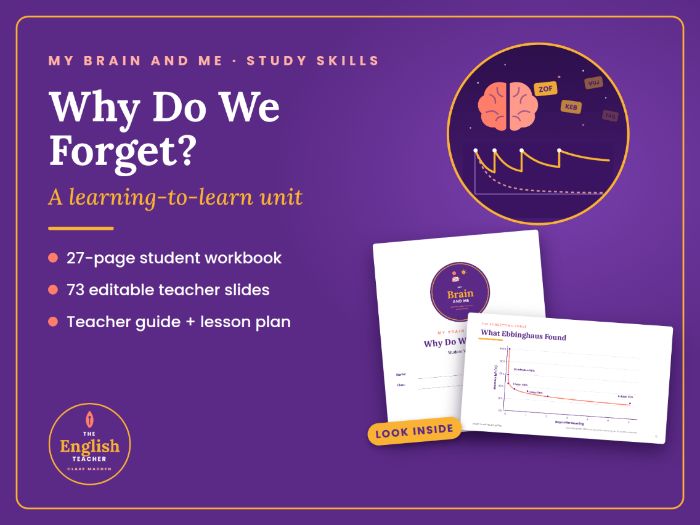
Why does revision seem to vanish by the day of the test? In this hands-on learning-to-learn unit, students watch their own forgetting happen over two weeks. They find out why it happens, and leave with a practical plan to beat it.
Created by Clare Madden, a secondary teacher with 15 years’ experience who has a special interest in how students learn, and author of the My Brain and Me programme.
What’s included
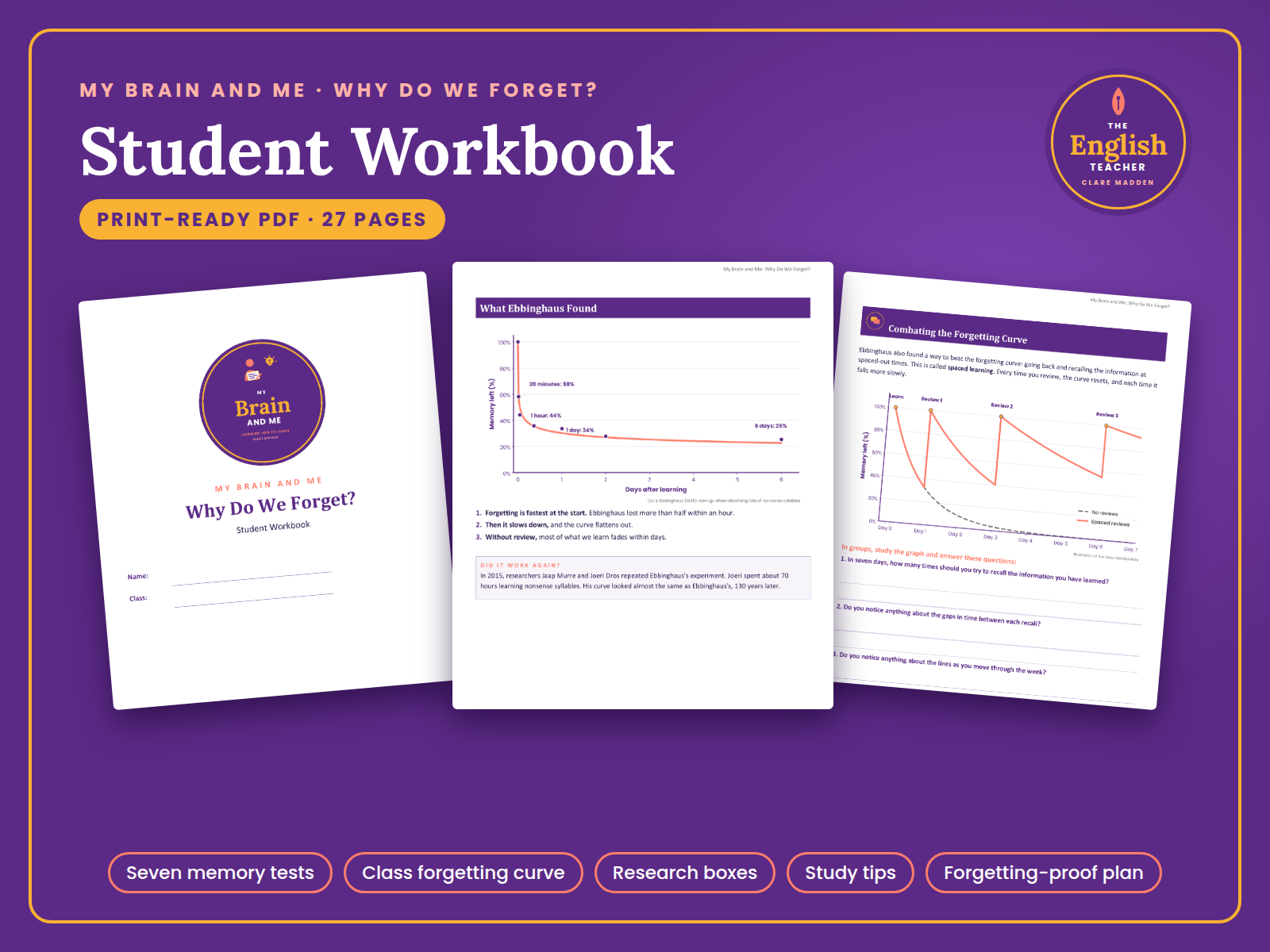
Student Workbook (27-page PDF): a matching page for every activity, with tables to record results, research boxes, study tips, reflections and a closing recap.
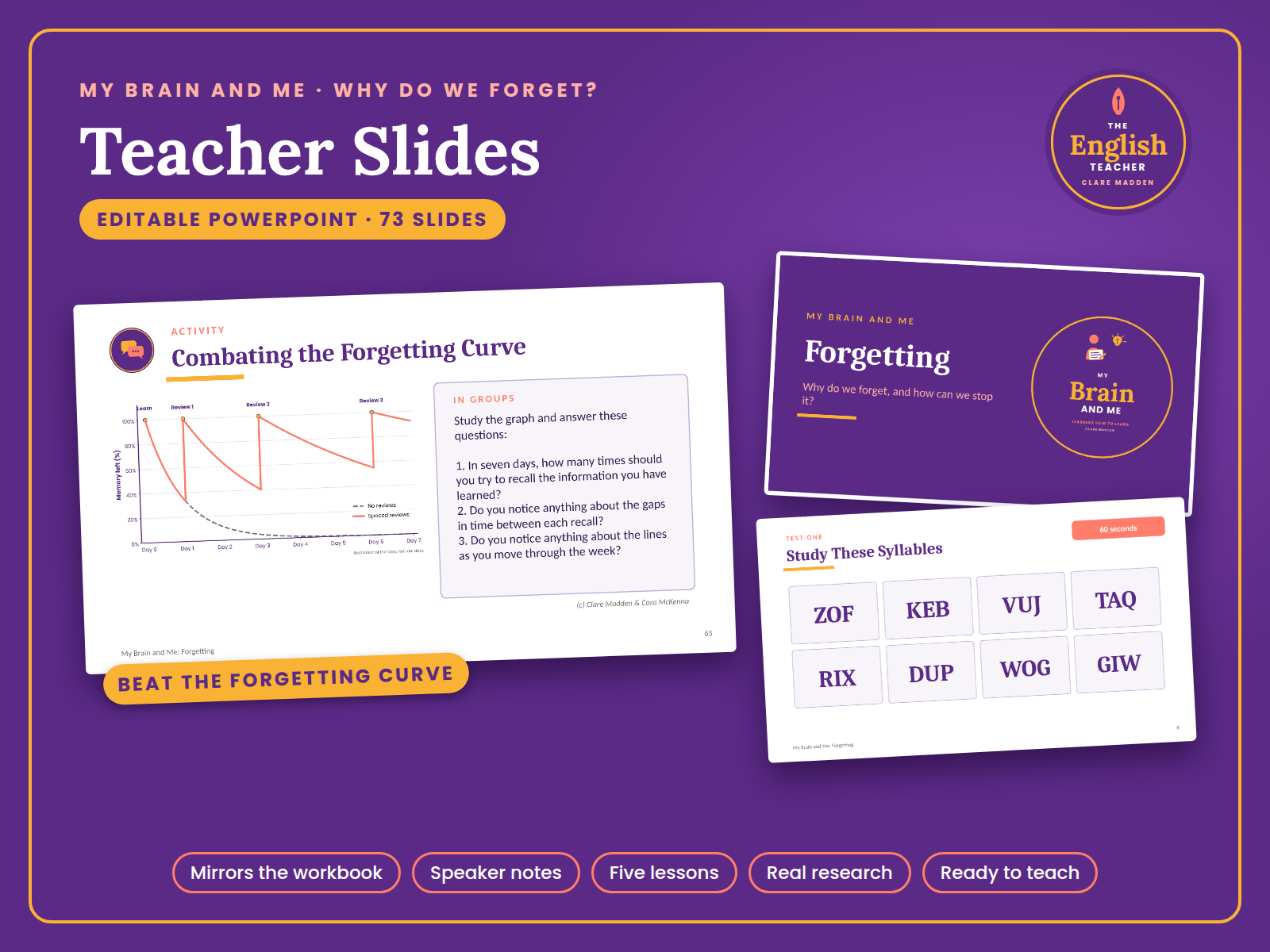
Teacher Slides (73 editable PowerPoint slides): these mirror the workbook page for page, with speaker notes.
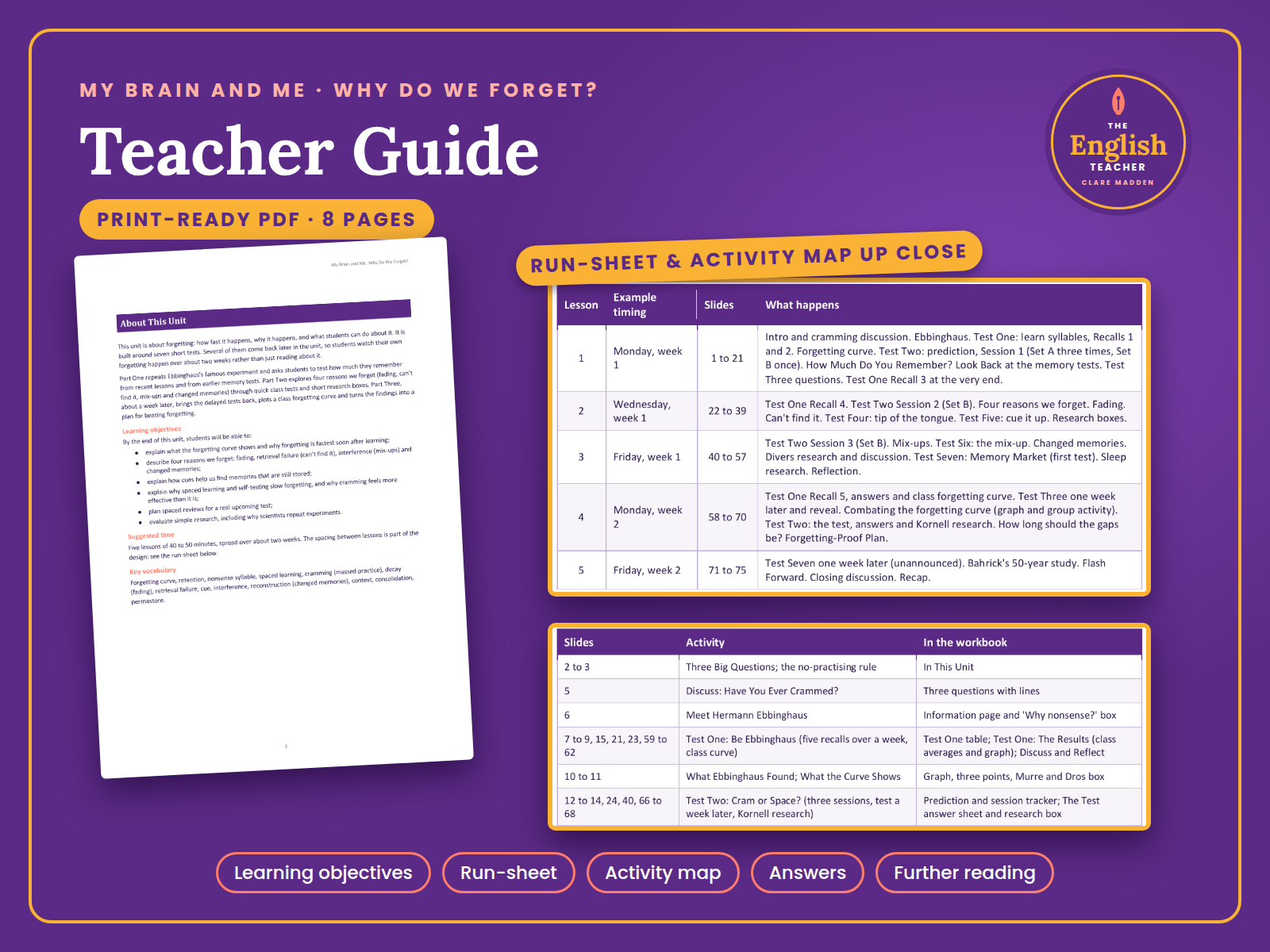
Teacher Guide (8-page PDF): learning objectives, key vocabulary and a preparation checklist. It also has a run-sheet that times the five lessons over two weeks, so the delayed tests work, and an activity map linking slides to workbook pages. Delivery notes cover answers for every test, discussion pointers, differentiation ideas, further reading and references.
Built around seven memory tests
Several tests come back later in the unit, so students see their memories fade in real time instead of just reading about it.
How fast do we forget? Students repeat Ebbinghaus’s famous nonsense-syllable experiment and run a week-long Cram or Space? challenge in an alien language. They also test how much they remember from recent lessons.
Why do we forget? Four reasons: fading, can’t find it, mix-ups and changed memories. Each one is explored through a quick class test: On the Tip of My Tongue, Cue It Up, The Mix-Up and Memory Market.
How can we beat forgetting? The class plots its own forgetting curve and compares it with Ebbinghaus’s, then discovers how spaced reviews flatten the curve. Each student makes a Forgetting-Proof Plan for a real upcoming test.
Real research, explained simply
Students meet classic and recent studies, including Ebbinghaus, Murre and Dros’s 2015 repeat of his experiment, Tulving and Pearlstone’s work on cues, the divers study on where you learn, Cepeda’s work on gap length and Bahrick’s 50-year memory study. Along the way, they talk about why scientists repeat experiments.
Why teachers use it
Students prove to themselves that cramming doesn’t work, which persuades them far more than being told
Gives them spaced practice and self-testing, two of the best-evidenced study strategies
Ready to teach in five lessons of 40 to 50 minutes over about two weeks
Works well for study skills, wellbeing, form time or pastoral programmes, and before exam season
Suitable for ages 12–16 (lower to middle secondary). Files: PowerPoint and PDF.
Something went wrong, please try again later.
This resource hasn't been reviewed yet
To ensure quality for our reviews, only customers who have purchased this resource can review it
Report this resourceto let us know if it violates our terms and conditions.
Our customer service team will review your report and will be in touch.
£4.00