IGCSE Physics: Core Practical — Investigating Motion | Edexcel Modular | Unit 1 | L4Quick View
groggsy

IGCSE Physics: Core Practical — Investigating Motion | Edexcel Modular | Unit 1 | L4

(0)
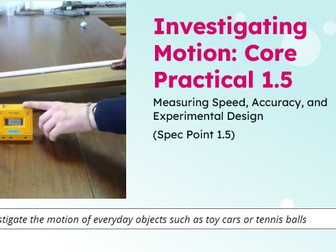
IGCSE Physics: Core Practical — Investigating Motion | Edexcel Modular | Unit 1 | L4 This lesson covers spec point 1.5 — investigating the motion of everyday objects such as toy cars or tennis balls. PowerPoint includes: • Retrieval starter reviewing DT graph features and speed calculations • Direct Instruction (I Do) — investigation method modelled step by step; equipment explained; ticker tape and light gate methods described; variables identified (distance, time); importance of repeat readings for reliability • Guided Practice (We Do) — worked example calculating speed from ticker tape dot spacing; identify anomalous results from a sample data set; plan how to improve reliability • Independent Practice (You Do) — students conduct the investigation, record results in the results table, calculate average speeds, and plot a distance–time graph from their data • Review and Reflect — evaluation questions on accuracy, anomalies and improvements Practical and Activity Sheet includes: • Results table with distance intervals, three time trials and mean time • Calculation section for average speed at each distance interval • Blank grid for plotting the distance–time graph with labelled axes • Evaluation questions covering repeat readings, sources of error and suggested improvements • Full mark scheme for teacher use
IGCSE Physics: Distance-Time Graphs | Edexcel Modular | Unit 1 | L3Quick View
groggsy

IGCSE Physics: Distance-Time Graphs | Edexcel Modular | Unit 1 | L3

(0)
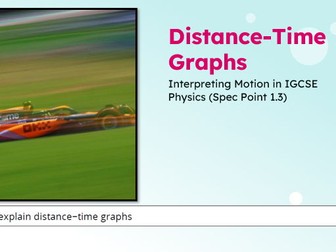
IGCSE Physics: Distance-Time Graphs | Edexcel Modular | Unit 1 | L3 This lesson covers spec point 1.3 — plotting and explaining distance–time graphs. PowerPoint includes: • Retrieval starter reviewing the speed equation and scalar/vector distinction • Direct Instruction (I Do) — distance–time graph features explained with annotated examples; gradient = speed; horizontal line = stationary; steeper gradient = greater speed; how to calculate speed from gradient • Guided Practice (We Do) — describe the motion shown in a three-section DT graph; calculate speed from a given gradient; identify the fastest section and justify using gradient comparison • Independent Practice (You Do) — multi-section DT graph interpretation; sketch a DT graph from a written description of a journey; calculate average speed from graph data • Review and Reflect — 3 MCQs and exit ticket graph description Activity Sheet includes: • Labelled distance–time graph for interpretation questions • 10 exam-style questions covering graph description, gradient calculation, motion identification and graph sketching • Stretch question requiring students to compare two journeys on the same axes and explain the differences • Full mark scheme for teacher use
IGCSE Physics: Scalars and Vectors | Edexcel Modular | Unit 1 | L2Quick View
groggsy

IGCSE Physics: Scalars and Vectors | Edexcel Modular | Unit 1 | L2

(0)
IGCSE Physics: Scalars and Vectors | Edexcel Modular | Unit 1 | L2 This lesson covers spec points 1.13 and 1.14 — understanding how vector quantities differ from scalar quantities, and understanding that force is a vector quantity. PowerPoint includes: • Retrieval starter reviewing speed calculations from L1 • Direct Instruction (I Do) — scalar quantities defined (magnitude only); vector quantities defined (magnitude and direction); key examples of each introduced; force confirmed as a vector; speed vs velocity distinction made; distance vs displacement explained • Guided Practice (We Do) — classify a list of quantities as scalar or vector; explain the difference between speed and velocity in context; identify how direction matters for forces • Independent Practice (You Do) — exam-style classification questions; explain why the direction of a force matters; real-world vector contexts • Review and Reflect and exit ticket classification task Activity Sheet includes: • 10 exam-style questions covering the scalar/vector distinction, examples, speed vs velocity, and distance vs displacement • Table task: classify quantities and give units for each • Stretch question requiring students to explain why two forces of equal magnitude can have different effects depending on direction • Full mark scheme for teacher use
IGCSE Physics: Acceleration | Edexcel Modular | Unit 1 | L5Quick View
groggsy

IGCSE Physics: Acceleration | Edexcel Modular | Unit 1 | L5

(0)
IGCSE Physics: Acceleration | Edexcel Modular | Unit 1 | L5 This lesson covers spec point 1.6 — knowing and using the relationship between acceleration, change in velocity and time taken. PowerPoint includes: • Retrieval starter reviewing speed calculations and distance–time graphs • Direct Instruction (I Do) — acceleration defined as rate of change of velocity; a = (v − u) / t introduced in words and symbols; worked examples calculating acceleration, deceleration and time; negative acceleration explained as deceleration • Guided Practice (We Do) — three calculations: find acceleration from a change in velocity; find time taken to reach a given speed; determine whether an object is accelerating or decelerating from data • Independent Practice (You Do) — acceleration calculations from real-world contexts (cars, rockets, cyclists); rearrangement for u and t • Review and Reflect — 3 MCQs and exit ticket calculation Activity Sheet includes: • Formula box: a = (v − u) / t • 10 exam-style questions covering acceleration calculations, rearranging for u and t, and interpreting motion descriptions • Stretch question requiring multi-step reasoning combining the acceleration and speed equations • Full mark scheme for teacher use
IGCSE Physics: Forces | Edexcel Modular | Unit 1 | L8Quick View
groggsy

IGCSE Physics: Forces | Edexcel Modular | Unit 1 | L8

(0)
IGCSE Physics: Forces | Edexcel Modular | Unit 1 | L8 This lesson covers spec points 1.11, 1.12, 1.13 and 1.14 — describing the effects of forces between bodies, identifying types of force, and understanding the difference between scalars and vectors, including that force is a vector quantity. PowerPoint includes: • Retrieval starter reviewing scalars, vectors and speed calculations • Direct Instruction (I Do) — three effects of forces introduced (change in speed, direction, shape); contact vs non-contact forces distinguished; specific force types defined with examples (gravitational, electrostatic, magnetic, normal reaction, tension, friction); force confirmed as a vector • Guided Practice (We Do) — contact/non-contact classification table with blank version for students; identify force types from scenarios; draw labelled force diagrams for a book on a table, a moving car and a falling stone • Independent Practice (You Do) — force type identification; effects of forces questions; labelled force diagram tasks in real-world contexts • Review and Reflect — 3 MCQs and exit ticket Activity Sheet includes: • 10 exam-style questions covering effects of forces, force type identification and contact/non-contact classification • Force diagram drawing tasks for real-world objects • Stretch question requiring students to explain how a single force can produce more than one effect • Full mark scheme for teacher use
IGCSE Physics: W=mg | Edexcel Modular | Unit 1 | L11Quick View
groggsy

IGCSE Physics: W=mg | Edexcel Modular | Unit 1 | L11

(0)
IGCSE Physics: W=mg | Edexcel Modular | Unit 1 | L11 This lesson covers spec point 1.18 — knowing and using the relationship between weight, mass and gravitational field strength: W = mg. PowerPoint includes: • Retrieval starter reviewing F = ma calculations • Direct Instruction (I Do) — mass defined (amount of matter, constant regardless of location); weight defined (gravitational force, varies with location); W = mg introduced; g = 10 N/kg on Earth defined; planetary gravity table showing g values for different bodies in the solar system; worked examples calculating weight, mass and g • Guided Practice (We Do) — calculate weight on Earth; calculate weight on the Moon; compare mass and weight for the same object on different planets • Independent Practice (You Do) — W = mg calculations on Earth and other planets; explain why weight changes but mass does not; multi-step problems combining W = mg with F = ma • Review and Reflect — 3 MCQs and exit ticket Activity Sheet includes: • Formula box: W = m × g • Planetary gravitational field strength reference table • 10 exam-style questions covering W = mg calculations, the mass vs weight distinction, and planetary contexts • Stretch question combining W = mg and F = ma in a multi-step problem • Full mark scheme for teacher use
IGCSE Physics: Velocity-Time Graphs | Edexcel Modular | Unit 1 | L6Quick View
groggsy

IGCSE Physics: Velocity-Time Graphs | Edexcel Modular | Unit 1 | L6

(0)
IGCSE Physics: Velocity-Time Graphs | Edexcel Modular | Unit 1 | L6 This lesson covers spec points 1.7, 1.8 and 1.9 — plotting and explaining velocity–time graphs, determining acceleration from the gradient, and calculating distance from the area under the graph. PowerPoint includes: • Retrieval starter reviewing acceleration calculations and DT graph interpretation • Direct Instruction (I Do) — VT graph features explained with annotated examples; gradient = acceleration; area under graph = distance travelled; positive gradient, negative gradient and horizontal line identified and explained; area calculations for triangles, rectangles and trapeziums • Guided Practice (We Do) — calculate acceleration from a VT graph gradient; calculate distance for a constant-velocity section; calculate total distance for a multi-section journey • Independent Practice (You Do) — multi-section VT graph analysis; gradient and area calculations; sketch a VT graph from a written description of motion • Misconception check: VT graph vs DT graph — common student confusion addressed • Review and Reflect — Exit ticket graph analysis Activity Sheet includes: • Formula box: a = Δv / t; distance = area under graph • Annotated multi-section VT graph for reference • 10 exam-style questions covering gradient, area (triangle, rectangle, trapezium), graph description and sketching • Stretch question requiring full analysis of a complex multi-section VT graph including acceleration, deceleration and total distance • Full mark scheme for teacher use
IGCSE Physics: Resultant Forces and Friction | Edexcel Modular | Unit 1 | L9Quick View
groggsy

IGCSE Physics: Resultant Forces and Friction | Edexcel Modular | Unit 1 | L9

(0)
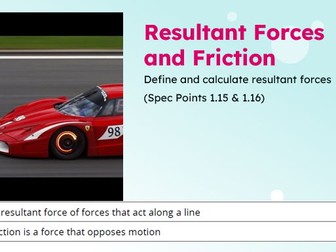
IGCSE Physics: Resultant Forces and Friction | Edexcel Modular | Unit 1 | L9 This lesson covers spec points 1.15 and 1.16 — calculating the resultant force of forces acting along a line, and knowing that friction is a force that opposes motion. PowerPoint includes: • Retrieval starter reviewing force types and effects from L8 • Direct Instruction (I Do) — resultant force defined as the single equivalent force; forces in the same direction added; forces in opposite directions subtracted; direction of resultant identified; friction defined as opposing motion; Newton’s First Law introduced (zero resultant = constant velocity or stationary) • Guided Practice (We Do) — calculate three resultant forces from force pairs; identify direction of resultant and predict motion; explain the role of friction in each scenario • Independent Practice (You Do) — resultant force calculations; free body diagram interpretation; friction in real-world contexts; Newton’s First Law application questions • Review and Reflect — 3 MCQs and exit ticket Activity Sheet includes: • 10 exam-style questions on resultant force calculations, direction identification, friction and Newton’s First Law • Free body diagram interpretation tasks • Stretch question requiring students to identify all forces, calculate the resultant and justify the predicted motion • Full mark scheme for teacher use
IGCSE Physics: F=ma | Edexcel Modular | Unit 1 | L10Quick View
groggsy

IGCSE Physics: F=ma | Edexcel Modular | Unit 1 | L10

(0)
IGCSE Physics: F=ma | Edexcel Modular | Unit 1 | L10 This lesson covers spec point 1.17 — knowing and using the relationship between unbalanced force, mass and acceleration: F = ma. PowerPoint includes: • Retrieval starter reviewing resultant force and friction from L9 • Direct Instruction (I Do) — Newton’s Second Law stated; F = ma introduced in words and symbols; each variable defined with units; worked examples calculating force, mass and acceleration with full rearrangement; link made between resultant force and F = ma • Guided Practice (We Do) — three calculations: find force from mass and acceleration; find acceleration from resultant force; find mass from force and acceleration • Independent Practice (You Do) — F = ma in real-world contexts; multi-step problems combining resultant force with F = ma; predict motion from calculated acceleration • Review and Reflect — 3 MCQs and exit ticket Activity Sheet includes: • Formula box: F = m × a • 10 exam-style questions including straightforward calculations, all three rearrangements, and multi-step problems requiring a resultant force to be found first • Stretch question requiring a two-step solution: find resultant force then calculate acceleration • Full mark scheme for teacher use
IGCSE Physics: v²=u²+2as | Edexcel Modular | Unit 1 | L7Quick View
groggsy

IGCSE Physics: v²=u²+2as | Edexcel Modular | Unit 1 | L7

(0)
IGCSE Physics: v²=u²+2as | Edexcel Modular | Unit 1 | L7 This lesson covers spec point 1.10 — using the relationship between final speed, initial speed, acceleration and distance moved. PowerPoint includes: • Retrieval starter reviewing acceleration calculations and VT graph area • Direct Instruction (I Do) — v² = u² + 2as introduced; each variable defined with units; equation linked to the area under a VT graph; worked examples calculating v, u, a and s with full substitution and rearrangement shown • Guided Practice (We Do) — three calculations: find final speed from rest over a known distance; find braking distance; find acceleration from initial and final speeds • Independent Practice (You Do) — real-world suvat problems including runway length, car braking distance and multi-step combinations with F = ma • Review and Reflect — 3 MCQs and exit ticket calculation Activity Sheet includes: • Formula box: v² = u² + 2as • 10 exam-style questions covering all four rearrangements and real-world contexts • Stretch question combining v² = u² + 2as with F = ma in a multi-step problem • Full mark scheme for teacher use
IGCSE Physics: Impulse and Safety Features | Edexcel Modular | Unit 1 | L17Quick View
groggsy

IGCSE Physics: Impulse and Safety Features | Edexcel Modular | Unit 1 | L17

(0)
IGCSE Physics: Impulse and Safety Features | Edexcel Modular | Unit 1 | L17 This lesson covers spec points 1.26P, 1.28P and 1.29P — using momentum to explain safety features, using F = Δp / t, and demonstrating understanding of Newton’s Third Law. Physics only. PowerPoint includes: • Retrieval starter reviewing conservation of momentum from L16 • Direct Instruction (I Do) — F = Δp / t introduced and linked to F = ma; impulse defined as change in momentum; key principle: same Δp over a longer time = smaller force; safety features analysed using F = Δp / t (crumple zones, airbags, seatbelts, crash helmets); Newton’s Third Law stated with key features of force pairs; real-world examples (rocket propulsion, swimming, collisions) • Guided Practice (We Do) — F = Δp / t calculation; explain how a crumple zone reduces force on passengers; identify a Newton’s Third Law pair from a scenario and explain why they qualify as a pair • Independent Practice (You Do) — F = Δp / t calculations; extended safety feature explanations; Newton’s Third Law pair identification and justification • Review and Reflect — 3 MCQs and exit ticket Activity Sheet includes: • Formula box: F = (mv − mu) / t • 10 exam-style questions covering impulse calculations, safety feature explanations using F = Δp / t, and Newton’s Third Law • Stretch question requiring students to calculate the force in a collision, evaluate the most effective safety feature, and identify the Newton’s Third Law pair acting during the impact • Full mark scheme for teacher use
IGCSE Physics: Hooke's Law Theory | Edexcel Modular | Unit 1 | L15Quick View
groggsy

IGCSE Physics: Hooke's Law Theory | Edexcel Modular | Unit 1 | L15

(0)
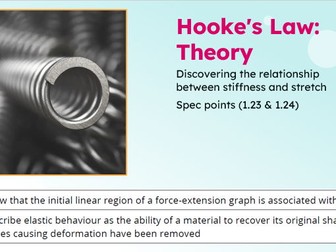
IGCSE Physics: Hooke’s Law Theory | Edexcel Modular | Unit 1 | L15 This lesson covers spec points 1.23 and 1.24 — knowing that the initial linear region of a force–extension graph is associated with Hooke’s law, and describing elastic behaviour. PowerPoint includes: • Retrieval starter reviewing the practical results and graph shapes from L14 • Direct Instruction (I Do) — Hooke’s law stated: extension is directly proportional to force in the linear region; proportionality shown on graph; limit of proportionality marked and defined; elastic behaviour defined; distinction between elastic and plastic deformation; rubber band behaviour contrasted with spring — rubber band does not obey Hooke’s law • Guided Practice (We Do) — annotate a force–extension graph (linear region, limit of proportionality, non-linear region); identify whether data obeys Hooke’s law; predict extension using proportional reasoning • Independent Practice (You Do) — Hooke’s law descriptions and graph annotations; elastic behaviour questions; predict and justify extensions within and beyond the linear region • Review and Reflect — 3 MCQs and exit ticket Activity Sheet includes: • Annotated force–extension graph comparing spring and rubber band • 10 exam-style questions covering Hooke’s law, graph annotation, limit of proportionality, elastic behaviour and prediction • Stretch question requiring students to evaluate a student’s claim about whether a material obeys Hooke’s law, using graph evidence to justify their answer • Full mark scheme for teacher use
IGCSE Physics: Core Practical — Hooke's Law | Edexcel Modular | Unit 1 | L14Quick View
groggsy

IGCSE Physics: Core Practical — Hooke's Law | Edexcel Modular | Unit 1 | L14

(0)
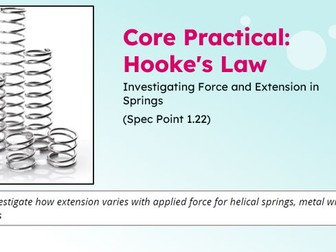
IGCSE Physics: Core Practical — Hooke’s Law | Edexcel Modular | Unit 1 | L14 This lesson covers spec point 1.22 — investigating how extension varies with applied force for helical springs, metal wires and rubber bands. PowerPoint includes: • Retrieval starter reviewing force types and effects • Direct Instruction (I Do) — practical method modelled step by step; equipment listed; how to measure natural length and extension correctly; importance of repeat readings; zero error identified; safety precautions explained; how to plot a force–extension graph • Guided Practice (We Do) — worked example calculating extension from raw length measurements; identify anomalous results from a sample data set; decide on appropriate axes and scale • Independent Practice (You Do) — students conduct the investigation, record results for a helical spring and a rubber band, calculate extensions, and plot results on the same axes • Review and Reflect — evaluation questions on accuracy, anomalies and graph shape comparison Practical and Activity Sheet includes: • Results table with columns for load (N), length (cm), extension (cm) and repeat readings • Blank force–extension grid for plotting spring and rubber band data on the same axes • Comparison questions on the graph shapes for spring vs rubber band • Evaluation questions on reliability, anomalies and improvements • Full mark scheme for teacher use
IGCSE Physics: Terminal Velocity | Edexcel Modular | Unit 1 | L13Quick View
groggsy

IGCSE Physics: Terminal Velocity | Edexcel Modular | Unit 1 | L13

(0)
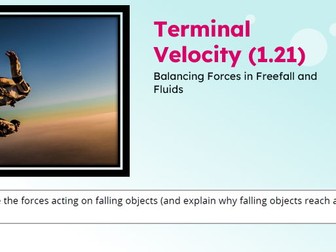
IGCSE Physics: Terminal Velocity | Edexcel Modular | Unit 1 | L13 This lesson covers spec point 1.21 — describing the forces acting on falling objects and explaining why falling objects reach a terminal velocity. PowerPoint includes: • Retrieval starter reviewing resultant force, F = ma and W = mg • Direct Instruction (I Do) — forces on a falling object introduced: weight (down) and air resistance (up); three-stage model explained: initial acceleration (weight > air resistance); decreasing acceleration (air resistance increases with speed); terminal velocity (weight = air resistance, resultant = 0 N); parachutist opening parachute as extension • Guided Practice (We Do) — describe forces at each stage of fall; explain why acceleration decreases as speed increases; sketch a velocity–time graph for a falling object reaching terminal velocity • Independent Practice (You Do) — extended explanation questions; VT graph analysis for a skydiver with and without a parachute • Review and Reflect — 3 MCQs and exit ticket Activity Sheet includes: • Three-stage free body diagram sequence (accelerating, still accelerating but less, terminal velocity) • 10 exam-style questions on forces, terminal velocity explanations and VT graph interpretation • Stretch question analysing the full VT graph of a skydiver who opens their parachute mid-fall, including the new lower terminal velocity • Full mark scheme for teacher use
IGCSE Physics: Stopping Distance | Edexcel Modular | Unit 1 | L12Quick View
groggsy

IGCSE Physics: Stopping Distance | Edexcel Modular | Unit 1 | L12

(0)
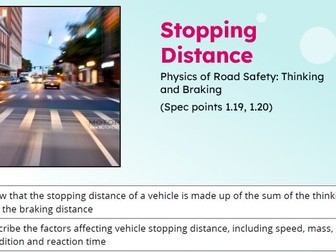
IGCSE Physics: Stopping Distance | Edexcel Modular | Unit 1 | L12 This lesson covers spec points 1.19 and 1.20 — knowing that stopping distance = thinking distance + braking distance, and describing the factors affecting each component. PowerPoint includes: • Retrieval starter reviewing forces and Newton’s laws • Direct Instruction (I Do) — stopping distance model introduced with diagram; thinking distance explained (reaction time × speed); braking distance explained (dependent on speed, mass, road and vehicle condition); factors affecting thinking distance: speed, tiredness, alcohol, drugs, distractions; factors affecting braking distance: speed, mass, road condition, tyre and brake condition • Guided Practice (We Do) — three tasks: classify factors as affecting thinking or braking distance; predict the effect of given changes on stopping distance; interpret a stopping distance data table for different speeds • Independent Practice (You Do) — evaluate stopping distance scenarios; extended explain questions; analyse stopping distance data and draw conclusions • Review and Reflect — 3 MCQs and exit ticket Activity Sheet includes: • Stopping distance diagram (thinking distance + braking distance = total stopping distance) • 10 exam-style questions covering factors, explain/describe responses and data analysis tasks • Stretch question evaluating a claim about the relative importance of different factors • Full mark scheme for teacher use
IGCSE Physics: Momentum | Edexcel Modular | Unit 1 | L16Quick View
groggsy

IGCSE Physics: Momentum | Edexcel Modular | Unit 1 | L16

(0)
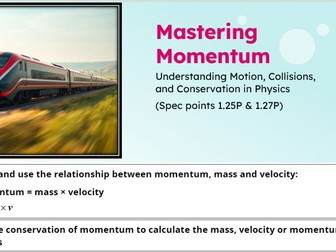
IGCSE Physics: Momentum | Edexcel Modular | Unit 1 | L16 This lesson covers spec points 1.25P and 1.27P — knowing and using momentum = mass × velocity, and using conservation of momentum to calculate mass, velocity or momentum of objects. Physics only. PowerPoint includes: • Retrieval starter reviewing F = ma and forces • Direct Instruction (I Do) — momentum defined as a vector quantity; p = mv introduced with units; conservation of momentum stated; three collision types modelled with before-and-after diagrams: perfectly inelastic (objects stick together), elastic (objects bounce apart), and explosion (objects start from rest and push apart); worked example for each type • Guided Practice (We Do) — three collision scenarios: find velocity after a perfectly inelastic collision; find the velocity of one object after a bounce; find the velocity of one object after an explosion • Independent Practice (You Do) — p = mv calculations; conservation of momentum applied to all three collision types; finding unknown mass and velocity • Review and Reflect — exit ticket Activity Sheet includes: • Formula box: p = m × v • Before-and-after collision diagrams for all three collision types • 10 exam-style questions covering momentum calculations and conservation of momentum across all collision types, including finding unknown mass and velocity • Stretch question requiring students to find the velocity of one object in an explosion given the mass and velocity of the other • Full mark scheme for teacher use
IGCSE Physics: Moments | Edexcel Modular | Unit 1 | L18Quick View
groggsy

IGCSE Physics: Moments | Edexcel Modular | Unit 1 | L18

(0)
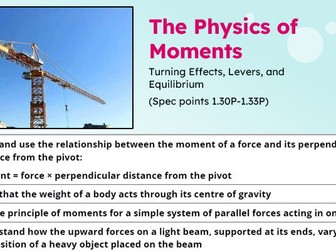
IGCSE Physics: Moments | Edexcel Modular | Unit 1 | L18 This lesson covers spec points 1.30P, 1.31P, 1.32P and 1.33P — knowing and using the moment equation, understanding the centre of gravity, applying the principle of moments, and understanding how support forces vary on a loaded beam. Physics only. PowerPoint includes: • Retrieval starter reviewing forces, weight and Newton’s laws • Direct Instruction (I Do) — moment of a force defined as the turning effect about a pivot; M = F × d introduced; clockwise and anticlockwise moments distinguished; centre of gravity defined and located for uniform objects; principle of moments stated; worked example finding an unknown force using the principle of moments; beam supported at both ends — finding support forces including beam weight • Guided Practice (We Do) — three tasks: calculate a moment from given force and distance; find an unknown force using the principle of moments; calculate support forces for a loaded beam • Independent Practice (You Do) — moment calculations; principle of moments applied to balanced beams and asymmetric loading; beam-supported-at-ends problems with and without beam weight • Review and Reflect — 3 MCQs and exit ticket Activity Sheet includes: • Formula box: M = F × d • Labelled diagrams for the spanner, balanced beam, beam AB, see-saw and stretch question (beam with own weight) • 8 exam-style questions plus stretch covering all four spec points: moment definition, equation, centre of gravity, principle of moments, and beams supported at both ends • Stretch question requiring students to account for the beam’s own weight acting through its centre of gravity at the midpoint • Full mark scheme for teacher use
IGCSE Physics: Forces and Motion | Complete Resource Pack | Edexcel Modular | Unit 1 | 18 LessonsQuick View
groggsy

IGCSE Physics: Forces and Motion | Complete Resource Pack | Edexcel Modular | Unit 1 | 18 Lessons

(0)
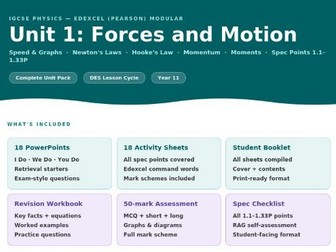
IGCSE Physics: Forces and Motion | Complete Resource Pack | Edexcel Modular | Unit 1 | 18 Lessons This is the complete resource bundle for Unit 1: Forces and Motion of the Edexcel International GCSE Physics (Modular) specification. It covers all 18 lessons across spec points 1.1–1.33P and includes everything needed to teach, practise and assess the full unit. What’s included: 18 lesson PowerPoints — each built around a 60-minute Lesson Cycle (Smart Start retrieval → Direct Instruction → Guided Practice → Independent Practice → Review and Reflect). Every PowerPoint includes exam-style MCQs and an exit ticket. Built on Rosenshine’s principles of instruction. 18 activity sheets — exam-style independent practice questions with full mark schemes. Questions use Edexcel command words throughout. Physics-only lessons (1.25P–1.33P) are clearly labelled. Student Activity Booklet — all 18 activity sheets compiled into a single student-facing booklet, ready to print and issue as a unit workbook. Mark Scheme Booklet — all 18 mark schemes compiled for teacher use. Unit Assessment — 50-mark end-of-unit test covering the full spec in mixed MCQ and short/extended answer format, with full mark scheme. Includes graphs and diagrams for Q11, Q13, Q15 and Q18. Revision Workbook — 15-page topic-grouped revision resource covering all five topic areas (Movement and Position, Forces, Hooke’s Law, Momentum, Moments) with key terms, equations, annotated diagrams, worked examples and practice questions with answers. Specification Checklist — student-facing RAG checklist covering every spec point from 1.1 to 1.33P. Lessons covered: L1 Calculating Speed · L2 Scalars and Vectors · L3 Distance-Time Graphs · L4 Core Practical: Investigating Motion · L5 Acceleration · L6 Velocity-Time Graphs · L7 v²=u²+2as · L8 Forces · L9 Resultant Forces and Friction · L10 F=ma · L11 W=mg · L12 Stopping Distance · L13 Terminal Velocity · L14 Core Practical: Hooke’s Law · L15 Hooke’s Law Theory · L16 Momentum · L17 Impulse and Safety Features · L18 Moments Specification: Edexcel International GCSE Physics (Modular) — Unit 1, spec points 1.1–1.33P Total marks in assessment: 50
IGCSE Physics: Pitch & Loudness | Edexcel Modular | Unit 5 | L12Quick View
groggsy

IGCSE Physics: Pitch & Loudness | Edexcel Modular | Unit 5 | L12

(0)
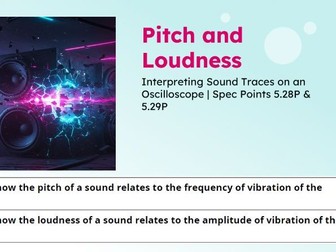
IGCSE Physics: Pitch & Loudness | Edexcel Modular | Unit 5 | L12 This lesson covers spec points 5.26P, 5.27P, 5.28P and 5.29P — how an oscilloscope displays sound, and how pitch relates to frequency and loudness relates to amplitude. PowerPoint includes: • Retrieval starter reviewing period and frequency from oscilloscope traces • Direct Instruction (I Do) — pitch linked to frequency; loudness linked to amplitude; oscilloscope trace visualisations for all four combinations (high/low pitch × loud/quiet) • Guided Practice (We Do) — three case studies: whisper vs bass drum trace identification; wave pattern MCQ; volume vs speed misconception check • Independent Practice (You Do) — oscilloscope frequency measurement description; shouting vs talking trace change; guitar string pitch physics • Digital audio context discussion (gain and pitch manipulation) • Real-world application: string instruments (length, tension, mass) • Review and Reflect unit summary exit ticket — final lesson of Unit 5 Activity Sheet includes: • 2×2 grid of four labelled oscilloscope traces (A–D) for Q4 comparison task • Side-by-side example wave and blank grid for Q8 sketching task • 10 exam-style questions plus stretch covering pitch, loudness, oscilloscope method, and calculations • Stretch question requires frequency calculation and comparison of both pitch and loudness • Full mark scheme for teacher use
IGCSE Physics: Waves — Complete Unit Resource Pack | Edexcel Modular | Unit 5 | 12 LessonsQuick View
groggsy

IGCSE Physics: Waves — Complete Unit Resource Pack | Edexcel Modular | Unit 5 | 12 Lessons

(0)
IGCSE Physics: Waves — Complete Unit Resource Pack | Edexcel Modular | Unit 5 | 12 Lessons This is the complete resource pack for Unit 5: Waves, covering all spec points 5.2–5.29P of the Edexcel IGCSE Physics (Modular) specification. Everything you need to teach, practise and assess the full Waves unit is included. What’s included (40+ files): 12 PowerPoints — each following the DES Lesson Cycle: Smart Start (retrieval starter, 4 questions with answers) Direct Instruction (I Do — worked examples, formula triangles) Guided Practice (We Do — 3 scaffolded problems) Independent Practice (You Do — Edexcel exam-style questions) Review and Reflect (traffic light exit ticket) 12 Activity Sheets / Practical Booklets — including: L1 — Types of Waves & Wave Properties L2 — The Wave Equation & Frequency-Period Relationship L3 — Oscilloscope Readings & Calculations (includes 4 labelled oscilloscope traces) L4 — The Doppler Effect L5 — The Electromagnetic Spectrum (includes full EM spectrum completion table) L6 — Properties of Light & Reflection (includes reflection results table) L7 — Core Practical: Investigating Refraction (full practical booklet with method, results, analysis and conclusion) L8 — Refraction Calculations — Snell’s Law L9 — Critical Angle & Total Internal Reflection L10 — Sound Waves & Hearing Range L11 — Core Practical: Speed of Sound in Air (full practical booklet with method, results, analysis and conclusion) L12 — Pitch & Loudness Compiled booklets: Student Activity Booklet — all 12 activity sheets in one document Mark Scheme Booklet — all 12 mark schemes compiled for teacher use Assessment: 50-mark end-of-unit assessment (10 MCQ + 7 structured questions) Full mark scheme included Revision materials: Revision Guide — all spec points 5.2–5.29P with key facts, equations, worked examples, examiner tips and quick check questions with answers Spec Checklist — RAG self-assessment covering all 29 spec points across 4 topic sections Spec points covered: 5.2–5.9 Wave properties, wave equation, Doppler Effect 5.10–5.13 Electromagnetic spectrum (uses and dangers) 5.14–5.22 Light waves, reflection, refraction, TIR, optical fibres (includes core practicals 5.17P and 5.19P) 5.23–5.29P Sound waves, hearing range, speed of sound (5.25P), oscilloscope investigation (5.27P), pitch and loudness All resources are: Aligned to the Edexcel IGCSE Physics (Modular) specification Written using Edexcel command words throughout Pitched to stretch top-end students with scaffolding for all Free from off-spec content — all spec point references checked Individual lessons from this unit are available separately.
IGCSE Physics: The Electromagnetic Spectrum | Edexcel Modular | Unit 5 | L5Quick View
groggsy

IGCSE Physics: The Electromagnetic Spectrum | Edexcel Modular | Unit 5 | L5

(0)
IGCSE Physics: The Electromagnetic Spectrum | Edexcel Modular | Unit 5 | L5 This lesson covers spec points 5.10, 5.11, 5.12 and 5.13 — common properties of all EM waves, the full spectrum order, and the uses and dangers of each band. PowerPoint includes: • Retrieval starter — list the visible spectrum in order • Direct Instruction (I Do) — common properties of all EM waves; full spectrum order with frequency/wavelength trends; detailed uses and dangers per band • Guided Practice (We Do) — three problems: identify EM wave from use case; hazard matching MCQ; fill-in-the-blanks on properties • Independent Practice (You Do) — compare UV and infrared dangers; two-property question; X-ray vs UV imaging question; ionising risk comparison • Order check activity (4 waves, longest to shortest wavelength) • Review and Reflect traffic light on spectrum order and uses Activity Sheet includes: • Task 1 — full EM spectrum completion table (dangers, uses, frequency/wavelength direction arrows) matching the lesson’s reference table • Task 2 — 8 exam-style questions plus stretch • Questions covering uses, dangers, ionising radiation, X-ray imaging, infrared applications • Stretch question evaluates a student claim about UV vs X-ray danger • Full mark scheme including completed table for teacher use