 Quick View
File Sizes: Images & Sound | AQA A Level Computer Science 7517 | 20 Worksheets + Answers
Storage calculations for AQA A Level Computer Science (7517): twenty different
sheets on bitmapped images and sound recordings, each worked all the way
through, and each with a complete answer key.
Two bullets of the specification say CALCULATE - storage requirements for
bitmapped images, and sound sample sizes in bytes. Questions 1 to 4 do nothing
else.
WHAT YOU GET
20 worksheets, 2 pages each, numbered 01 to 20
20 matching answer keys
A contents table giving each sheet’s image size, colour depth and sampling
rate, so you can pick one without opening all twenty
WHAT IS ON EVERY SHEET
Question 1 gives an image in pixels with its colour depth: how many colours
each pixel can take, the size in bits, the size in bytes, and then the size in
KiB and in kB - the same file, twice.
Question 2 starts from a printed original in inches scanned at a given number
of dots per inch: pixels across, pixels down, pixels in total, bytes, and MiB.
Question 3 is a recording: sampling rate, sample resolution, length and
channels to a size in bytes and in MiB, then the lowest sampling rate the
Nyquist theorem allows for a given highest frequency.
Question 4 saves the image from question 1 with metadata, and asks how many
complete files fit on a memory card.
Question 5 is a written question on kilobytes against kibibytes, on the
Nyquist theorem, on sample resolution and quality, on vector against
bitmapped graphics, or on colour depth.
Every sheet is 30 marks.
THE CONVENTION THIS TOPIC ARGUES ABOUT, SETTLED ON THE PAGE
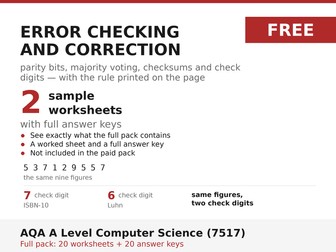
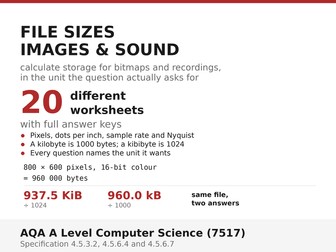
A kilobyte is not a kibibyte. 1 kB is 1000 bytes and 1 KiB is 1024, so the
same file is 937.5 KiB and 960.0 kB. A student who gives one where the other
was wanted is marked wrong having done nothing wrong. AQA says so itself, in
the additional information to 4.5.3.2: the terms kilobyte and megabyte have
often been used where kibibyte and mebibyte were meant. Every question on
these sheets names the unit it wants, and question 1 asks for both on one
file so that the gap is seen rather than described.
The smaller conventions are printed too. Metadata counts only when a question
gives it. Resolution is in dots per inch and a dot is a pixel. A sound is mono
unless the question says stereo. Sizes round to one decimal place with a half
going upwards.
NO AMBIGUOUS ROUNDING
No sheet asks you to round a value that lands exactly on a half at the digit
being dropped. “12.25 to one decimal place” is answered 12.2 or 12.3 depending
on which rule you were taught, and both can be defended. Every sheet in this
pack is built so that the question has one answer.
FORMAT
PDF, A4, print-ready. Twenty different images, scanner settings and
recordings, so you already have a fresh sheet for every class, every resit and
every homework.
Licensed for the purchasing teacher and their own classes.