


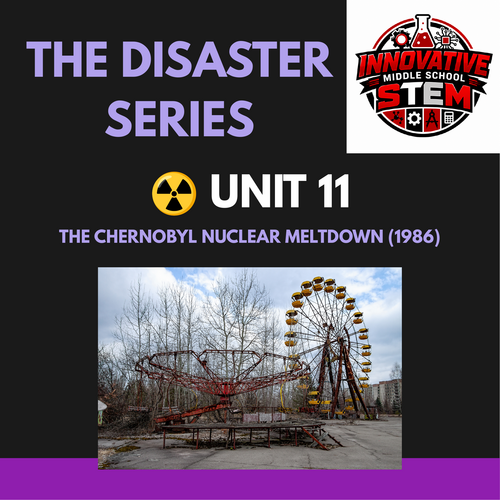
Investigate the 1986 Chernobyl nuclear disaster with this 6-page STEM packet covering reactor physics, void coefficients, half-life math, and ethics.
Engage your middle and high school students with a comprehensive, hands-on deep dive into the world’s worst nuclear energy disaster. This complete printable unit bridges nuclear physics, environmental chemistry, and regulatory ethics to teach RBMK-1000 reactor mechanics, positive void coefficient reactivity, graphite-tipped control rod power surges, xenon-135 poisoning kinetics, and nuclear containment engineering.
What’s Included in this 6-Page Unit Packet:
Page 1: Historical Case Study & Technical Breakdown – Full narrative of the April 26, 1986 explosion in Pripyat, USSR, RBMK-1000 water-cooled graphite-moderated reactor design, fatal electrical turbine rundown test, positive void coefficient mechanics, graphite-tipped boron control rod power surges, steam explosions, and comprehension check questions.
Page 2: Day in the Life Scenario Challenge – Roleplay assignment where students step into the shoes of a Chief Nuclear Control Room Engineer at 1:23 AM on April 26, 1986, analyzing real-time neutron flux telemetry, coolant flow drops, Xenon pit dynamics, and emergency scram button (AZ-5) protocols.
Page 3: Hands-On Unplugged Simulation & Applied Math – Step-by-step math calculations comparing thermal power spikes in megawatts thermal (MWt) versus safety thresholds, positive void coefficient reactivity multiplication, and radioactive half-life decay rates for Iodine-131 and Cesium-137.
Page 4: Engineering Ethics & Workplace Dilemma – Critical thinking exercise exploring the decision to disable emergency safety systems for test schedules, bypassing automatic emergency core cooling systems (ECCS), political secrecy, operating below minimum control rod limits, and international nuclear regulatory reform.
Page 5: Redesign Brief & Innovation Lab – Creative blueprinting assignment where students design “RBMK Nuclear Reactor V-2,” incorporating negative void coefficient fuel geometry, solid-boron control rods without graphite tips, reinforced steel-and-concrete containment domes, and automated passive cooling loops.
Page 6: Teacher Answer Key & Scoring Rubric – Complete answer key for all analytical questions and math calculations, along with a 10-point grading rubric for evaluating student blueprints on Page 5.
Teacher Benefits:
100% Print-Friendly Format: Clean text layout with zero dark background boxes or awkward formatting for easy editing and printing.
Multi-Day Classroom Value: Designed to cover 3 to 5 full class periods. Perfect for Physics, Chemistry, Physical Science, Environmental Science, Nuclear Engineering, World History electives, or emergency sub plans.
High-Interest Real-World Content: Combines nuclear decay math, reactor physics, control room decision telemetry, nuclear ethics, and power plant engineering redesign!
Something went wrong, please try again later.
This resource hasn't been reviewed yet
To ensure quality for our reviews, only customers who have purchased this resource can review it
Report this resourceto let us know if it violates our terms and conditions.
Our customer service team will review your report and will be in touch.
$3.99