


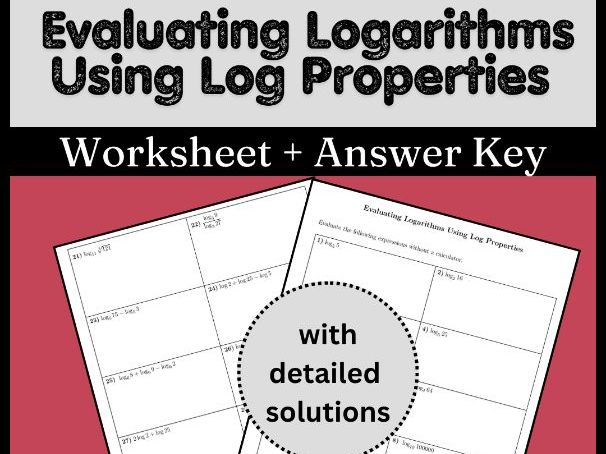
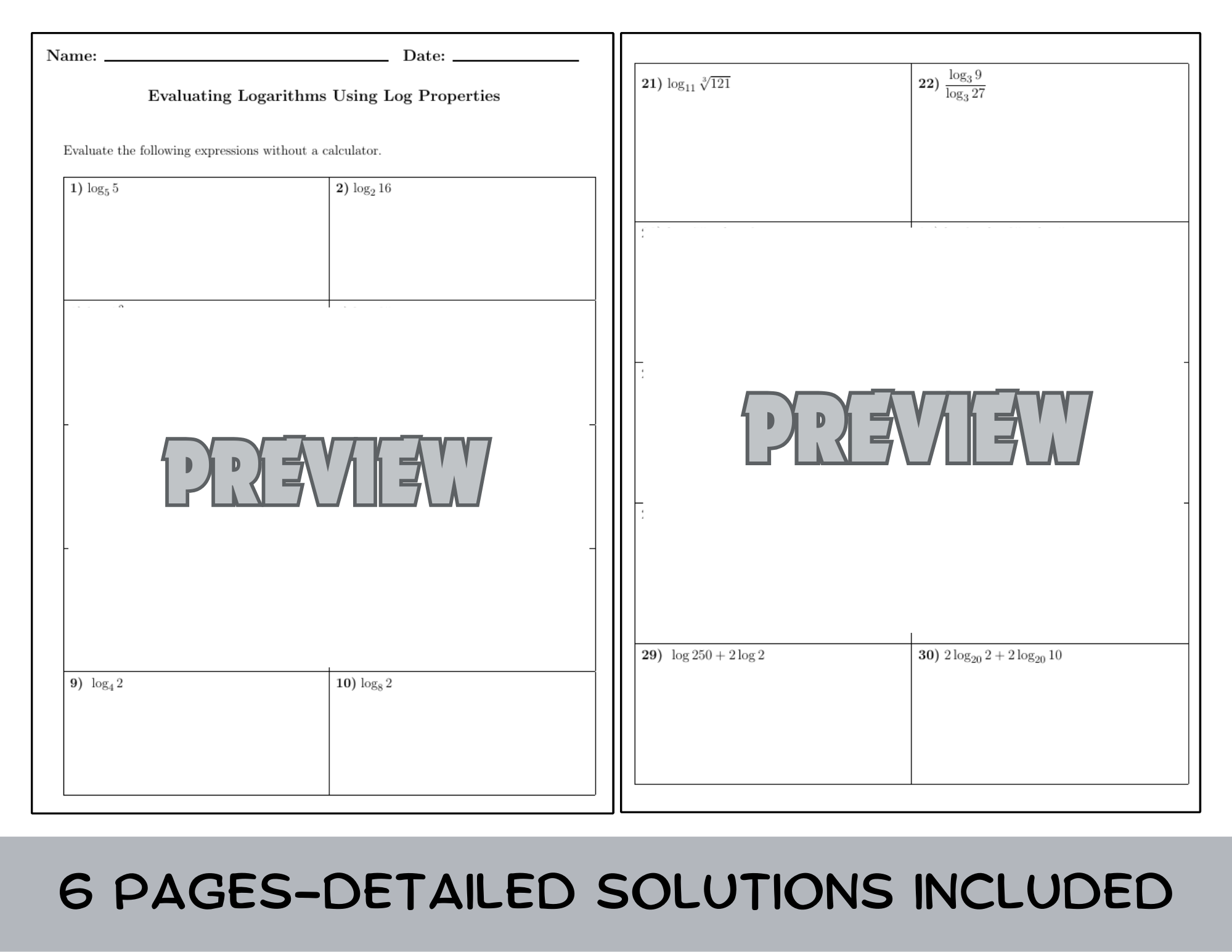
A worksheet on evaluating logarithms using properties of logs. Students are required to use the following laws:
- power law
- product law
- quotient law
- identity of 1
- identity of the base
There are 30 problems and detailed solutions are included.
Looking for a rigorous, no-prep practice resource to help your students master logarithms? This comprehensive worksheet is designed to build deep operational fluency with log laws, taking students smoothly from basic single-log evaluations to complex multi-property expressions that must be solved completely without a calculator!
Whether you need a targeted homework assignment, an in-class review challenge, or a reliable cover plan, this resource has you covered.
What’s Included:
- 30 Carefully Sequenced Problems: A balanced progression of problems that systematically builds student confidence and mastery.
- Complete Step-by-Step Solutions: Saves hours of marking time and is perfect for student self-assessment, independent study, or lesson cover.
- Diverse Problem Types:
Section 1: Evaluating single logarithmic expressions using integers, fractions, fractional bases, negative indices, and radicals.
Section 2: Using the Product, Quotient, and Power laws of logarithms to condense and evaluate multi-term algebraic expressions.
Curriculum & Level Alignment:
This worksheet perfectly maps to higher-level secondary math and senior secondary courses globally:
- UK Curriculum: Key Stage 4 (Higher GCSE) and AS/A-Level Mathematics (Pure Mathematics - Logarithmic Laws and Evaluation).
- Australian Curriculum: Year 11 & 12 Mathematical Methods (Unit 1/2 Functions & Graphs).
- International Curricula: IB Math (AA/AI SL & HL) and IGCSE Additional Mathematics.
Something went wrong, please try again later.
This resource hasn't been reviewed yet
To ensure quality for our reviews, only customers who have purchased this resource can review it
Report this resourceto let us know if it violates our terms and conditions.
Our customer service team will review your report and will be in touch.
£1.70