pptx, 17.28 MB
pptx, 17.28 MB

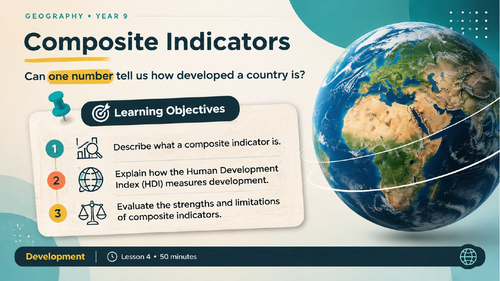
Can one number really tell us how developed a country is?

Challenge students to think critically about how development is measured with this engaging, visually appealing KS3 and Middle School Geography PowerPoint lesson exploring composite development indicators, global inequalities and the Human Development Index (HDI).

Designed for Year 9 (UK), Grades 8–9 (USA) and international schools, this ready-to-teach lesson combines real-world statistics, geographical analysis, interactive discussion and an independent research project.

What’s Included?

  • Engaging starter: Compare two fictional countries with contrasting income, life expectancy and education statistics. Which is more developed?
  • Understanding composite indicators: Discover why geographers combine several measures to assess development.
  • Human Development Index (HDI): Explore how health, education and income contribute to measuring development.
  • Real-world HDI comparisons: Analyse published 2023 HDI data for Iceland, Norway and Switzerland.
  • Inequality-adjusted HDI (IHDI): Investigate how national averages can conceal differences in opportunity and living standards.
  • Evaluating HDI: Sort and justify the strengths and limitations of this widely used development indicator.
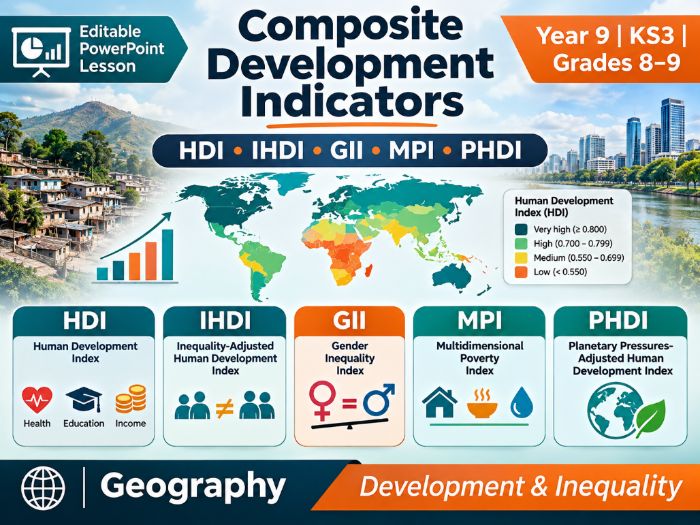
  • Beyond HDI: Introduce four important UNDP composite indices:
  • IHDI – Inequality-adjusted Human Development Index
  • GII – Gender Inequality Index
  • MPI – Multidimensional Poverty Index
  • PHDI – Planetary pressures-adjusted Human Development Index
  • Final Data Detective Project: Students independently investigate two composite indices, examine global distribution patterns using maps, explain how each index measures development and evaluate their usefulness.
  • Teacher guidance: Suggested timings, answers and links to UNDP data sources.

Why Teachers Will Love This Resource

This lesson moves beyond memorising definitions, encouraging students to interpret geographical data, identify global patterns, question national averages and evaluate the reliability of development measurements.

Activities are structured to promote discussion, analytical thinking and independent geographical enquiry, with extension opportunities for higher-attaining students.

Ideal For

UK KS3 Geography – Year 9

US Middle School Geography – Grades 8–9

International Geography programmes

Global Development and Inequality units

Introducing skills needed for IGCSE/GCSE Geography

Resource format: Editable PowerPoint presentation

Lesson duration: Approximately 50 minutes, with a research activity that can be extended into homework.

Data: Includes published UNDP Human Development Report 2025 statistics (2023 observations) and links to further research.

A valuable follow-up to an introductory What Is Development? lesson, helping students develop a deeper understanding of how geographers measure and evaluate global development.

Get this resource as part of a bundle and save up to 29%

A bundle is a package of resources grouped together to teach a particular topic, or a series of lessons, in one place.

Bundle

Global Development & Inequality -7 Lesson Geography Bundle - KS3 & Middle School

A complete Geography unit exploring global development, inequality and sustainability – with six engaging lessons and a film-inspired assessment project. Help students understand why some people and places experience greater opportunities than others with this comprehensive, fully editable KS3 / Middle School Geography bundle. Designed for Year 9 (UK), Grades 8–9 (USA) and international schools, this collection combines geographical enquiry, real-world statistics, interactive activities, map skills, critical thinking and independent research. The six PowerPoint lessons build students' understanding of development, from measuring quality of life to examining poverty, gender inequality, international aid and the Sustainable Development Goals (SDGs). A creative project inspired by The Boy Who Harnessed the Wind provides an opportunity to apply and assess their learning. What's Included? 7 Resources 1. What Is Development? Explore economic, social, political and sustainable development. Introduces GDP, HDI, the Gini coefficient, World Bank income classifications, the Brandt Line and Gapminder Dollar Street. 2. Composite Development Indicators Investigate HDI, IHDI, GII, MPI and PHDI. Students analyse development data, evaluate the limitations of national averages and complete an independent geographical research task. 3. Poverty & Inequality Examine absolute and relative poverty, regional inequalities in the UK, differences within London, causes of poverty and the poverty trap. Includes mapping, data analysis and decision-making activities. 4. Gender Equality & Development Explore SDG 5, education, employment, empowerment and global gender gaps using World Economic Forum statistics, videos, geographical comparisons and a development-budget challenge. 5. Aid & Development Investigate bilateral, multilateral, humanitarian and development aid, NGOs, grants, loans and debt relief. Includes classification activities, evaluation tasks and an extensive NGO research investigation. 6. Sustainable Development Goals Introduce the 17 SDGs, global cooperation and interconnected development challenges. Includes the collaborative Circle of Viewpoints activity and stakeholder research. 7. The Boy Who Harnessed the Wind – Assessment Project A film-inspired creative writing project exploring life in Malawi. Students write diary entries or letters examining poverty, education, gender inequality, food security and renewable energy. Includes a detailed five-criteria assessment rubric. Why Choose This Bundle? * Fully editable PowerPoint resources * Engaging starters, discussions and plenaries * Real-world data and geographical case studies * Map interpretation and analytical skills * Collaborative decision-making and research * Critical thinking and evaluation activities * Differentiation and extension opportunities * Independent assessment project with marking rubric Suitable For UK: KS3 Geography, Year 9; preparation for GCSE/IGCSE. USA: Middle School / World Geography, Grades 8–9. International: Geography and Global Perspectives programmes. An excellent way to teach development as more than economic wealth, helping students understand global inequalities, quality of life, sustainable development and the opportunities for creating a fairer future.

£10.00

Reviews

Something went wrong, please try again later.

This resource hasn't been reviewed yet

To ensure quality for our reviews, only customers who have purchased this resource can review it

Report this resourceto let us know if it violates our terms and conditions.
Our customer service team will review your report and will be in touch.