

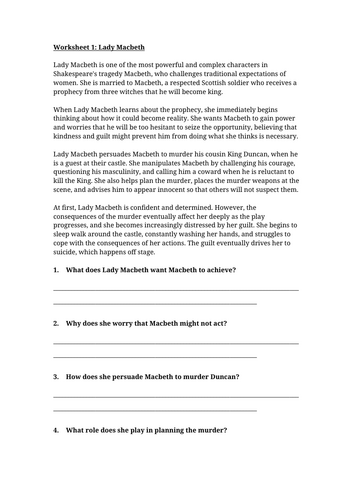

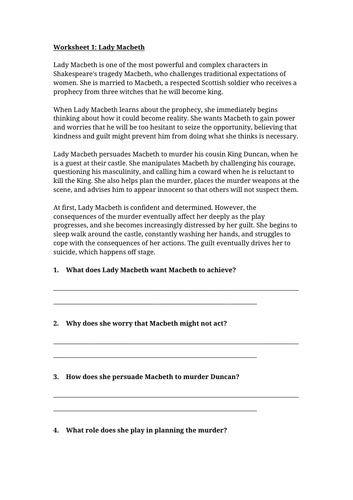
A 2 page worksheet on Lady Macbeth from Macbeth, where pupils are given a description of Lady Macbeth and must answer 8 questions. Writing space included.
Get this resource as part of a bundle and save up to 44%
A bundle is a package of resources grouped together to teach a particular topic, or a series of lessons, in one place.
Bundle
Macbeth and Lady Macbeth Worksheets
This bundle includes 11 worksheets (28 pages) to help pupils explore Shakespearean villains, with a focus on Macbeth and Lady Macbeth. Pupils develop their understanding of characterisation, ambition, fate, gender, power, deception and morality. Each worksheet includes questions and writing space for pupils to record their ideas and develop their analytical skills. **Students develop their ability to:** Explore Shakespeare’s presentation of villains Develop their understanding of Shakespeare’s Macbeth Explore Macbeth and Lady Macbeth’s characters, behaviour and motivations Analyse Shakespeare’s presentation of both characters as villains Explore ambition, fate, gender, power and responsibility Consider how ambition influences characters’ decisions Explore the relationship between ambition and morality Analyse Shakespeare’s use of language and dramatic methods Analyse quotations and explain their effects Use textual evidence to support their interpretations Consider what makes a character dangerous and why people behave cruelly Evaluate whether understanding someone’s motives makes their actions any less wrong Develop analytical responses about Shakespeare’s characters and themes Build confidence when writing about Shakespeare **What’s Included?** Introduction to Villains: Activities exploring what makes a villain, their motivations, key terminology and questions about villainous behaviour. Shakespeare and Villainy: Questions exploring Shakespeare’s presentation of villains, what makes a character dangerous, why people behave cruelly and whether understanding someone’s motives makes their actions any less wrong. Macbeth Character Worksheet: A description of Macbeth followed by seven questions exploring his character and behaviour. Macbeth Quotation Analysis: A 4 page worksheet featuring three quotations spoken by Macbeth, questions on language analysis, a final question on Macbeth’s character and a model paragraph with missing words for pupils to complete. Ambition in Macbeth: Information about ambition in the play, followed by five questions to develop pupils’ understanding. Ambition or Fate?: Four statements for pupils to consider and evaluate whether ambition or fate is responsible for Macbeth’s actions. Macbeth’s Decisions: Seven actions Macbeth takes throughout the play, with questions asking pupils to explain what each action reveals about his character. Lady Macbeth Character Worksheet: A description of Lady Macbeth followed by 8 questions exploring her character and behaviour. Lady Macbeth Language Analysis: A 4 page worksheet featuring three quotations spoken by Lady Macbeth, questions on language analysis, a final question on Lady Macbeth’s character and a model paragraph with missing words for pupils to complete. Gender and Power in Macbeth: Information about gender and power in the play, followed by 5 questions exploring Shakespeare’s presentation of gender roles and the relationship between gender and power. Lady Macbeth’s Ambition and Morality: Information about Lady Macbeth’s ambition and morality, followed by 7 questions exploring her motivations, actions and attitudes. The worksheets combine reading, comprehension, and language analysis, making them useful for introducing the topic, developing pupils’ understanding or supporting a wider unit on Shakespeare’s villains. They could also be easily combined into a short booklet.
£7.00
Bundle
Lady Macbeth Worksheets
This bundle includes 6 worksheets (18 pages) to help pupils explore Shakespearean villains, with a focus on Lady Macbeth. Pupils develop their understanding of characterisation, gender, ambition and the reasons people behave cruelly. Each worksheet includes questions and writing space for pupils to record their ideas and develop their analytical skills. **Students develop their ability to:** Explore Shakespeare’s presentation of villains Develop their understanding of Shakespeare’s Macbeth Explore Lady Macbeth’s character, behaviour and motivations Analyse Shakespeare’s presentation of Lady Macbeth as a villain Explore ambition, fate, power and responsibility Consider how ambition, gender and power influences Lady Macbeth Analyse Shakespeare’s use of language Analyse quotations and explain their effects Use textual evidence to support their interpretations Develop analytical responses about Shakespeare’s characters and themes Build confidence when writing about Shakespeare **What’s Included?** Introduction to Villains: Activities exploring what makes a villain, their motivations, key terminology and questions about villainous behaviour. Shakespeare and Villainy: Questions exploring Shakespeare’s presentation of villains, what makes a character dangerous, why people behave cruelly and whether understanding someone’s motives makes their actions any less wrong. Lady Macbeth Character Worksheet: A description of LAdy Macbeth followed by 8 questions exploring his character and behaviour. Gender and Power in Macbeth: Information about gender and power in the play, followed by 5 questions exploring Shakespeare’s presentation of gender roles and the relationship between gender and power. Lady Macbeth’s Ambition and Morality: Information about Lady Macbeth’s ambition and morality, followed by 7 questions exploring her motivations, actions and attitudes. Lady Macbeth Language Analysis: A 4 page worksheet featuring three quotations spoken by Lady Macbeth, questions on language analysis, a final question on Lady Macbeth’s character and a model paragraph with missing words for pupils to complete. The worksheets combine reading, comprehension, and language analysis, making them useful for introducing the topic, developing pupils’ understanding or supporting a wider unit on Shakespeare’s villains. They could also be easily combined into a short booklet.
£4.00
Something went wrong, please try again later.
This resource hasn't been reviewed yet
To ensure quality for our reviews, only customers who have purchased this resource can review it
Report this resourceto let us know if it violates our terms and conditions.
Our customer service team will review your report and will be in touch.
£1.00