pptx, 959.54 KB
pptx, 959.54 KB
PNG, 410.12 KB
PNG, 410.12 KB
PNG, 247.35 KB
PNG, 247.35 KB

Edexcel Superpower Relations and the Cold War, 1941-91

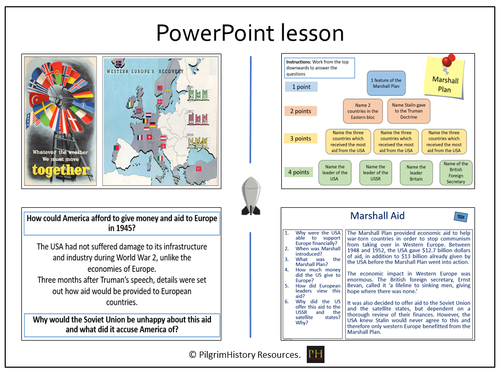
This lesson focuses on the financial aid given to Western Europe as part of the Marshall Plan.

Students have to evaluate how significant Marshall AId was in relation to the Truman Doctrine and how Stalin reacted this ‘dollar imperialism’.

There are differentiated questions which explore why this aid was also offered to Eastern bloc countries, how America was able to offer such huge sums and who received a majority of the Marshall Aid.

There is some text to therefore analyse and use to make inferences on Superpower relations and Cold War tensions.

The plenary asks students a series of questions which recap the lesson and consolidate their learning from previous ones.

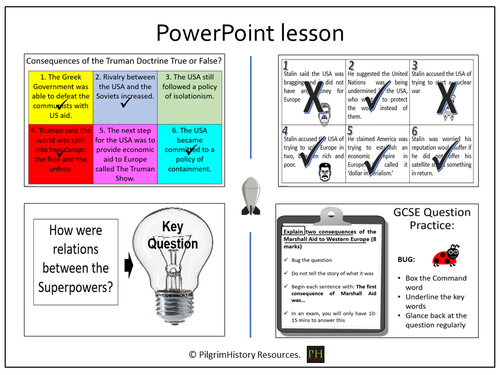
There is some GCSE exam question practice to complete, with tips on how to answer the consequences question, with a model answer given if required.

The lesson is enquiry based with a key question using a lightbulb posed at the start of the lesson and revisited throughout this and subsequent lessons to show the progress of learning.

The resource includes retrieval practice, suggested teaching strategies, differentiated materials and GCSE exam practice.

It also comes in PowerPoint format if there is a wish to adapt and change.

Get this resource as part of a bundle and save up to 48%

A bundle is a package of resources grouped together to teach a particular topic, or a series of lessons, in one place.

Bundle

Edexcel GCSE Superpower Relations and the Cold War Lessons and Resource Bundle

This bundle is the first part in a series of lessons created for Edexcel GCSE 9–1 Superpower Relations and the Cold War, 1941–91. It contains fully resourced, differentiated and editable lessons designed to save planning time while helping students develop the knowledge and exam skills needed to achieve the highest grades. The lessons are enquiry based, with a key question running throughout each lesson to encourage students to think critically about how tensions developed between East and West. Students will build their understanding of: * changing relations between the USA and USSR * the causes and consequences of key Cold War events * the impact of ideology, diplomacy, propaganda and conflict * continuity and change across the period Each lesson includes: * retrieval practice * differentiated tasks * source and interpretation activities * GCSE-style exam questions * suggested teaching strategies * editable PowerPoint resources The lessons are designed to work together as a coherent unit, helping students build a clear narrative understanding of the Cold War over time. The lessons are as follows: L1 Origins of the Cold War L2 Conferences of Tehran, Yalta and Potsdam L3 The Kennan and Novikov Telegrams L4 Soviet Satellite States L5 Truman Doctrine L6 Marshall Aid L7 Cominform and Comecon (free resource) L8 Berlin Crisis 1948 L9 NATO and Warsaw Pact L10 Significance of Arms Race (free resource) L11 Hungarian Uprising Further GCSE Assessment materials can be found on the Edexcel Website. A complete set of lessons for this unit can be found here: https://www.tes.com/teaching-resource/resource-13325744

£15.00

Reviews

Something went wrong, please try again later.

This resource hasn't been reviewed yet

To ensure quality for our reviews, only customers who have purchased this resource can review it

Report this resourceto let us know if it violates our terms and conditions.
Our customer service team will review your report and will be in touch.