


Stroop Test
Assess and develop cognitive control, working memory, and mental flexibility with this ready-to-use Stroop Test assessment tool. Designed for classroom intervention, and learning support settings, this resource gives teachers and SENCOs a structured, evidence-based way to observe and measure how students manage competing cognitive demands.
What’s Inside
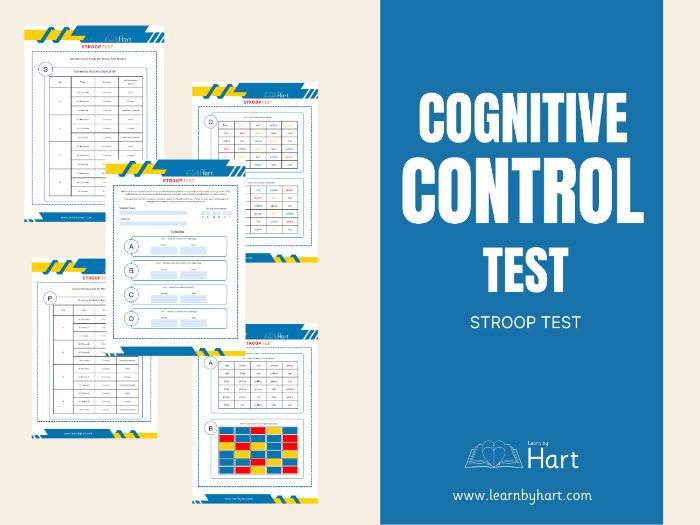
A 5 page PDF containing the following:
-
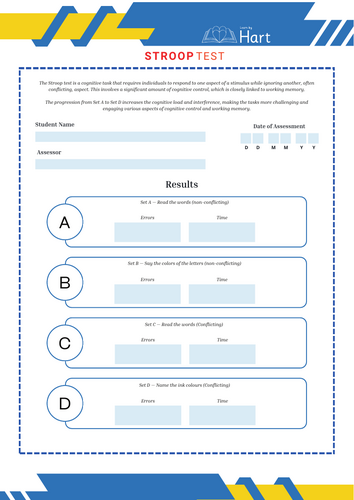
Recording & Results Sheet — A clean, structured sheet for capturing student name, assessor, and date of assessment alongside scores for all four task sets. Each set has dedicated fields for errors and time, making data collection straightforward during live administration.
-
Set A – Read the Words (Non-Conflicting) — Students read colour words printed in plain black text, providing a baseline measure of reading speed and accuracy without any conflicting visual information. This establishes a cognitive baseline before interference is introduced.
-
Set B – Name the Ink Colours (Non-Conflicting) — Students name the colour of plain colour blocks, again without conflicting information. This second baseline task isolates colour-naming speed independently of word reading.
-
Set C – Read the Words (Conflicting) — Students read colour words that are printed in a mismatching ink colour, introducing cognitive interference. This begins to reveal the degree to which automatic word-reading competes with task demands.
-
Set D – Name the Ink Colours (Conflicting) — The most cognitively demanding task, requiring students to name the ink colour of words whose meaning conflicts with that colour. Performance on this set is the core measure of cognitive control and inhibition.
-
Interpretation Guides (Primary & Secondary) — Two age-specific scoring tables provide clear performance benchmarks across all four sets, categorising results as Good, Average, or Needs Improvement based on both time and error count. The Primary guide covers ages 6–11 and the Secondary guide covers ages 12–18.
How to Use
Administer the test individually or in small groups as part of a cognitive assessment, SEN review, or learning support session. Use Sets A and B first to establish baseline performance before moving to the conflicting sets, then apply the appropriate interpretation guide to contextualise results. Individual components can also be used in isolation — for example, Sets C and D alone make an effective focused attention activity during intervention sessions or at the start of a unit on metacognition or self-regulation.
Grade Levels: Primary and Secondary (Ages 6–18)
File Format: PDF (printable and projectable)
**Note: **
This is a digital download only.
Something went wrong, please try again later.
This resource hasn't been reviewed yet
To ensure quality for our reviews, only customers who have purchased this resource can review it
Report this resourceto let us know if it violates our terms and conditions.
Our customer service team will review your report and will be in touch.
£1.49