THE LOVELY BONES - CHAPTER 6 & 7Quick View
KCAssar13

THE LOVELY BONES - CHAPTER 6 & 7

(0)
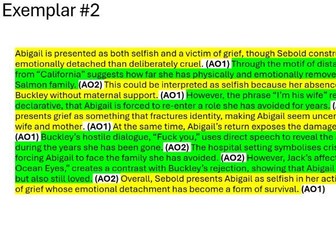
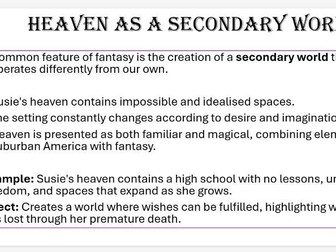
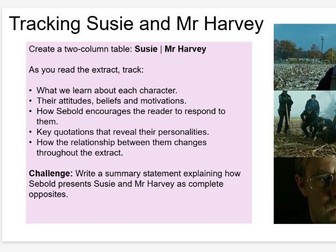
The Lovely Bones: Chapters 6–7 (AQA KS5) This KS5 lesson is designed for AQA A Level English Literature and Language and focuses on Chapters 6 and 7 of The Lovely Bones. The session is deliberately highly student-led and requires pre-reading before the lesson. Short summaries are provided to secure understanding, but recall and engagement with the chapters are expected. Students begin by revisiting key events through guided recall questions. They then explore Ray and Susie’s developing relationship in Chapter 6, analysing how it is presented linguistically. Modelled examples are provided to demonstrate how language shapes tone and perspective. The focus then shifts to the interaction between Jack and Ruana, with teacher-led modelling of how the exchange can be analysed linguistically. Students are given an exam-style question on Jack and Ruana and use the attached planning sheet to structure an essay plan clearly aligned to the Assessment Objectives. The lesson also revisits Buckley, working through a scaffolded extract. Guided questions support close linguistic analysis, with support gradually reduced to encourage independence. Students then attempt a short response to a question focused on Buckley. This resource is suitable for Year 12 or Year 13 students studying The Lovely Bones. It prioritises independent recall, structured planning, and careful linguistic analysis in preparation for AQA assessment.
THE LOVELY BONES - CHAPTER 8 & 9Quick View
KCAssar13

THE LOVELY BONES - CHAPTER 8 & 9

(0)
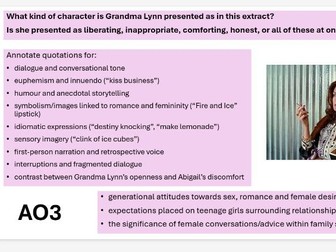
The Lovely Bones: Chapters 8–9 (AQA KS5) This KS5 lesson is designed for AQA A Level English Literature and Language and focuses on Chapters 8 and 9 of The Lovely Bones, with particular emphasis on Chapter 9 and the character of Grandma Lynn. The lesson is student-led and analytical in focus. Students begin with brief recall of Chapters 8 and 9 to re-establish narrative context. The core of the lesson centres on a sustained question about how Sebold presents Grandma Lynn, which runs throughout the session and shapes discussion and annotation. Students work independently to analyse Grandma Lynn linguistically and structurally, exploring voice, description, dialogue, and narrative positioning. They consider how she functions within the family dynamic and how her presence complicates representations of grief. Close textual work is prioritised, with students identifying and explaining patterns before any teacher input. After independent exploration, the teacher provides selected examples to model how analysis can be sharpened and linked clearly to the Assessment Objectives. The lesson concludes with a mock exam-style question, which students plan or begin to answer using their annotations. This resource is suitable for Year 12 or Year 13 and supports confident application of AO1 and AO2 through focused, extract-based analysis and structured exam preparation.
REVISION - STREETCAR & FEMININE GOSPEL GENERALQuick View
KCAssar13

REVISION - STREETCAR & FEMININE GOSPEL GENERAL

(0)
Feminine Gospels & Streetcar: AO Revision (AQA KS5) This KS5 revision lesson is designed for AQA A Level English Literature and focuses on comparative preparation for Feminine Gospels and A Streetcar Named Desire. The lesson supports students in applying the Assessment Objectives effectively when comparing poetry and prose. The session revisits AO1–AO4, guiding students through how to interpret a comparative question, structure an argument across genres, integrate context meaningfully, and maintain balance between texts. Students practise mapping AOs onto a question, planning comparative paragraphs, and refining thesis statements to ensure ideas are integrated rather than written as two separate mini-essays. The lesson includes detailed revision tasks that revisit key themes, methods, and contextual factors across both texts, helping students strengthen connections and avoid superficial comparison. Emphasis is placed on close analysis (AO2) and purposeful contextual integration (AO3), with structured opportunities for timed planning or paragraph writing. This resource is suitable for Year 13 students preparing for AQA examinations. It prioritises clarity, confidence with the Assessment Objectives, and secure comparative writing across poetry and drama.
REVISION - HANDMAID'S TALE GENERALQuick View
KCAssar13

REVISION - HANDMAID'S TALE GENERAL

(0)
The Handmaid’s Tale: AO Revision (AQA KS5) This KS5 revision lesson is designed for AQA A Level English Literature and focuses on applying the Assessment Objectives effectively to exam questions on The Handmaid’s Tale. It is intended as structured revision rather than new content teaching. The lesson revisits AO1–AO5, guiding students through how to interpret questions, shape arguments, integrate context, and apply critical perspectives with control. Students practise breaking down a question, mapping AOs onto their response, and evaluating how to balance analysis, context, and interpretation in a coherent essay. The resource also includes a comprehensive revision booklet outlining practical revision strategies grounded in cognitive research. This covers approaches such as retrieval practice, spaced learning, interleaving, and effective essay planning, helping students revise in a structured and sustainable way rather than relying on passive re-reading. This resource is suitable for Year 13 students preparing for AQA examinations. It supports exam confidence, independent revision, and purposeful application of the Assessment Objectives.
PARIS ANTHOLOGY - NANCY MILLERQuick View
KCAssar13

PARIS ANTHOLOGY - NANCY MILLER

(0)
Paris Anthology: Breathless (AQA KS5) This KS5 lesson is designed for AQA A Level English Literature and Language (Paris Anthology) and focuses on Breathless: An American Girl in Paris by Nancy Miller. The lesson supports students in developing independent comparative skills and exam confidence. The lesson is student-focused and task-driven. Students begin by reading the text and applying GRAMPS to establish genre, register, audience, mode, purpose, and structure. They then create their own individual Paris-style mock comparison questions (teacher checked before moving forward), encouraging ownership of exam thinking. Students annotate Breathless with a focus on representation and language levels, before selecting a second text to compare. They are reminded to work with a clear extract rather than an entire text. The lesson concludes with students planning and writing a comparative response to their chosen question. This resource is suitable for Year 12 or Year 13 students preparing for AQA Paper 1. It prioritises independent thinking, careful text selection, and exam-style writing practice.
REVISION - PARIS ANTHOLOGY GENERALQuick View
KCAssar13

REVISION - PARIS ANTHOLOGY GENERAL

(0)
Paris Anthology: AO Revision (AQA KS5) This KS5 revision lesson is designed for AQA A Level English Literature and Language (Paris Anthology) and focuses on strengthening students’ application of the Assessment Objectives in comparative exam responses. The lesson revisits AO1–AO4, guiding students through how to interpret a Paris-style question, construct a comparative thesis, and integrate analysis across texts rather than treating them separately. Students practise mapping AOs onto a question, refining introductions, and planning comparative paragraphs with clear conceptual links. Emphasis is placed on purposeful language analysis (AO2), secure contextual understanding through GRAMPS (AO3), and consistent comparison (AO4). The resource also includes a comprehensive revision booklet outlining effective revision strategies grounded in cognitive research. This supports students in using retrieval practice, spaced revision, interleaving texts, and structured planning methods to revise efficiently and independently, rather than relying on passive re-reading. This resource is suitable for Year 13 students preparing for AQA examinations. It supports confident AO application, sharper comparative writing, and structured, research-informed revision habits.
REVISION METHODS - ENGLISHQuick View
KCAssar13

REVISION METHODS - ENGLISH

(0)
A Level English Revision Guide (AQA KS5) This resource is a structured revision booklet designed for AQA A Level English Literature and English Literature & Language. Two versions are provided: one tailored to Literature, and one to Literature and Language, with minor adjustments to reflect the different Assessment Objectives and exam structures. The booklet focuses on the general application of effective revision methods, rather than text-specific content. It supports students in understanding how to revise strategically for A Level English, including how to apply AOs consistently, plan comparative essays, organise quotations, and refine written expression under timed conditions. Revision approaches are grounded in established cognitive research, promoting strategies such as retrieval practice, spaced revision, interleaving texts, active recall, and structured essay planning. Students are encouraged to move beyond passive re-reading and instead practise the skills required in the exam: argument construction, close analysis, and integrated comparison. This resource is suitable for Year 12 or Year 13 students preparing for internal assessments or final examinations. It is designed to build independent, sustainable revision habits and improve confidence in applying the Assessment Objectives across both qualifications.
THE LOVELY BONES - CHAPTER 5Quick View
KCAssar13

THE LOVELY BONES - CHAPTER 5

(0)
The Lovely Bones: Chapter 5 (AQA KS5) This KS5 lesson is designed for AQA A Level English Literature and Language and focuses on Chapter 5 of The Lovely Bones. The lesson centres on characterisation and shifting perspectives, with attention to Lindsey, Jack Salmon, Len Fenerman, Buckley, and Samuel. The lesson is student-led and task-based. Students complete focused analytical tasks on Lindsey and Jack, considering how grief shapes their behaviour and narrative presence. They then examine the significance of Len and analyse his interactions with both Harvey and Jack, exploring how authority and suspicion are presented. Further tasks address Buckley’s role in the Monopoly scene, encouraging students to consider innocence, normality, and disruption within the family. The lesson concludes with work on Lindsey and Samuel, leading to an exam-style question on Lindsey using an extract from the chapter. This resource supports close analysis (AO2), clear argument (AO1), and understanding of perspective and character development. It is suitable for Year 12 or Year 13 and prioritises independent annotation and discussion rather than teacher exposition.
PARIS ANTHOLOGY - DEM BONES & MILE BY MILEQuick View
KCAssar13

PARIS ANTHOLOGY - DEM BONES & MILE BY MILE

(0)
Paris Anthology: Place & Voice (AQA KS5) This KS5 lesson is designed for AQA A Level English Literature and Language (Paris Anthology) and focuses on the representation of place in ‘Dem Bones’ and ‘Mile by Mile’. The lesson supports students in comparing how writers present Paris through movement, perspective, and personal experience, and is intended to build confidence with integrated analysis rather than treating texts separately. The lesson is student-led and task-driven. Students begin by applying GRAMPS to Dem Bones, with a brief teacher reminder to anchor prior learning, before independently analysing Mile by Mile using the same framework. The emphasis is on students making their own analytical decisions about genre, audience, purpose, and mode, supporting AO3 without over-scaffolding. Students then annotate both texts with a clear focus on representation of place, linking GRAMPS to language levels and meaning. Short examples of annotation are provided to support expectations, but the majority of the work is independent. Comparison is encouraged throughout, rather than added on at the end, supporting AO2 and AO4. The lesson finishes with a Paris-style comparative question on place. Depending on time and cohort, students can either plan or write a response using their annotations. This resource is suitable for Year 12 or Year 13 students studying the Paris Anthology. It is not a content-heavy PowerPoint and is designed to prioritise independent reading, annotation, and exam-focused comparison.
THE LOVELY BONES - CHAPTER 4Quick View
KCAssar13

THE LOVELY BONES - CHAPTER 4

(0)
The Lovely Bones: Chapter 4 (AQA KS5) This lesson is designed for AQA A Level English Literature and Language and focuses on Chapter 4 of The Lovely Bones. The lesson builds on prior reading and requires students to have read the chapter in advance. Its focus is on Harvey, the bracelet, and how meaning is constructed through detail, perspective, and symbolism. The lesson is student-led and task-driven. Students begin by recapping Chapter 4 through a short summary task, consolidating understanding of events and narrative focus before analysis. This ensures students are working from a secure knowledge base rather than re-reading large sections of the text in lesson time. Students then focus on Harvey as a figure within the chapter, exploring how Sebold presents him through narrative perspective and selective detail. Alongside this, students examine the bracelet and track its significance, considering how it functions symbolically and structurally within the chapter. Discussion of the bracelet’s importance is completed collaboratively after students have worked independently, allowing ideas to be tested and refined. A substantial proportion of the lesson is dedicated to independent annotation. Students annotate the chapter with a focus on language, structure, and representation, linking their observations directly to meaning rather than technique identification. Short exemplar annotations are provided to support accuracy and depth, but these are not intended to replace student thinking. The resource also includes an optional annotated document, produced through live modelling with a class. This can be used at the teacher’s discretion to demonstrate effective annotation or to support students who require additional guidance, but it is not essential to the lesson’s core tasks. This resource is suitable for Year 12 or Year 13 students studying The Lovely Bones for AQA English Literature and Language. It is not a content-heavy PowerPoint and is designed to prioritise independent analysis, discussion, and exam-relevant annotation skills.
THE LOVELY BONES - CHAPTER 3Quick View
KCAssar13

THE LOVELY BONES - CHAPTER 3

(0)
The Lovely Bones: Chapter 3 (AQA KS5) This lesson is designed for AQA A Level English Literature and Language and focuses on Chapter 3 of The Lovely Bones. The lesson develops students’ understanding of narrative voice, grief, memory, and the relationship between the living and the dead, with a clear emphasis on close textual analysis rather than narrative recall. The lesson is student-led and task-focused. Students begin with a short retrieval activity to re-establish the key strands of the chapter, including Susie’s observations from heaven, the role of Ruth, and the differing responses to grief within Susie’s family. This ensures a secure understanding of the chapter before analysis begins. Students then explore narrative perspective and voice, considering Susie as a limited but privileged narrator. Guided questions support students in identifying what Susie can and cannot access, where her voice appears emotionally controlled or more expressive, and why Sebold may choose a narrator who is emotionally involved but physically detached. This work supports AO1 by developing clear, conceptual understanding of narrative method. Language analysis focuses on how meaning is shaped without graphic description. Students identify and explain examples of imagery, observation, and metaphor that soften trauma and create a reflective tone, linking language choices directly to the representation of grief. This supports AO2 and discourages feature-spotting in favour of purposeful analysis. The lesson also addresses structure, with students identifying shifts in focus across the chapter and considering how these shifts reflect emotional disruption and fragmented experiences of grief. A comparative task then asks students to consider how grief is represented across different characters, reinforcing the idea that grief is uneven and varied. The lesson concludes with a short exam-style analytical paragraph, requiring students to respond to a focused question using minimal quotation and clear analysis. Plot retelling is explicitly avoided. This resource is suitable for Year 12 or Year 13 and is intended for classes developing confidence with analytical writing for AQA English Literature and Language. It is not a content-heavy PowerPoint; independent thinking and structured tasks are central by design.
PARIS ANTHOLOGY - inside Out & Bill BrysonQuick View
KCAssar13

PARIS ANTHOLOGY - inside Out & Bill Bryson

(0)
Paris Anthology: Places & Representation (AQA) This KS5 lesson is designed for AQA A Level English Literature and Language (Paris Anthology) and focuses on the representation of place through Inside Out: Kids (Paris) and Bill Bryson’s Neither Here Nor There. The lesson is intended to follow a previous Bryson-focused lesson (also attached to this TES profile), and builds directly on that groundwork by moving students into integrated comparison, with a specific emphasis on places in Paris, particularly the Pompidou Centre. The lesson is deliberately student-focused and task-driven. Students are reminded of GRAMPS in relation to Bryson to reactivate prior learning, before independently applying GRAMPS to the Inside Out: Kids text. Rather than re-teaching content, the lesson assumes familiarity with Bryson and prioritises analytical independence. A short GRAMPS recap is provided by the teacher for Bryson, while students are expected to construct their own GRAMPS framework for Inside Out: Kids, reinforcing AO3 understanding of genre, audience, and purpose. Students then move into comparative analytical writing at paragraph level by producing a GRAMPS-style introduction, modelling how contextual and structural awareness can be embedded at the start of an exam response. While an exemplar student introduction may be shown in class to support modelling, this is not included within the resource itself, allowing you to adapt this to you cohort. Students subsequently annotate both texts with a focus on representation of place, drawing connections between GRAMPS, language levels, and meaning-making. Exemplars of effective annotation are provided within the resource (slide-based), with flexibility for teachers to decide whether these are shared before or after students annotate independently. Language analysis is integrated rather than isolated, with students encouraged to link language choices to the writers’ differing representations of Parisian places. This supports AO2 and AO4 by ensuring that analysis remains comparative and conceptually driven rather than feature-led. The lesson concludes with a Paris-style comparative question focused on places across both texts. Students are given time to either plan or write a response, depending on lesson timing and cohort needs. This resource is best suited to Year 12 or Year 13 students studying the Paris Anthology who are developing confidence with comparative non-fiction analysis. It is not a content-heavy PowerPoint and is intentionally structured around independent reading, annotation, and analytical decision-making. The lesson supports exam preparation while strengthening transferable skills in comparison, representation, and integrated language analysis.
PARIS ANTHOLOGY - Trip Advisor & 18 Months LaterQuick View
KCAssar13

PARIS ANTHOLOGY - Trip Advisor & 18 Months Later

(0)
Paris Anthology: Representation of Paris (AQA) This KS5 lesson is designed for AQA A Level English Literature and Language (Paris Anthology) and focuses on comparative analysis of representation through a TripAdvisor comment and the blog ‘18 Months Later’. The lesson foregrounds how ideas about visiting Paris are constructed through language choices, rather than content recall, and prepares students for the integrated comparison required by the AQA specification. The lesson follows a task-driven, student-led approach. Students begin by reading the TripAdvisor text independently and recording initial impressions, before applying GRAMPS (Genre, Register, Audience, Mode, Purpose, Structure/Subject Matter) to establish contextual and communicative positioning. GRAMPS guidance and exemplification are provided by the teacher to support accuracy and consistency, but interpretation is intentionally student-generated. Students then complete a structured language analysis task with a clear focus on representation of Paris. They locate and annotate features across language levels, including graphology, lexis and semantics, grammar, phonology/prosodics, and discourse. The teacher supplies exemplar features and modelling for each level rather than enforcing fixed quotas, allowing flexibility while still supporting AO1 and AO2 development. The emphasis is on purposeful selection and analytical commentary rather than feature-spotting. The second text, 18 Months Later, is introduced through a comparative lens. Students apply GRAMPS again in bullet-point form, supported by teacher-provided prompts, enabling them to identify contrasts in voice, perspective, and representation. Ideas are integrated across both texts rather than treated separately, reinforcing comparative thinking and supporting AO4. The lesson culminates in exam-focused application. Students are given a Paris-style comparative question — “Compare and contrast how the writers of these texts express their ideas about visiting Paris” — and use their annotations to plan and, where appropriate, write a comparative response. This stage consolidates AO1 (coherent argument), AO2 (language analysis), AO3 (context through mode, audience, and purpose), and AO4 (connections between texts). It is not overly content-heavy PowerPoint; independent reading, annotation, and analytical decision-making are central by design. The lesson supports exam preparation while building transferable skills in linguistic analysis and comparative writing.
PARIS ANTHOLOGY - MILE BY MILEQuick View
KCAssar13

PARIS ANTHOLOGY - MILE BY MILE

(0)
Mile by Mile – AQA English Language & Literature (Paris Anthology) This lesson is designed for AQA A Level English Language and Literature, focusing on the Paris Anthology text Mile by Mile. It introduces students to GRAMPS, models detailed linguistic analysis, and supports the development of strong, exam-style analytical paragraphs. What’s included: Introduction to GRAMPS (Genre, Register, Audience, Mode, Purpose, Structure) – helping students understand how Mile by Mile fits within the broader conventions of travel writing and historical documentation. Linguistic breakdown of a short extract – covering key language levels (lexis, grammar, semantics, pragmatics, discourse) to build AO1 precision and confidence. Focus on representation and purpose – guiding students in analysing how Paris is constructed through descriptive, factual, and historically grounded language. Guided annotation tasks – helping students track narrative voice, perspective, and structural choices. This resource supports students in developing a secure linguistic method, ensuring they understand both how to analyse Mile by Mile and how to transfer these skills to the wider anthology.
LOVE THROUGH THE AGES - UNSEEN POETRY PAINQuick View
KCAssar13

LOVE THROUGH THE AGES - UNSEEN POETRY PAIN

(0)
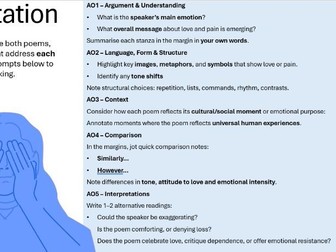
This lesson is designed for AQA A Level English Literature and focuses on responding to two unseen poems on the theme of pain and love. The lesson supports students in developing a confident, exam-ready approach to unseen poetry by addressing all assessment objectives (AO1–AO5) through structured planning and comparison. Students work collaboratively to read and annotate both poems, identifying key ideas, emotions, and patterns of meaning linked to pain and love. The lesson encourages students to explore how love is intertwined with suffering, considering emotional intensity, conflict, and vulnerability while forming an initial comparative argument. Close analysis of language, form, and structure is central to the lesson, with students guided to examine imagery, symbolism, sound patterns, and structural choices. Attention is given to how these methods shape emotional impact and meaning, directly supporting AO2. Context is addressed in a flexible way appropriate for unseen poetry, with students encouraged to consider possible contextual influences such as attitudes to relationships, desire, emotional restraint, or loss, while avoiding biographical speculation. This supports AO3 in a controlled and relevant manner. Comparative skills are developed as students plan paragraphs that integrate both poems throughout, focusing on similarities and differences in how pain and love are presented. Students are supported in making conceptual links between the texts rather than treating them separately, meeting AO4 expectations. The lesson also encourages evaluative and exploratory responses by prompting students to consider alternative interpretations of love and pain, ambiguity in tone or voice, and the effectiveness of poetic choices. This supports AO5 and helps students develop confident, critical responses. This resource is ideal for preparing students for the unseen poetry component, helping them practise close reading, comparison, and planning under exam-style conditions while building confidence across all assessment objectives.
LOVE THROUGH THE AGES - The Flea & To His Coy MistressQuick View
KCAssar13

LOVE THROUGH THE AGES - The Flea & To His Coy Mistress

(0)
This lesson is designed for AQA A Level English Literature, Love Through the Ages, and focuses on planning a comparative essay on John Donne’s The Flea and Andrew Marvell’s To His Coy Mistress. The lesson centres on collaborative planning and developing confident, comparative argumentation in preparation for exam writing. Students work in pairs to plan a full comparative essay, using guided prompts to shape a coherent line of argument across both poems. The focus is on comparing how love, persuasion, time, and power are presented, with attention to poetic methods and form. Students are encouraged to move beyond feature spotting and instead develop conceptual links between the texts. The resource supports students in constructing comparative paragraphs that integrate both poems throughout, rather than treating them separately. Emphasis is placed on embedding quotations, linking ideas clearly, and maintaining a comparative voice across each paragraph. Contextual understanding is incorporated through consideration of metaphysical poetry, carpe diem traditions, and early modern attitudes towards love, gender, and sexuality. Students are guided to connect contextual insight naturally to analysis, in line with AO3 expectations. Assessment objectives are explicitly supported, with a particular focus on AO1 (clear argument and expression), AO2 (analysis of language, form, and structure), AO3 (context), and AO4 (connections across texts). Sentence starters and planning scaffolds are provided to support all ability levels. This resource is ideal for consolidating understanding before an assessed essay or exam response, helping students practise planning effectively, articulating comparisons, and preparing to write with confidence under timed conditions.
LOVE THROUGH THE AGES - UNSEEN POETRY GRIEFQuick View
KCAssar13

LOVE THROUGH THE AGES - UNSEEN POETRY GRIEF

(0)
This lesson is designed for AQA A Level English Literature and focuses on responding to two unseen poems on the theme of grief. The lesson supports students in developing a confident, exam-ready approach to unseen poetry by addressing all assessment objectives (AO1–AO5) through structured planning and comparison. Students work collaboratively to read and annotate both poems, identifying key ideas, emotions, and patterns of meaning linked to grief. The lesson encourages students to explore how grief is presented differently across the two texts, considering tone, voice, and perspective, while forming an initial comparative argument. Close analysis of language, form, and structure is central to the lesson, with students guided to examine imagery, symbolism, sound patterns, and structural choices. Attention is given to how these methods shape emotional impact and meaning, directly supporting AO2. Context is addressed in a flexible way appropriate for unseen poetry, with students encouraged to consider possible contextual influences such as attitudes to loss, relationships, spirituality, or the speaker’s situation, while avoiding biographical speculation. This supports AO3 in a controlled and relevant manner. Comparative skills are developed as students plan paragraphs that integrate both poems throughout, focusing on similarities and differences in the presentation of grief. Students are supported in making conceptual links between the texts rather than treating them separately, meeting AO4 expectations. The lesson also introduces students to different possible interpretations of grief, encouraging evaluative and exploratory responses. Students are prompted to consider ambiguity, alternative readings, and the effectiveness of poetic choices, supporting AO5. This resource is ideal for preparing students for the unseen poetry component, helping them practise close reading, comparison, and planning under exam-style conditions while building confidence across all assessment objectives.
Paris Anthology - City Guide & Zara's Personal NarrativeQuick View
KCAssar13

Paris Anthology - City Guide & Zara's Personal Narrative

(0)
Paris City Guide & Zara Narrative – AQA English Language & Literature (Paris Anthology) This lesson is designed for AQA A Level English Language and Literature, focusing on two Paris Anthology transcript texts: the Paris City Guide transcript and Zara’s Narrative transcript. The lesson is highly interactive and student-led, encouraging independent analysis, collaboration, and exam-style question creation. What’s included: Expert group task – students become “experts” on either the Paris City Guide transcript or Zara’s Narrative transcript, using a directional resource to guide focused linguistic analysis. Linguistic and structural analysis – students examine key language levels (lexis, grammar, discourse, pragmatics) and spoken language features such as interaction, audience address, and purpose. GRAMPS application – learners apply Genre, Register, Audience, Mode, Purpose, and Structure to their allocated text, linking form and function to representation. Paired knowledge exchange – students work in pairs to teach their findings to a partner who has studied the other transcript, reinforcing understanding through explanation and comparison. Exam-style question creation – students design their own Paris Anthology-style question based on the two transcripts, developing insight into assessment demands. Question swap and response – questions are exchanged within the class and students write a response to the question they receive, practising exam technique and adaptability. This resource supports AO1–AO4, developing confident linguistic analysis, comparative thinking, and strong awareness of exam expectations. Ideal for consolidating understanding of transcript texts while promoting independence and active learning.
Love Through The Ages: Great Gatsby CHAPTER 7Quick View
KCAssar13

Love Through The Ages: Great Gatsby CHAPTER 7

(1)
A-Level AQA (Love Through The Ages) resource. Looking at Chapter 7 of The Great Gatsby and relating to Pre-1900 poetry. Relevant context, relevant informtion and clear to use. A 13 slide power point Looks at Gatsby, Daisy, Tom, Myrtle Looks at Tom and Gatsby as a contrast, includes critical quotations when looking at Gatsby and Myrtle - scaffolded too. Tasks that gets student analysing and comparing,. A comparative question from a pre-1900 poem. (poem not included)
Love Through The Ages: Great Gatsby CHAPTER 9Quick View
KCAssar13

Love Through The Ages: Great Gatsby CHAPTER 9

(1)
A-Level AQA (Love Through The Ages) resource. Looking at Chapter 8 of The Great Gatsby and relating to Pre-1900 poetry. Relevant context, relevant informtion and clear to use. A 20 slide power point Looks at Nick, Daisy (or lackthereof), Wolfsheim, Mr Gatz, Klipspringer, Owl Eyes, Jordan and Nick, and Tom Looks at Nick’s loyalty, Daisy’s disappearance, Wolfsheim’s behaviour, Mr Gatz’ naivety, the American Dream, Klipspringer as a representative of 1920s Jazz Age, Owl Eyes and his sympathy, Jordan and Nick’s final words, Tom and the run in, and the last passage. Includes a couple critical comments too. A comparative question from a pre-1900 poem. (poem not included)
Love Through The Ages: Great Gatsby CHAPTER 6Quick View
KCAssar13

Love Through The Ages: Great Gatsby CHAPTER 6

(1)
A-Level AQA (Love Through The Ages) resource. Looking at Chapter 6 of The Great Gatsby and relating to Pre-1900 poetry. Relevant context, relevant informtion and clear to use. A 9 slide power point Looks at Gatsby, Daisy, Tom Looks at obsession with the past, the difference between East and West egg and masculinity A comparative question from a pre-1900 poem. (poem not included)