 Quick View
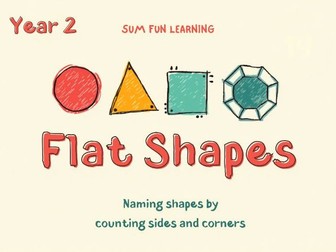
Year 2 Flat Shapes
This chapter covers three related skills: counting the sides and corners of a flat shape so the shape names itself, telling a square from an oblong, and finding a line of symmetry by picturing the fold. Six shapes are named and described: circle, triangle, square, oblong, pentagon and hexagon. Pupils are taught to mark a starting side before counting so they do not go round the shape twice, and to check by counting the corners, since sides and corners always come in matching numbers.
The central idea is that a triangle does not have to point upwards. Most Year 2 children learn the shape from a single picture and reject any triangle that is turned or has sides of different lengths, so this is taught head on rather than assumed. Pupils are also shown the number of lines of symmetry in a square, an oblong, a triangle and a circle, and told that having no line of symmetry is a perfectly normal answer.
Includes a worked explanation, a tips page, common misconceptions addressed directly (thinking a triangle must point up, calling every four-sided shape a square, counting the same side twice, drawing a diagonal line of symmetry on an oblong), and 30 questions across three sections: warm up, getting stronger and challenge, moving from naming shapes to worded reasoning problems.
Answers included, with a star chart for pupils to track progress and a confidence check-in at the end. A short note for the adult explains why the turned triangle question is the one worth testing at home.
Written by a qualified teacher with over ten years’ classroom experience, aligned to the UK National Curriculum for Year 2 geometry, properties of shapes (ages 6 to 7).
Supplied as a printable PDF. Suitable for whole-class teaching, small-group intervention, tutoring or home learning.