 Quick View
TIME GLITCH! SEN History | Back After Half-Term
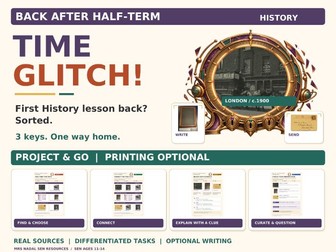
First History lesson back after half-term? Open, project and take your SEN class on a time-travel adventure with real sources and four differentiated starting points.
Three missions. One way home.
TIME GLITCH! invites pupils to imagine arriving in London around 1900. Three everyday missions - travel, write and send a message - build historical vocabulary, comparisons and source-based reasoning. Pupils choose objects, show clues and discover how they were used. A shared return to today explores what changed and what stayed the same.
Four self-contained A4 level sheets
Level 1 | Early KS1: recognise named historical objects from two photo choices.
Level 2 | KS1: connect historical and modern examples by their shared job.
Level 3 | Early KS2: choose an object for each purpose, then point to its matching source fact.
Level 4 | KS2: curate one object for a history display, justify it using a source fact and ask an unanswered question.
Level labels describe learning demand, not chronological age. Designed for SEN learners aged 11-14. Pointing, eye gaze, speech, AAC and adult recording are valid responses. No compulsory handwriting, cutting, props or acting.
What’s included
Teacher Guide: 10 A4 pages, with quick-start routes, answers, access guidance and source credits.
Display Adventure: 14 landscape pages.
Missions: 6 A4 pages - four level sheets, an optional photo word board and an optional partner-guide sheet.
30 classroom PDF pages in total. The separate 8-page preview shows actual pages, including all four level sheets.
Suggested timings: about 15 minutes for the short restart or 25-35 minutes for a fuller lesson; estimates, not classroom-trial findings.
Project and go - printing optional
No-print route: open the Display PDF; optionally project a Missions page. One-sheet route: print the selected level task. All pictures and facts needed for each level are on its sheet. These are static PDFs; the teacher advances pages manually, with an optional internal shortcut to the shared finish. This is not an app, animated slide deck or automatic branching game.
Real historical sources
A London horsebus photograph (1901), a British postal card (1890) and a photographed 1882 slate example from a US museum; UK slate use is separately supported by museum records. A classroom scene is explicitly a modern museum photograph from Hitchin. Modern photographs support comparison. The imagined portal is AI-generated decorative artwork, not historical evidence. Photo credits and separate licences are included in the Teacher Guide.
History learning
Selected links to the National Curriculum in England: past/present vocabulary, continuity and change, similarities and differences, selecting source evidence and asking historical questions. This is a short everyday-history enquiry, not a complete KS3 unit or full UK curriculum coverage. No classroom or physical print trial has been conducted.