


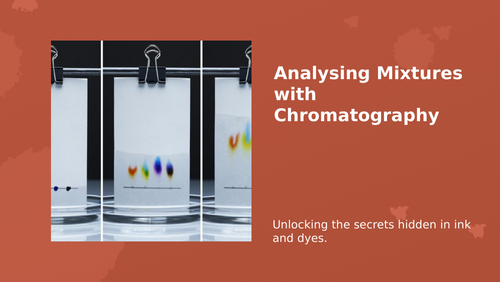
This Year 7 Science lesson introduces pupils to the fourth key separation technique: chromatography. Building on their understanding of filtration, crystallisation and distillation, students learn how chromatography separates mixtures of coloured substances based on how far they travel with a solvent. The lesson strengthens pupils’ understanding of mixtures, solubility and scientific investigation.
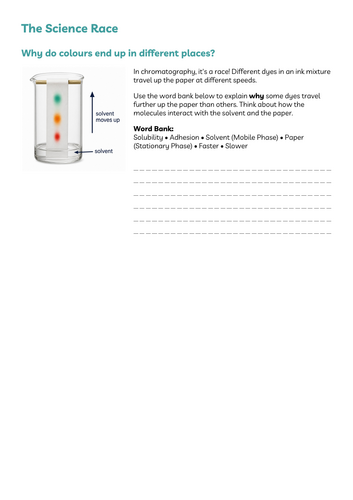
Learners explore how the solvent moves up the chromatography paper, why different dyes travel at different speeds, and how to interpret a simple chromatogram. They examine real‑world uses of chromatography, including food testing, forensic science and ink analysis. Pupils label diagrams, make predictions, and analyse chromatograms to deepen their scientific reasoning.
A fully editable PPT and worksheet are included, supporting modelling, diagram interpretation and structured explanation.
Learning Objective:
To explain how chromatography separates mixtures of coloured substances.
Success Criteria:
- Describe how the solvent moves up the paper.
- Explain why different dyes travel different distances.
- Interpret a simple chromatogram.
Something went wrong, please try again later.
This resource hasn't been reviewed yet
To ensure quality for our reviews, only customers who have purchased this resource can review it
Report this resourceto let us know if it violates our terms and conditions.
Our customer service team will review your report and will be in touch.
£2.00