


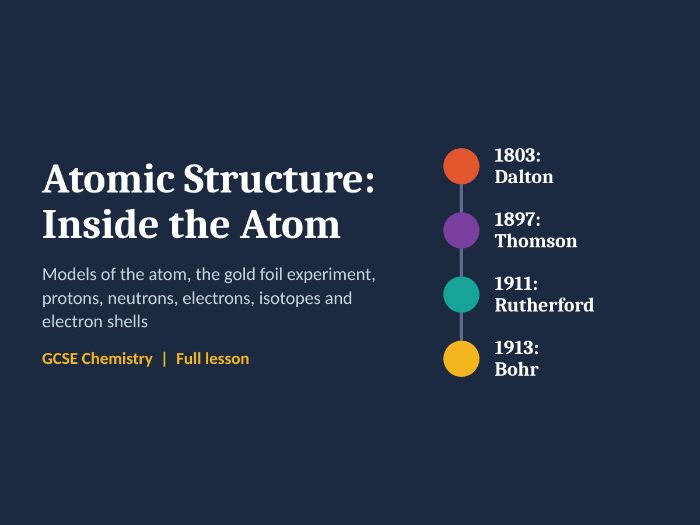
A complete, ready to teach GCSE Chemistry lesson on atomic structure. Students follow how the model of the atom developed from Dalton’s solid spheres to Bohr’s shells, see how the gold foil experiment revealed the nucleus, and learn to work out the protons, neutrons and electrons in any atom. 31 slides with clear, editable diagrams and teacher notes on every slide.
What’s included:
- Learning objectives at three levels: must, should and could
- A warm up quiz with answers, and key words including nucleus, atomic number, mass number and isotope
- A timeline from Dalton (1803) to Chadwick’s discovery of the neutron (1932)
- The scientists: Dalton, Thomson, Rutherford, Bohr and Chadwick, with public domain portraits
- Four models of the atom drawn side by side: solid sphere, plum pudding, nuclear and shell models
- The gold foil experiment: a diagram of alpha particle scattering, with each observation linked to its conclusion
- A labelled atom, the charge and mass of subatomic particles, and the size of an atom
- Atomic number and mass number, with a practice quiz and answers
- Isotopes (carbon 12 and carbon 14 drawn side by side) and electron shell diagrams with a practice quiz
- An AQA style 6 mark question with a mark scheme and a model answer
- Common mistakes, an exit ticket with answers and a key points summary
All slides are fully editable. Suitable for Year 9, 10 and 11, GCSE Chemistry and Combined Science, and works for AQA, Edexcel, OCR and WJEC.
If you find this lesson useful, a quick review would be really appreciated.
Something went wrong, please try again later.
This resource hasn't been reviewed yet
To ensure quality for our reviews, only customers who have purchased this resource can review it
Report this resourceto let us know if it violates our terms and conditions.
Our customer service team will review your report and will be in touch.
£3.00