


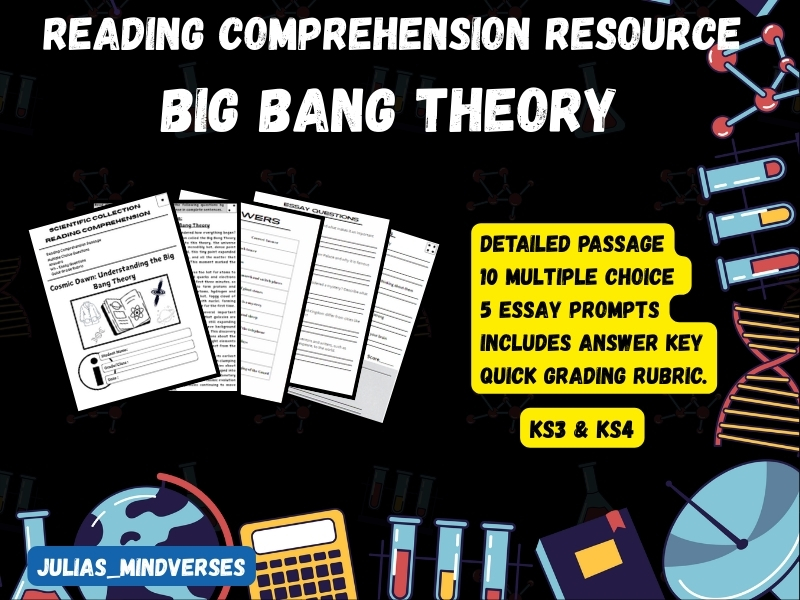
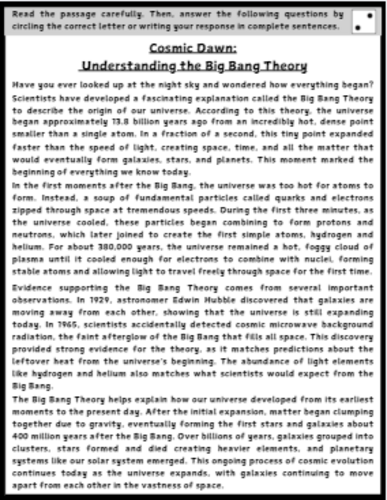
A comprehensive 5-page reading comprehension activity about the Big Bang Theory, perfect for KS3 and KS4 science lessons. This print-ready PDF resource explores the origins of the universe and includes a detailed passage, 10 multiple-choice questions, and 5 essay prompts with a quick grading rubric.
This resource provides a complete lesson package centered on cosmic dawn and the evolution of the universe. The reading passage covers key concepts such as the initial expansion, formation of fundamental particles, nucleosynthesis of hydrogen and helium, cosmic microwave background radiation, Edwin Hubble’s discoveries, and the role of gravity in forming galaxies. The package includes 10 multiple-choice questions perfect for quick assessment and 5 in-depth essay questions that encourage critical thinking and deeper understanding of cosmological evidence.
How I use this resource: This activity works perfectly for a 45-60 minute science lesson. I begin by having students read the passage independently, then we discuss the key concepts as a class. The multiple-choice questions serve as an excellent exit ticket or quick assessment, while the essay questions are perfect for homework assignments or group discussions. The included rubric makes grading efficient and consistent.
Key features:
5-page PDF format (print-ready)
Age-appropriate language for years 7-11
Mixture of assessment styles (multiple choice and extended writing)
Includes answer key for easy grading
Rubric included for consistent assessment
This resource aligns with the national curriculum standards for science and helps students develop crucial reading comprehension skills while exploring fundamental concepts in cosmology and astronomy.
Something went wrong, please try again later.
This resource hasn't been reviewed yet
To ensure quality for our reviews, only customers who have purchased this resource can review it
Report this resourceto let us know if it violates our terms and conditions.
Our customer service team will review your report and will be in touch.
£1.25