


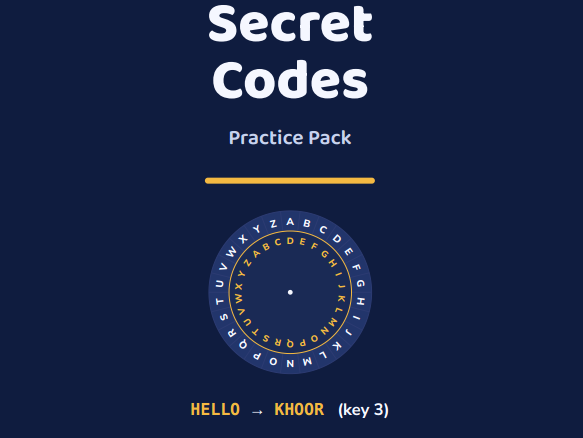
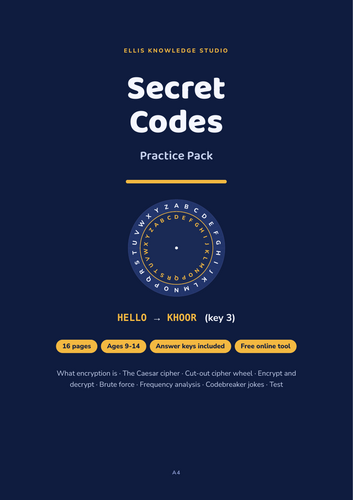
Turn your pupils into codebreakers! This 16-page A4 practice pack teaches what encryption is, how the Caesar cipher works, and how codes are cracked using brute force and frequency analysis. A cut-out cipher wheel and codebreaker jokes make it a real hit with classes.
It supports the KS3 Computing aim of understanding how to use technology safely and securely, and introduces encryption ideas that come up again in GCSE Computer Science. It’s also great for able upper KS2 pupils.
Every activity matches a free interactive online tool, and a QR code inside the pack takes pupils straight to it.
What’s included:
Teacher guide: a 4-lesson plan with support and stretch ideas, plus which tool mode goes with each page.
3 learn pages: what encryption is and where it’s used, how the Caesar cipher works, and how codes are cracked.
8 practice pages: make a cut-out cipher wheel, encrypt 8 messages, decrypt 8 messages, crack codes without the key using brute force, a frequency detective task, codebreaker jokes, send a secret message to a partner (plus ROT13), and key words.
Assessment: a 12-question test with full answer keys.
Key features:
A4 format, ready to print.
Works on paper or alongside the free companion tool, where pupils turn an on-screen cipher wheel, crack 8 codes with and without the key, and count letters to break long messages. No login needed.
Perfect for end-of-term lessons, code clubs, STEM days or escape-room style activities.
Keywords: Caesar cipher, encryption, cryptography, secret codes, cipher wheel, code breaking, frequency analysis, cyber security, ROT13, escape room, KS2 computing, KS3 computing
Something went wrong, please try again later.
This resource hasn't been reviewed yet
To ensure quality for our reviews, only customers who have purchased this resource can review it
Report this resourceto let us know if it violates our terms and conditions.
Our customer service team will review your report and will be in touch.
£4.00