


We hope these guide series help you plan your review/revision work. These are concise and precisely aligned with the updated syllabus. Many teachers have collaborated in making of these guides. If they are useful in your teaching, please consider leaving a review. It would truly be helpful for us to improve on the process of making. You can also explore other guides at the store.
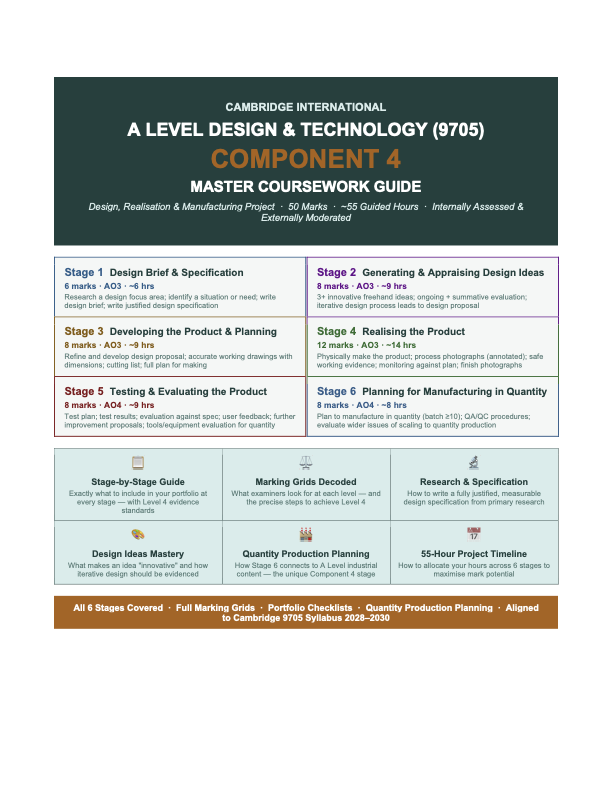
Cambridge A Level D&T Component 4 is the Design, Realisation and Manufacturing Project – 50 marks, 25% of A Level, 55 guided hours. This guide, updated May 2026, transforms how students approach the 6-stage portfolio.
What’s inside (32 pages):
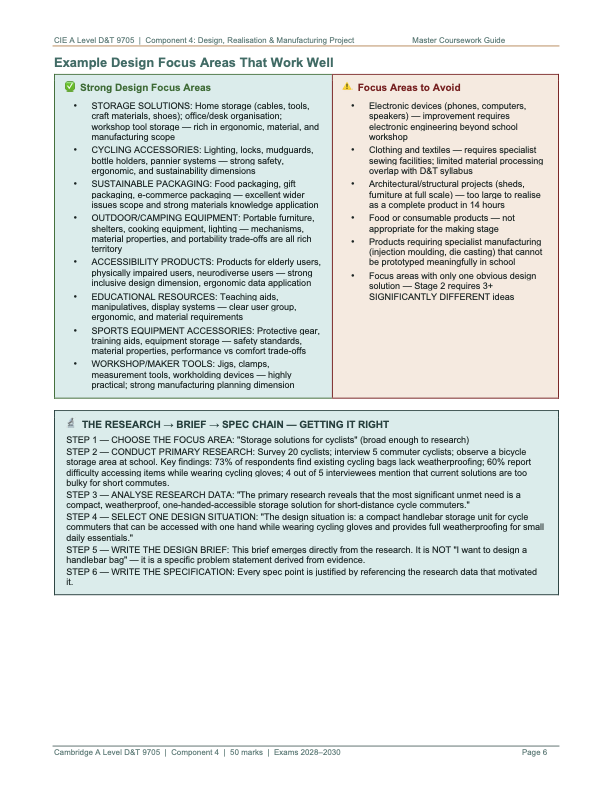
Stage 1 (6 marks) – Research (questionnaire + interview/observation) → design brief → specification. 8+ measurable, justified points covering ALL 4 factor types (human, aesthetic, technical, environmental).
Stage 2 (8 marks) – 3 genuinely different ideas. Each idea: 3D sketch; material annotations (specific name + property + reason); ergonomic reference; spec connection. Evaluation matrix → design proposal integrating best features.
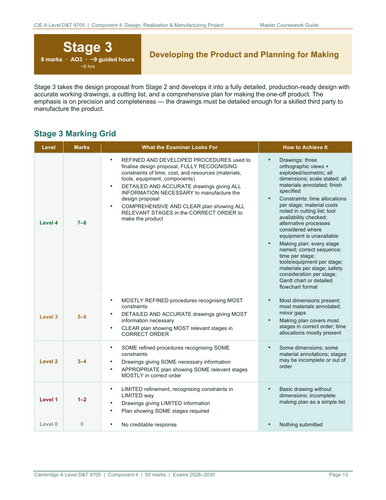
Stage 3 (8 marks) – Orthographic drawings (front/side/plan) with dimensions and scale. Parts/cutting list. Gantt chart plan (time, tools, materials, safety per stage).
Stage 4 (12 marks – highest mark stage) – Complete product. 12+ process photographs (annotated, PPE visible). Wide range of skills evidenced. Teacher sign-off required.
Stage 5 (8 marks) – One test per spec point (method, criterion, measured result). User feedback from 3+ users. Quantity modification proposals (what process/tooling changes for batch production).
Stage 6 (8 marks – unique to Component 4) – Quantity plan for batch of ≥10. Production system selection. QA checkpoints; QC checks. Wider issues analysis covering ALL FOUR dimensions: economic (unit cost comparison), environmental (waste, energy), social (employment, skills), cultural (standardisation vs customisation). Analysis must be evaluative.
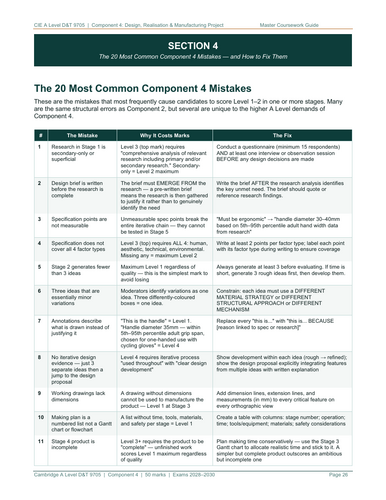
20 most common mistakes – research secondary-only, specification not measurable, fewer than 3 ideas, sketches without annotations, missing dimensions, no PPE in photos, vague quantity proposals – with how to fix each.
Grade boundaries – A* = 44–50 marks.
Independently produced by Samata Reviews. Not affiliated with or endorsed by Cambridge Assessment International Education.
#ALevel #CambridgeALevel #DesignAndTechnology #9705 #Component4 #Coursework #QuantityProduction #Jigs #Formers #QA #QC #WiderIssues #SustainableDesign #BatchProduction #Portfolio #ExamPrep #RevisionGuide #TesResources #DTTeacher
Something went wrong, please try again later.
This resource hasn't been reviewed yet
To ensure quality for our reviews, only customers who have purchased this resource can review it
Report this resourceto let us know if it violates our terms and conditions.
Our customer service team will review your report and will be in touch.
£5.50