pdf, 6.89 MB
pdf, 6.89 MB
docx, 10.07 MB
docx, 10.07 MB
pdf, 124.08 KB
pdf, 124.08 KB
pdf, 75.94 KB
pdf, 75.94 KB
pdf, 76.11 KB
pdf, 76.11 KB

We hope these guide series help you plan your review/revision work. These are concise and precisely aligned with the updated syllabus. Many teachers have collaborated in making of these guides. If they are useful in your teaching, please consider leaving a review. It would truly be helpful for us to improve on the process of making. You can also explore other guides at the store.

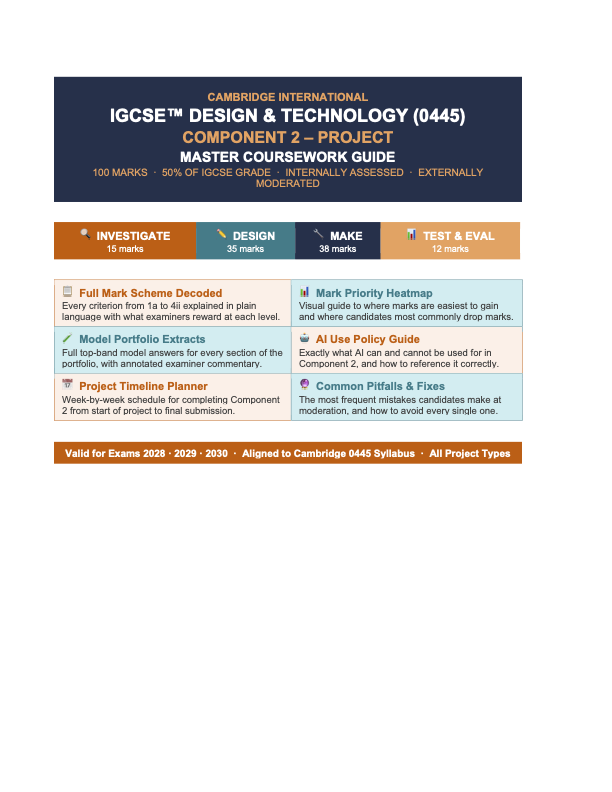
Cambridge IGCSE D&T Component 2 is the project-based coursework – 100 marks, 50% of IGCSE. This guide, updated May 2026, transforms how students approach every section of the portfolio, from investigation to final evaluation.

What’s inside (43 pages):

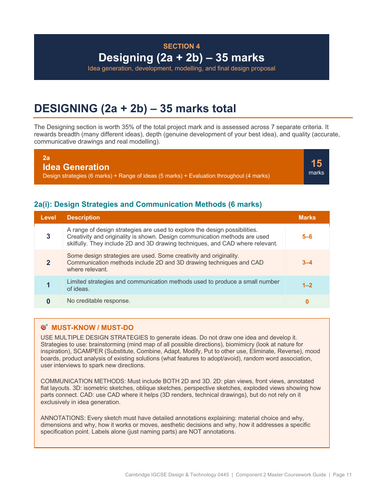
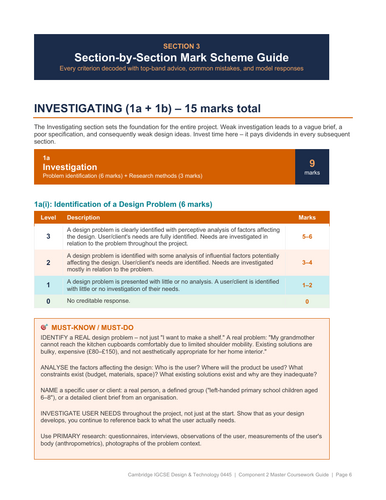
Full mark scheme decoded for every criterion – 1a(i) problem identification (6 marks), 1b(ii) measurable specification with CSE factors (4 marks – CRITICAL), 2a(ii) range of design ideas (5 marks), 2b(iii) modelling and testing (4 marks – CRITICAL), 3b(i) making techniques and processes (12 marks – highest value), 4(ii) critical evaluation with justified further development (8 marks – CRITICAL). Each criterion explained in plain language with what examiners reward at each level.

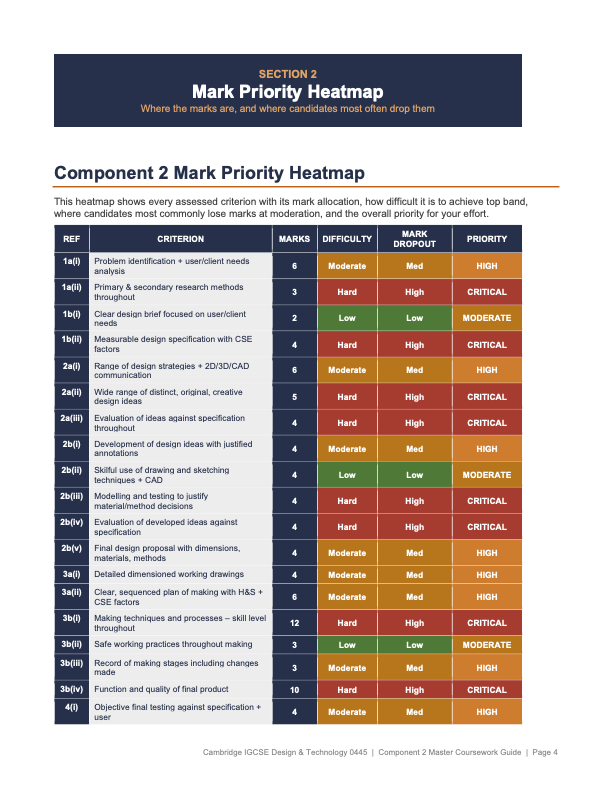
Mark priority heatmap – where marks are easiest to gain and where candidates most commonly drop marks at moderation (specification measurability, idea variety, modelling evidence, making process photos, critical evaluation).

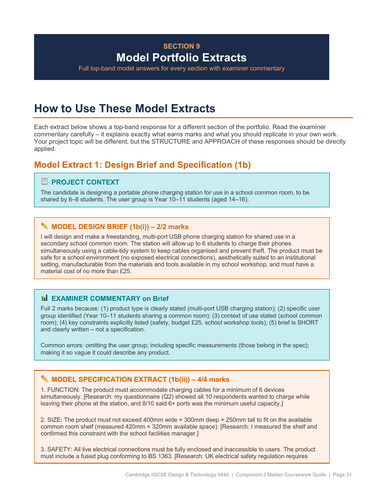
Model portfolio extracts – top-band responses for design brief and specification, evaluation of design ideas, and final evaluation with examiner commentary explaining exactly what earns marks.

AI use policy guide – what AI can and cannot be used for, how to reference it correctly, and what constitutes academic integrity breach.

Common moderation pitfalls – the most frequent reasons marks are adjusted downward (unmeasurable spec points, ideas that are variations of same concept, missing PPE in photos, positive-only evaluation, vague improvement proposals). How to avoid every single one.

20-week project timeline – week-by-week schedule from problem identification to final submission. Strategic advice: Week 12 (planning complete) is the most critical deadline – never start making without a plan.

Pre-submission checklist – every criterion in one place. Verify before submission.

Grade boundaries – A* = 90–100 marks, A = 80–89, B = 65–79.

#IGCSE #CambridgeIGCSE #DesignAndTechnology #0445 #Component2 #Coursework #DesignProject #Making #Portfolio #GCSE #ExamPrep #RevisionGuide #TesResources #DTTeacher

Get this resource as part of a bundle and save up to 20%

A bundle is a package of resources grouped together to teach a particular topic, or a series of lessons, in one place.

Bundle

CIE IGCSE Design & Technology (0445) Complete Exam Preparation Bundle: All 4 Components and Papers - Teaching & Revision Guide + Past Paper Analysis + Exam Strategies

IGCSE D&T has four very different assessments. Two written papers. A coursework portfolio. A drawing paper. This bundle covers every single component. Four complete master guides – Paper 1 (Product Design), Component 2 (Project – Coursework), Paper 3 (Materials), and Paper 4 (Graphic Products). Buy the bundle and save. Paper 1 – Product Design (1 hour, 50 marks, 25% of IGCSE): Common content all candidates take. Design process, sustainability (6Rs), ergonomics, materials (polymers, timbers, metals, composites, smart materials), structures (forces, triangulation), mechanisms (levers, gears, MA), electronics (circuit symbols, open/closed loops). 25% of IGCSE. Component 2 – Project (100 marks, 50% of IGCSE): Coursework portfolio + final product. Investigating (15 marks – research, brief, measurable specification), Designing (35 marks – ideas, development, final proposal), Making (38 marks – drawings, plan, prototype, safety), Testing & Evaluating (12 marks – testing, user feedback, evaluation). Mark scheme decoded. Moderation pitfalls. AI policy guide. Paper 3 – Materials (1 hour, 50 marks, 25% of IGCSE): Specialist option. Polymers (thermoplastics – PET, HDPE, PVC, acrylic, PS, PP, ABS, PLA; thermosets – polyester, epoxy). Timbers (hardwoods, softwoods, manufactured boards). Metals (ferrous, non-ferrous, heat treatment – hardening, tempering, annealing). Composites (CFRP, GRP). Smart materials. Making processes. QA vs QC. Paper 4 – Graphic Products (1 hour, 50 marks, 25% of IGCSE): Drawing paper. A3 answer sheets. Orthographic projection (third angle), isometric, perspective, nets, geometrical constructions (ellipses, polygons, bisecting), rendering, pie charts, flowcharts. Printing processes (lithography, screen printing, digital printing). CAD/CAM. Everything follows Cambridge 0445 syllabus for 2028–2030. What's included: Topic frequency heatmaps, material property tables, 16 sustainability strategies, command words decoded, mark scheme decoded for all components, worked examples, 4-week revision plans, pre-submission checklist for Component 2, orthographic projection guide, grade boundaries (A* to G). Grab the bundle and save – Four guides. One price. All the planning done for you. #IGCSE #CambridgeIGCSE #DesignAndTechnology #0445 #DTBundle #Paper1 #Component2 #Paper3 #Paper4 #ProductDesign #Coursework #Materials #GraphicProducts #Sustainability #Polymers #HeatTreatment #Orthographic #Isometric #Printing #DTTeacher #RevisionGuide #TeachingBundle

£10.65

Reviews

Something went wrong, please try again later.

This resource hasn't been reviewed yet

To ensure quality for our reviews, only customers who have purchased this resource can review it

Report this resourceto let us know if it violates our terms and conditions.
Our customer service team will review your report and will be in touch.