

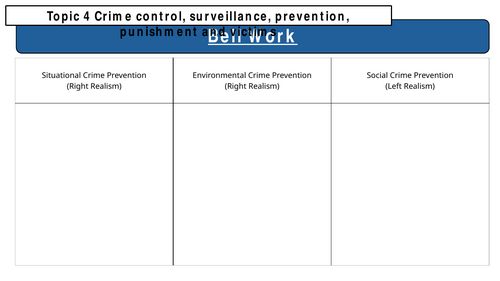

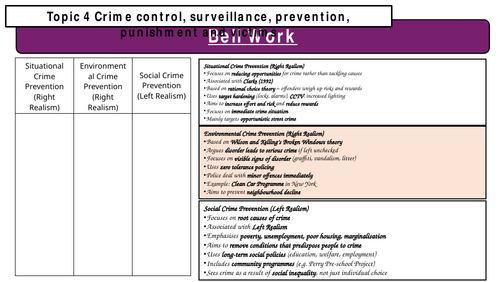
A comprehensive lesson sequence covering surveillance and crime control, suitable for AQA A-level Sociology.
The lessons cover:
- The meaning, purpose and different forms of surveillance
- CCTV, facial recognition, digital monitoring and the collection of personal data
- Foucault’s concepts of disciplinary power and self-surveillance
- Bentham’s Panopticon and its application to contemporary society
- Mathiesen’s synopticon, in which the many observe the few
- Bauman’s concept of liquid surveillance
- Feeley and Simon’s actuarial justice, risk assessment and social sorting
- The use of surveillance by the police, government and private companies
- The effectiveness of surveillance in preventing and controlling crime
- Concerns surrounding privacy, discrimination, civil liberties and unequal targeting
Students are supported in understanding key sociologists and concepts, applying theories to contemporary examples, and evaluating whether surveillance increases public safety or extends social control.
These lessons are ideal for teaching surveillance for the first time, consolidating learning, or supporting revision and exam preparation.
Get this resource as part of a bundle and save up to 9%
A bundle is a package of resources grouped together to teach a particular topic, or a series of lessons, in one place.
Bundle
A Level Sociology Crime and Deviance- ALL LESSONS
A complete AQA A-level Sociology Crime and Deviance teaching bundle, covering the entire unit across four organised topics. The bundle includes: * Sociological theories – Functionalism, strain and subcultural theories, Interactionism, Marxism, neo-Marxism, and Left and Right Realism * Social distribution of crime – gender and ethnicity * Contemporary crime – media representations, moral panics, globalisation, cybercrime, green crime and state crime * Crime control and punishment – crime prevention, surveillance, punishment and victimology Students are supported in developing detailed knowledge of key sociologists and concepts, applying theories to contemporary examples, comparing perspectives and building strong evaluation skills. Ideal for complete course delivery, revision, exam preparation or supporting non-specialist teachers.
£70.00
Bundle
Crime and Deviance Topic 4: Crime control, surveillance, prevention and punishment
A comprehensive Topic 4 lesson bundle covering crime prevention, surveillance, punishment and victimology, suitable for AQA A-level Sociology. The crime-prevention lessons cover: * Situational, environmental, social and community crime prevention * Clarke’s rational-choice approach and crime displacement * Wilson and Kelling’s broken windows theory * Zero-tolerance policing and strategies designed to tackle the causes of crime The surveillance lessons cover: * CCTV, facial recognition, digital monitoring and data collection * Foucault’s disciplinary power and Bentham’s Panopticon * Mathiesen’s synopticon and Bauman’s liquid surveillance * Feeley and Simon’s actuarial justice * Privacy, civil liberties, social sorting and unequal targeting The punishment lessons cover: * Retribution, deterrence, rehabilitation, incapacitation and reparation * Functionalist and Marxist perspectives on punishment * Rusche and Kirchheimer’s economic explanation * Foucault’s distinction between sovereign and disciplinary power * Garland’s culture of control * Prisons, community sentences and restorative justice The victimology lessons cover: * Patterns and risks of victimisation * Positivist and critical victimology * Victim proneness, victim precipitation and victim blaming * Mawby and Walklate’s structural powerlessness * Christie’s ideal victim and the hierarchy of victimisation * The impact of crime and secondary victimisation Students are supported in developing detailed knowledge of key sociologists and concepts, applying theories to contemporary examples, comparing different approaches, and evaluating their strengths and limitations. This complete Topic 4 bundle is ideal for first teaching, consolidating learning, or supporting revision and exam preparation.
£15.00
Something went wrong, please try again later.
This resource hasn't been reviewed yet
To ensure quality for our reviews, only customers who have purchased this resource can review it
Report this resourceto let us know if it violates our terms and conditions.
Our customer service team will review your report and will be in touch.
£4.00