pptx, 148.79 KB
pptx, 148.79 KB
pdf, 1.27 MB
pdf, 1.27 MB
pdf, 1.27 MB
pdf, 1.27 MB
pdf, 1.28 MB
pdf, 1.28 MB
pdf, 1.27 MB
pdf, 1.27 MB
pdf, 1.27 MB
pdf, 1.27 MB
pdf, 1.27 MB
pdf, 1.27 MB
pdf, 1.27 MB
pdf, 1.27 MB
pdf, 1.27 MB
pdf, 1.27 MB
pdf, 1.27 MB
pdf, 1.27 MB
pdf, 1.27 MB
pdf, 1.27 MB
docx, 276.01 KB
docx, 276.01 KB
docx, 275.7 KB
docx, 275.7 KB
docx, 321.28 KB
docx, 321.28 KB
docx, 300.55 KB
docx, 300.55 KB
docx, 282.74 KB
docx, 282.74 KB
docx, 283.49 KB
docx, 283.49 KB
docx, 298.35 KB
docx, 298.35 KB
docx, 259.37 KB
docx, 259.37 KB
docx, 264.95 KB
docx, 264.95 KB
docx, 265.37 KB
docx, 265.37 KB

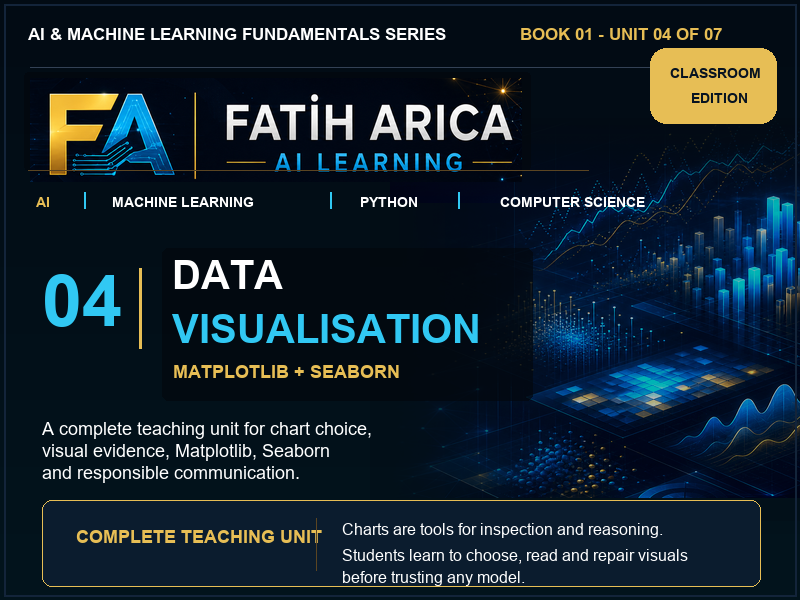
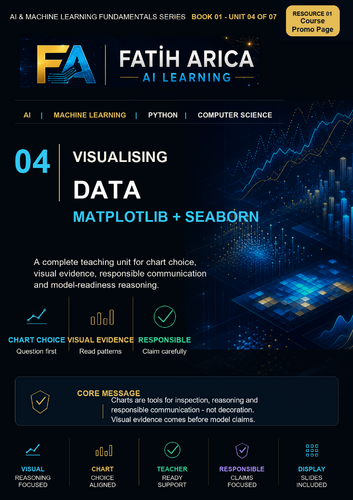
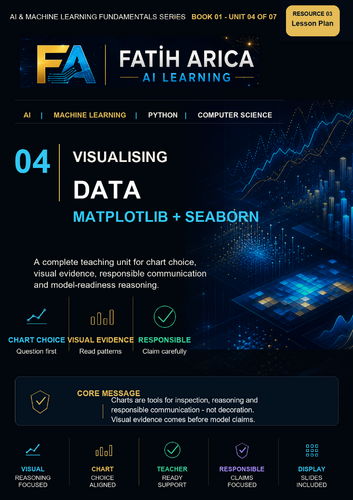
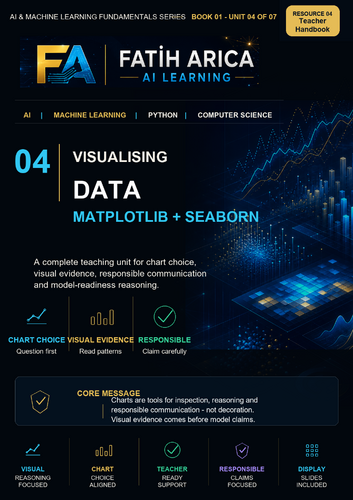
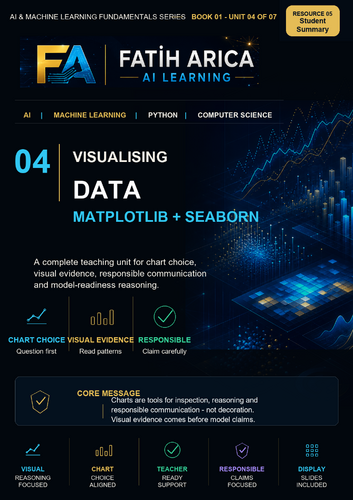
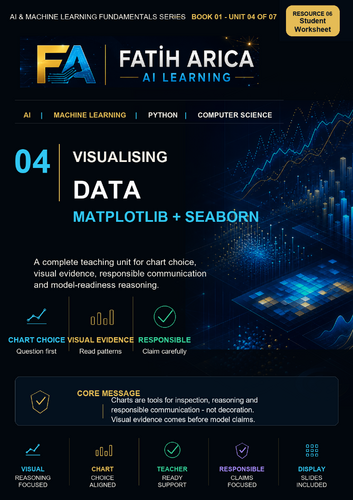
Teach data visualisation as a tool for evidence, reasoning and responsible communication rather than decoration. This Unit 04 pack transforms Chapter 4 of AI & Machine Learning: Foundations & Data – Volume 1 into four structured, classroom-ready lessons covering visual inspection, chart selection, Matplotlib and Seaborn, pattern and outlier interpretation, misleading chart repair and model-readiness reasoning.

Students learn to begin with the question rather than the chart. They match bar, line, histogram, scatter, box, violin and heatmap charts to different data questions and variable types. They identify trends, clusters, skew, spread and outliers, explain what a visual reveals, and distinguish supported association from unsupported causal claims.

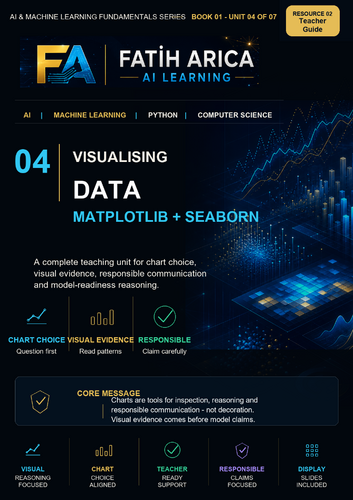
Designed as the classroom teaching companion to AI & Machine Learning: Foundations & Data – Volume 1, the package includes a Teacher Guide, four-lesson plan, detailed Teacher Handbook, Student Summary Notes, printable Worksheet, full Answer Key, Activity Cards, Exit Tickets, an editable 34-slide presentation deck and a Read Me First guide. An optional Python code-reading route using Matplotlib and Seaborn can be used with or without student devices.

The no-prep structure supports direct teaching, discussion, group work, assessment and independent revision. The central message is simple: charts are tools for inspection, reasoning and responsible communication.

By the end of this unit, students will be able to:

• Explain why visualisation should come before modelling
• Choose charts based on question and variable type
• Compare bar, line, histogram, scatter, box, violin and heatmap use cases
• Identify trends, clusters, outliers, spread and skew
• Distinguish visual evidence from interpretation
• Write responsible scatterplot claims without assuming causation
• Identify misleading scales, labels, colours, titles and missing context
• Repair weak or misleading chart decisions
• Explain Figure and Axes in Matplotlib
• Recognise when Seaborn is useful
• Read simple Matplotlib and Seaborn code
• Connect visual clues to model-readiness decisions
• Design a simple evidence-based dashboard

Lesson 1 – Why Visualisation Matters
Explore how charts reveal information that summary statistics may hide.

Lesson 2 – Choosing the Right Chart
Match questions and variable types to appropriate charts and justify each choice.

Lesson 3 – Patterns, Outliers and Careful Claims
Read visual evidence, investigate unusual values and distinguish association from causation.

Lesson 4 – Responsible Visualisation
Repair misleading charts, check scale, colour, labels and context, and connect visual reasoning to modelling.

Get this resource as part of a bundle and save up to 36%

A bundle is a package of resources grouped together to teach a particular topic, or a series of lessons, in one place.

Bundle

AI & Machine Learning Volume 1 – Complete Curriculum Bundle | Course Book + 7 Teaching Units

AI & Machine Learning Volume 1 – Complete Curriculum Bundle combines the full 197-page course book with 7 complete teaching units, creating a structured pathway from the fundamentals of artificial intelligence to practical machine learning with Python. Designed for secondary, post-16, vocational and introductory computing learners, this bundle provides both the student-facing course content and the teacher resources needed to deliver it in the classroom. What’s included AI & Machine Learning: Foundations & Data – Volume 1 A complete 197-page European Edition course book covering Chapters 1–7, with explanations, Python examples, worked examples, exercises, European case studies and practical projects. 7 Complete Teaching Units: Unit 01 – What is Artificial Intelligence? AI foundations, branches of AI, real-world applications and responsible AI. Unit 02 – Setting Up Your AI Environment Python environments, Jupyter, Google Colab, development tools and practical setup. Unit 03 – NumPy & Pandas Data Handling Arrays, DataFrames, filtering, cleaning, grouping and preparing data for AI. Unit 04 – Data Visualisation Chart selection, interpretation, Matplotlib, Seaborn and evidence-based communication. Unit 05 – Introduction to Machine Learning Supervised and unsupervised learning, ML workflows, regression, evaluation and overfitting. Unit 06 – Scikit-learn in Depth Estimator API, pipelines, preprocessing, model selection, tuning and practical ML workflows. Unit 07 – Classification Algorithms K-NN, Decision Trees, Support Vector Machines, Random Forests, confusion matrices, precision, recall, F1 and responsible classifier selection. Each teaching unit follows a structured 4-lesson sequence, giving you 28 ready-to-teach lessons across Volume 1. Resources across the units include: • Teacher Guides • Detailed Lesson Plans • Teacher Handbooks • Student Summary Notes • Student Worksheets • Answer Keys • Activity Cards • Exit Tickets • Editable PowerPoint presentations • Supporting teacher and course materials The course progresses logically from understanding AI and preparing a Python environment through data handling and visualisation to complete machine learning workflows and classification. European examples and responsible AI considerations are integrated throughout, helping students connect technical skills with issues including bias, privacy, explainability, human oversight and the EU AI context. Ideal for • Computer Science and Computing courses • AI and Machine Learning introductions • Python and Data Science pathways • Post-16 and vocational computing • Teachers introducing AI into an existing curriculum • Independent study and enrichment programmes Volume 1 | Chapters 1–7 | 197-page Course Book | 7 Teaching Units | 28 Lessons A complete teaching and learning package for taking students from their first introduction to artificial intelligence through to building, evaluating and discussing practical machine learning systems.

£14.99

Reviews

Something went wrong, please try again later.

This resource hasn't been reviewed yet

To ensure quality for our reviews, only customers who have purchased this resource can review it

Report this resourceto let us know if it violates our terms and conditions.
Our customer service team will review your report and will be in touch.