


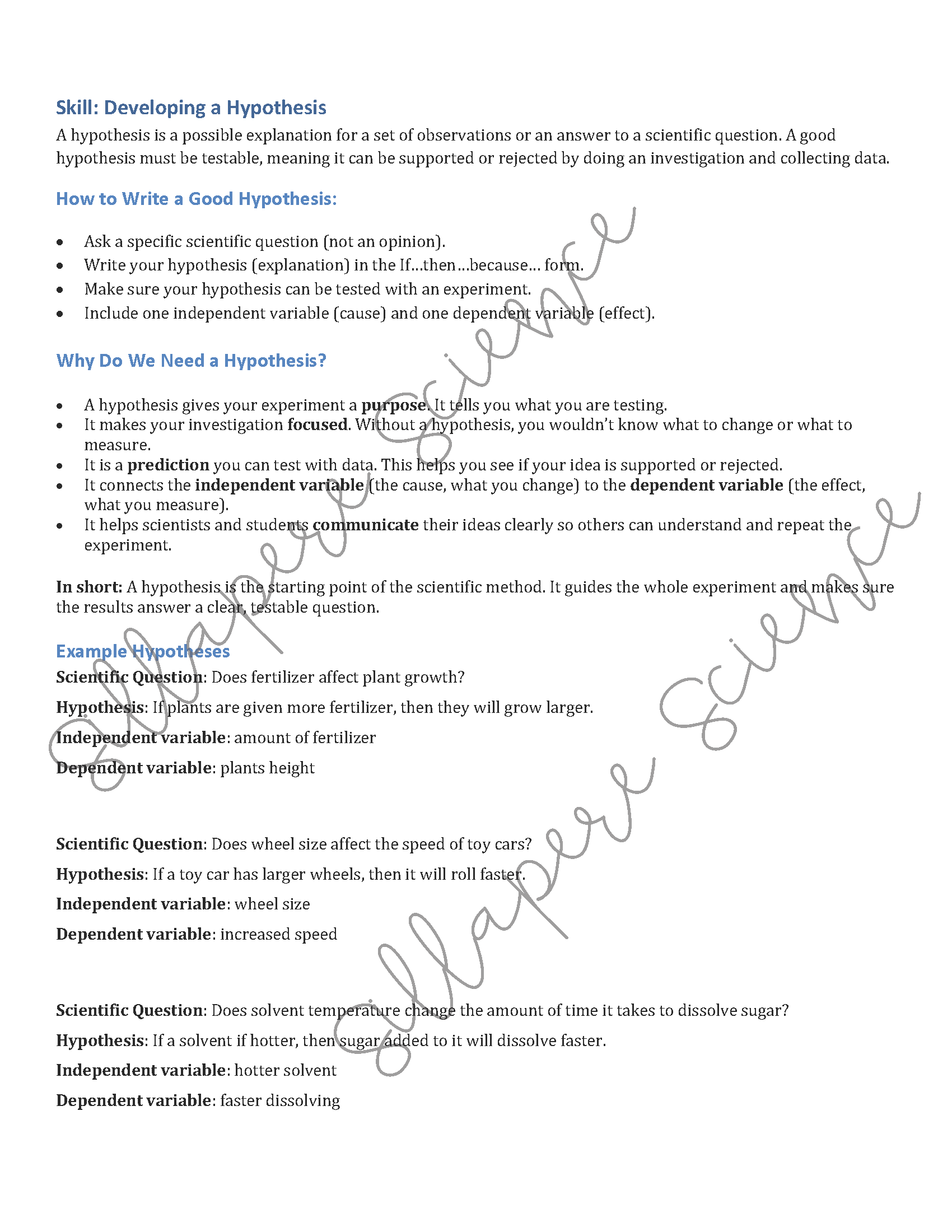
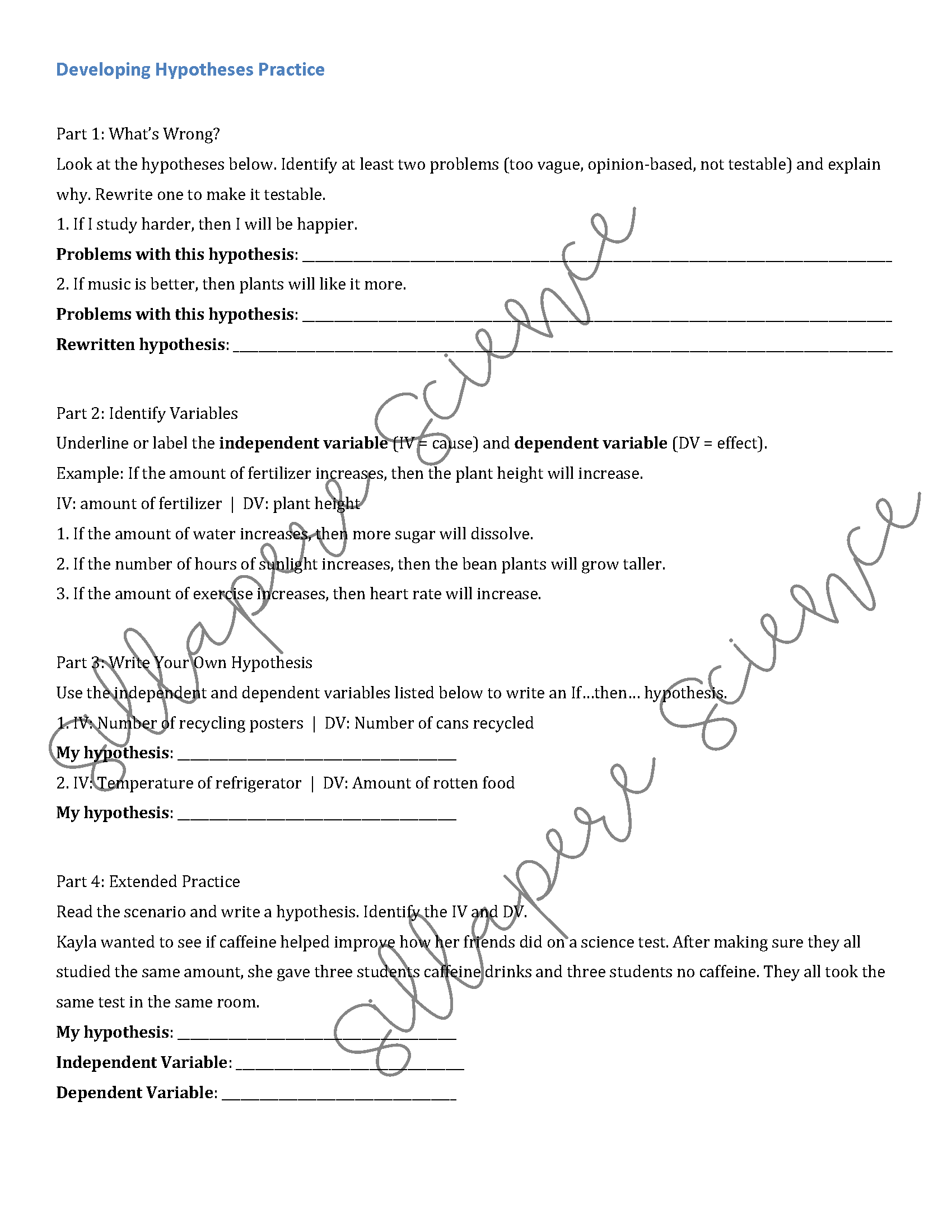
This student-friendly guide teaches how to correctly develop testable hypotheses for science experiments. It explains what makes a strong hypothesis, introduces the If…then… format, and highlights the importance of identifying independent and dependent variables. Students practice spotting weak or opinion-based hypotheses, correcting them, and writing their own using real-world scenarios.
Included in the resource are complete objective descriptions for MYP Criterion, ATL, UDL, NGSS, and standard objectives.
Resource Highlights:
· Clear instructions on how to:
o Ask scientific questions that can be tested
o Write hypotheses in the If…then… format
o Identify independent (cause) and dependent (effect) variables
o Recognize and correct vague or non-testable hypotheses
o Apply hypotheses to real-world examples
· Example hypotheses included:
o Fertilizer and plant growth
o Wheel size and toy car speed
· Practice worksheet:
o Part 1: Error identification in flawed hypotheses
o Part 2: Identify independent and dependent variables
o Part 3: Write your own hypotheses from given variables
o Part 4: Extended scenario practice with IV/DV identification
· Support tools:
o Student checklist for writing strong hypotheses
This resource builds essential science inquiry skills and prepares students for designing controlled experiments. It can be used as a class activity, independent practice, or formative assessment.
Something went wrong, please try again later.
This resource hasn't been reviewed yet
To ensure quality for our reviews, only customers who have purchased this resource can review it
Report this resourceto let us know if it violates our terms and conditions.
Our customer service team will review your report and will be in touch.
£1.00