pptx, 3.49 MB
pptx, 3.49 MB

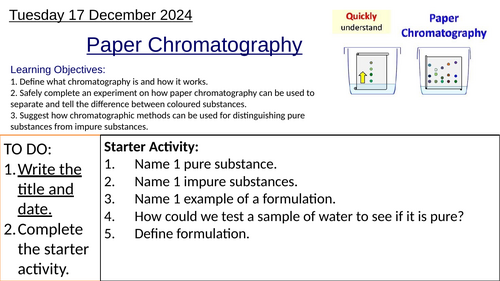
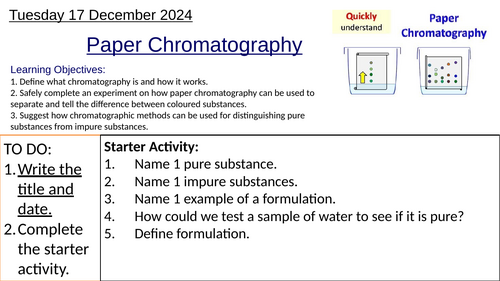
Paper Chromatography with Required Practical is an engaging PowerPoint resource that guides students through the principles and applications of chromatography in secondary science. Designed for practical and theoretical learning, this lesson focuses on defining chromatography, explaining its use in separating mixtures, and identifying pure and impure substances.

The resource begins with a clear introduction to chromatography as a separation technique for soluble substances, such as inks, dyes, and food colorings. Step-by-step instructions are provided for conducting a paper chromatography experiment, including a detailed demonstration and an alternative practical setup for classrooms with limited resources. Students will explore the concepts of stationary phase and mobile phase while understanding the role of solubility and particle attraction in chromatographic separation.

Interactive activities include labeling diagrams, completing fill-in-the-gaps exercises, and analyzing chromatograms to identify the components of mixtures. Students will calculate Rf values to compare and identify substances, building analytical and mathematical skills. Practice questions and quizzes reinforce key ideas and ensure thorough understanding of how chromatography can distinguish pure substances from impure ones.

The PowerPoint format (.pptx) makes it easily accessible for teachers and students, compatible with Microsoft PowerPoint and Google Slides. With its structured layout, real-world examples, and opportunities for hands-on experimentation, this resource provides a dynamic and engaging way to teach chromatography. Last updated in December 2024, it includes updated visuals, practical notes, and example calculations to enhance learning outcomes.

Ideal for science teachers seeking a comprehensive, curriculum-aligned resource, this PowerPoint is perfect for classroom instruction, revision sessions, and independent study.

Get this resource as part of a bundle and save up to 56%

A bundle is a package of resources grouped together to teach a particular topic, or a series of lessons, in one place.

Bundle

GCSE Chemistry Mixtures and Separation Techniques Bundle: 8-Lesson Unit

This is a comprehensive collection of interactive PowerPoint lessons designed for secondary-level science students. This engaging resource guides learners through essential chemistry topics, focusing on mixtures, pure substances, and various separation techniques, aligning with key science curriculum standards. Lesson 1: Solutions introduces the concept of solutions, explaining solutes, solvents, and the particle model of dissolution. Students explore real-world examples and conduct hands-on activities to reinforce their understanding, including the conservation of mass during dissolution. Lesson 2: Solubility explains solubility, identifying soluble and insoluble substances, and the impact of temperature on solubility. The lesson features graph-based analysis and a practical experiment to investigate temperature effects, helping students develop analytical skills. Lesson 3: Filtration explores the separation of mixtures using filtration. Students learn about insoluble solids, filtrate, and residue through relatable examples like muddy water and coffee. The lesson includes a hands-on experiment and reflective questions to solidify key concepts. Lesson 4: Separating Salt from Rock Salt focuses on evaporation and crystallization. Students follow a practical demonstration to extract salt, applying techniques like filtration and evaporation. Activities include step-by-step tasks, fill-in-the-gaps exercises, and review questions. Lesson 5: Simple Distillation introduces evaporation and condensation processes for separating mixtures. Students learn to label apparatus diagrams, understand the role of condensers, and explore real-world applications through engaging questions and demonstrations. Lesson 6: Fractional Distillation builds on simple distillation, explaining the separation of miscible liquids based on boiling points. Students sequence the process, label diagrams, and tackle challenge questions that highlight the role of the fractionating column. Lesson 7: Pure Substances, Mixtures, and Formulations helps students distinguish between pure and impure substances, elements, and compounds. Real-world examples, such as mineral water and toothpaste, illustrate formulations, with activities that analyze boiling and melting points. Lesson 8: Chromatography introduces chromatography as a separation technique for soluble substances like inks and dyes. Students conduct a practical experiment, calculate Rf values, and analyze chromatograms to identify pure substances and mixtures. This bundle includes eight fully editable PowerPoint presentations (.pptx), each featuring starter activities, interactive tasks, practical experiments, and practice questions to assess understanding. Updated with modern visuals and examples as of December 2024, it supports hands-on learning, critical thinking, and real-world applications. Perfect for science educators, this resource ensures a thorough and engaging exploration of chemistry topics, making it ideal for classroom teaching, revision, or independent study.

£7.00

Reviews

Something went wrong, please try again later.

This resource hasn't been reviewed yet

To ensure quality for our reviews, only customers who have purchased this resource can review it

Report this resourceto let us know if it violates our terms and conditions.
Our customer service team will review your report and will be in touch.