


Denormalising databases lesson for IB Diploma Computer Science (first assessment 2027), with editable PowerPoint slides, a student worksheet and full answers. Denormalisation adds back some repeated data to speed up queries, trading storage and update safety for read performance.
Written for the 2027 IB Computer Science guide, unit A3 Databases. Everything is editable, so you can adapt it to your class.
What’s included- PowerPoint lesson (10 slides) with speaker notes on every slide
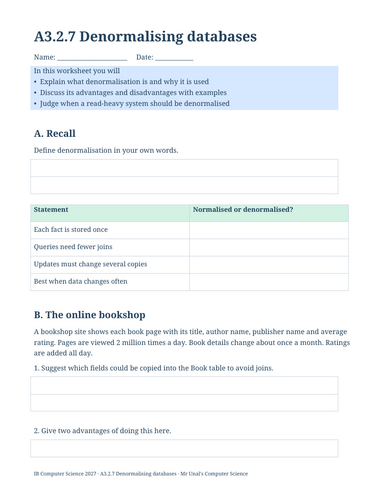
- Student worksheet (Word), ready to print or edit
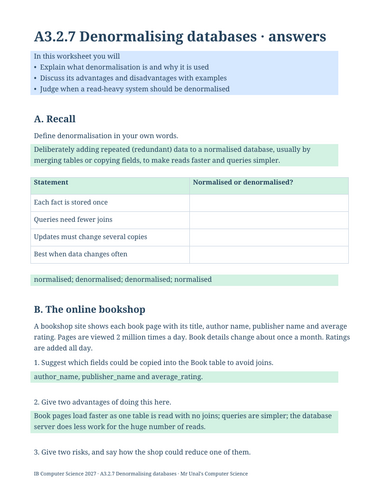
- Answer sheet (Word) with model answers for every question
By the end of the lesson students can:
- Explain what denormalisation is and why it is used
- Discuss its advantages and disadvantages with examples
- Judge when a read-heavy system should be denormalised
Worksheet sections: A. Recall; B. The online bookshop; C. Decide; D. Challenge
Every lesson includes- Learning goals and a starter question
- Clear explanations with worked examples (Python where code is needed)
- A quick check and a “your turn” task linked to the worksheet
- An exit ticket
- PowerPoint (.pptx) and Word (.docx), fully editable
- Works in PowerPoint and Google Slides
- Calm pastel design, consistent across the whole IB course
These are independent resources written for the IB Diploma Programme Computer Science guide (first assessment 2027). They are not produced or endorsed by the International Baccalaureate Organization.
More lessons in this series- Previous lesson: Normalising a scenario to 3NF – IB Computer Science lesson
- Next lesson: Data languages: DDL and DML – IB Computer Science lesson
- Save with the bundle: Databases – IB Computer Science (18 lessons)
Last updated: November 2026.
Something went wrong, please try again later.
This resource hasn't been reviewed yet
To ensure quality for our reviews, only customers who have purchased this resource can review it
Report this resourceto let us know if it violates our terms and conditions.
Our customer service team will review your report and will be in touch.
£3.00