


Intersecting Chords – Differentiated Worksheet with Worked Solutions (Pearson Edexcel IGCSE 9–1, Higher Tier)
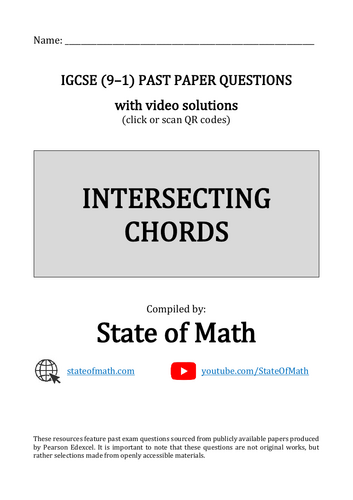
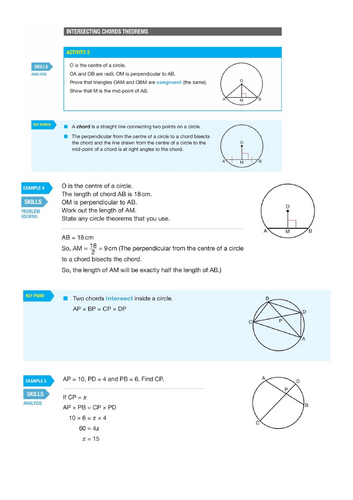
This worksheet develops the internal and external intersecting chord theorems from the Pearson Edexcel International GCSE (4MA1) Higher Tier specification. Students start with simple chords crossing inside a circle and work up to multi-mark exam-style questions involving quadratics and surds. The full worked solutions come as a separate PDF, which makes the pack useful for classwork, homework, independent revision and exam preparation.
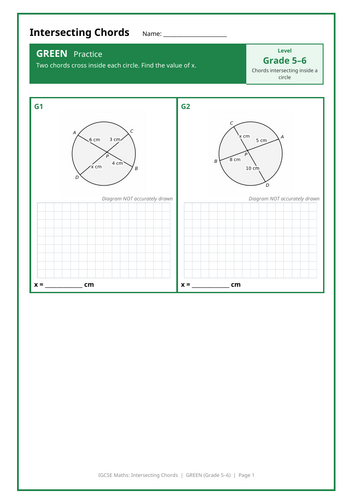
The worksheet has five colour-coded levels, each on its own page with a matching border and a clear grade label, so students know how hard the work is before they begin. Every question has an exam-style diagram marked “Diagram NOT accurately drawn”, a square grid for working out and an answer line.
Green – Practice (Grade 5–6): four questions on chords intersecting inside a circle, using AP × PB = CP × PD with whole-number lengths.
Amber – Further practice (Grade 6–7): three questions on chords that meet outside the circle, where students must add the outside part and the chord to get the whole line, plus one inside-circle question with decimals.
Red – Developing understanding (Grade 7): four questions where students form and solve equations in x. Two lead to linear equations and two to quadratics, where students must reject the negative root.
TIF – Problem solving (Grade 8): four exam-style questions with marks shown:
finding the radius from a diameter and a crossing chord
a “show that” quadratic answered to 3 significant figures
a six-mark question combining the internal and external theorems with a circle centre O
a question where the chord segments are given as a ratio
TIEF – Challenge (Grade 9): four exam-style questions with surds. Students rationalise denominators, use the difference of two squares, solve a quadratic by completing the square, and give exact answers in the form a + b√3.
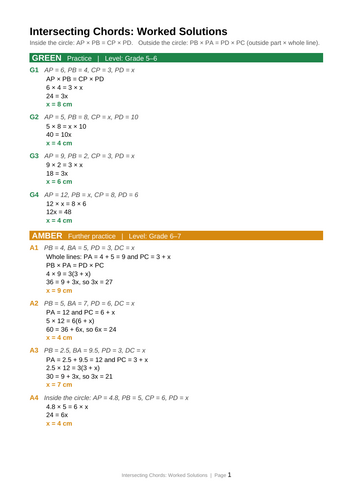
The worked solutions set out every step for all 20 questions. They show how to set up each equation from the correct theorem, handle quadratics and surds, and give answers to the required accuracy. They also highlight common mistakes, such as using only the outside part of the line instead of the whole line in external chord questions, and not rejecting negative lengths.
Something went wrong, please try again later.
This resource hasn't been reviewed yet
To ensure quality for our reviews, only customers who have purchased this resource can review it
Report this resourceto let us know if it violates our terms and conditions.
Our customer service team will review your report and will be in touch.
£3.00