


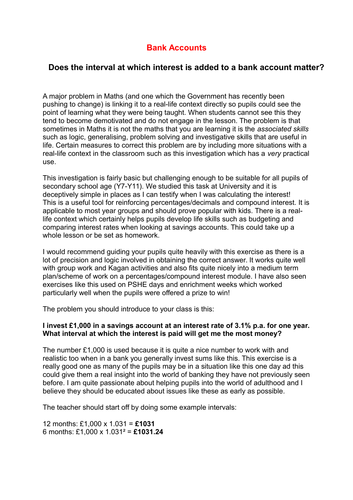
This resource handily introduces compound interest to more able KS3 groups and GCSE in the form of adding interest to a bank account. Other topics covered include percentages and decimal multipliers.
This resource is an investigation (with teacher notes and accompanying worksheets) which gets students to investigate whether how often interest is added to a bank account effects the total amount of interest.
The problem is so:
I invest £1,000 in a savings account at an interest rate of 3.1% p.a. for one year. What interval at which the interest is paid will get me the most money?
The students can then be guided to calculating the total amount of interest when it is added, daily montly etc. before being guided to an overall formula to solve the problem.
Get this resource as part of a bundle and save up to 88%
A bundle is a package of resources grouped together to teach a particular topic, or a series of lessons, in one place.
Bundle
Huge Set of KS3/GCSE Maths Investigations
A set of 6 investigations (complete with teacher notes and worksheets) where students are set a challenging problem and work to find the solution. Each investigation should take up a whole lesson. The first investigation focuses mainly on probability and gets pupils to find the total possible number of half-time scores if given the full-time score, eventually finding a formula connecting the two. The second connects geometry and algebra, getting pupils to generate a formula which links the the area of triangles and their dimensions. The third investigation gets pupils to discover the origins of square numbers whilst the fourth gets students to calculate the optimum rate (using compound interest) at which interest should be added to money in order to achieve maximum interest. The bundle concludes with a pair of investigations on triangular numbers, the first helping pupils to appreciate the properties of the sequence and the second which gets pupils to discover the derivation for the nth term of the triangular number sequence.
£6.50
Bundle
KS3/KS4 Maths Number Resources
This bundle contains a huge set of resources for teaching number topics for use in KS3 and KS4 Maths. The bundle contains a set of interactive investigations (with worksheets provided) on number topics like square numbers, factors, compound interest and triangular numbers as well as a set of starters involving fractions and addition. Also included in the bundle are worksheets/exam questions on fractions, decimals and percentages, a test on averages and a whole powerpoint lesson on standard form.
£7.00
Bundle
Boosting Literacy skills in KS3 and GCSE Maths Resources
This bundle contains a set of resources for KS3 and GCSE Maths which aims to boost students' literacy skills and build strong cross-curricular links. It has several varied resources including lists of key terms and formulae in KS3 and GCSE Maths to help students become more familiar with key words and notation, a set of 6 investigations on topics such as square numbers, compound interest and factors which support students in building their mathematical fluency and communication skills and a collaborative learning activity involving key words to promote discussion and team work and a template for peer assessing a piece of work.
£6.00
Bundle
KS3 and GCSE Maths Algebra Resources
This bundle contains a set of materials to help teachers plan and deliver lessons for KS3 and GCSE Maths on Algebra topics. Included in the bundle are full lessons on constructing and solving linear equations, rearranging formulae, a bank of exam questions for quadratics, acceleration and velocity and general set for KS3 algebra topics. It also contains a set of investigations which involve significant algebraic content on topics such as convergence, compound interest and factors.
£7.00
Something went wrong, please try again later.
This resource hasn't been reviewed yet
To ensure quality for our reviews, only customers who have purchased this resource can review it
Report this resourceto let us know if it violates our terms and conditions.
Our customer service team will review your report and will be in touch.
£5.00