pptx, 20.35 MB
pptx, 20.35 MB

A complete OCR A-Level Media Studies lesson exploring narrative structure, flashbacks, enigmas and audience engagement in Lupin Season 1 Episode 1.

This fully editable PowerPoint (.pptx) lesson focuses on Lupin: Chapter One for OCR A-Level Media Studies Paper 2: Evolving Media, Section B – Long Form Television Drama.

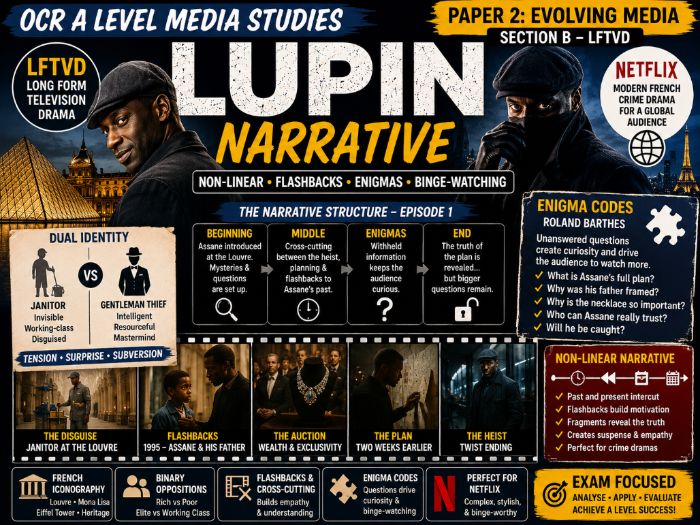
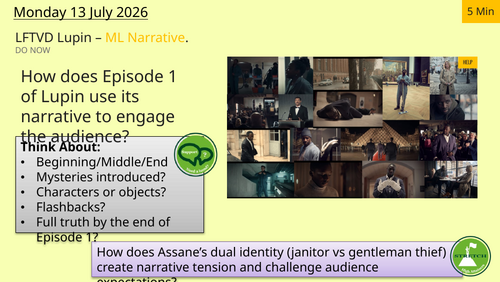
The lesson explores how Lupin uses non-linear narrative, flashbacks, enigma codes, cross-cutting and dual identity to engage audiences. Students begin by considering how Assane’s identity as both a janitor and a gentleman thief creates narrative tension and challenges audience expectations. The Do Now also asks students to consider the episode’s beginning, middle and end, the mysteries introduced, the use of flashbacks and whether the full truth is revealed by the end of Episode 1.

Students then learn how Lupin uses a non-linear structure, shifting between the present-day Louvre heist, two-weeks-earlier planning scenes and flashbacks to Assane’s childhood. The lesson explains how this structure creates suspense, mystery and sympathy by gradually revealing Assane’s motivations and the injustice surrounding his father.

The lesson includes focused analysis of two key flashback sequences: the 1995 scene with Assane’s father and Mrs Pellegrini, and the later flashback showing Babakar’s betrayal, arrest and imprisonment. Students explore how these scenes reveal class prejudice, racial injustice, betrayal, identity, revenge and Assane’s gentleman-thief persona.

The second half of the lesson introduces Roland Barthes’ enigma codes, helping students understand how unanswered questions sustain audience curiosity and encourage binge-watching on Netflix. Students match key enigmas to their effects, including questions around the necklace, Assane’s plan, his father’s guilt, surveillance, the heist and whether Assane will be caught.

The lesson builds towards an exam-style written response on how the complexity of Lupin’s narrative ensures the audience is engaged. It includes sentence starters, a word bank, a model response and success criteria for WWW/EBI self-assessment.

This lesson covers:

OCR A-Level Media Studies
Paper 2: Evolving Media
Section B: Long Form Television Drama
Lupin: Chapter One
Media language
Narrative structure
Non-linear narrative
Flashbacks
Enigma codes
Roland Barthes
Cross-cutting
Dual identity
Janitor vs gentleman thief
Assane Diop
Babakar Diop
Pellegrini family
Betrayal
Revenge
Injustice
Class prejudice
Racial prejudice
Character depth
Audience engagement
Netflix binge-watching
Crime drama conventions

What is included:

Fully editable PowerPoint (.pptx) lesson
Do Now narrative analysis task
Teacher feedback/model response
Lesson objectives
Non-linear narrative explanation
Turn and Talk task on narrative effect
Flashback analysis task: 9:25–11:40
Flashback anal

Get this resource as part of a bundle and save up to 34%

A bundle is a package of resources grouped together to teach a particular topic, or a series of lessons, in one place.

Bundle

OCR A-Level Stranger Things & Lupin Bundle (LFTVD)

A complete OCR A-Level Media Studies Long Form Television Drama bundle covering Stranger Things S1E1 and Lupin S1E1 for Paper 2: Evolving Media, Section B. This bundle contains 5 fully editable PowerPoint lessons and 1 viewing sheet resource pack for OCR A-Level Media Studies. It is designed to support the teaching of the LFTVD set texts: Stranger Things, Season 1 Episode 1: The Vanishing of Will Byers and Lupin, Chapter One. The bundle builds students’ knowledge step-by-step, beginning with structured viewing sheets before moving into genre, narrative, audience, media language and representation. Students explore key areas of the OCR framework including media language, representation, audience, industry, contexts and theory application. Lessons include retrieval practice, key terminology, model answers, I Do / We Do / You Do structures, printable tasks, scene analysis, theory application, sentence starters, word banks, exam-style responses and peer/self-assessment opportunities. This resource is suitable for Year 12 or Year 13 OCR A-Level Media Studies and can be used as a full teaching sequence, revision unit, intervention pack or cover lesson sequence. Suggested teaching order 1. LFTVD Viewing Sheets: Stranger Things + Lupin Students begin with structured viewing sheets for Stranger Things S1E1 and Lupin S1E1. These support first viewing, note-taking and revision across media language, representation, contexts, audience and media theory. The Stranger Things sheet covers Cold War context, 1980s nostalgia, intertextuality, Hawkins Lab, gender roles and audience appeal, while the Lupin sheet covers the Louvre heist, French colonial legacy, class inequality, Arsène Lupin intertextuality, national identity and Netflix global audience appeal. 2. Stranger Things Genre & Narrative Theory This lesson introduces Stranger Things through genre hybridity and narrative structure. Students explore sci-fi, horror, teen drama and mystery/thriller conventions before applying Todorov’s Narrative Theory to Episode 1. The lesson considers equilibrium, disruption, recognition, attempt to repair, open endings, cliff-hangers, multi-strand narrative and how LFTVDs encourage binge-watching. 3. Stranger Things Audience This lesson explores how Stranger Things appeals to both mass and specialised audiences. Students define and apply key audience terms including mass audience, specialised audience, target audience, consumption, response, active audience and passive audience. The lesson also covers Netflix distribution, binge-watching, younger online audiences, 1980s nostalgia, Dungeons & Dragons culture, character types and representation. 4. Lupin Media Language 1 This lesson introduces Lupin through media language, mise-en-scène and visual contrasts. Students analyse how setting, costume, colour palette and lighting construct representations of wealth, class and inequality. The lesson focuses on the Louvre, the French housing estate, janitors vs guests, the auction room, French iconography and Lévi-Strauss’ binary oppositions. 5. Lupin Narrative This lesson explores how Lupin uses narrative complexity to engage audiences. Students analyse non-linear narrative, flashbacks, cross-cutting, dual identity, enigma codes and Netflix binge-watching. The lesson applies Roland Barthes’ enigma codes to questions around Assane’s plan, the necklace, his father’s imprisonment, revenge and the heist structure. 6. Lupin Representation This lesson focuses on representation of race, class, ethnicity, power and social hierarchy in Lupin. Students explore stereotypes and anti-stereotypes, Assane’s representation as a Black French protagonist, the contrast between Assane/Babakar and the Pellegrini family, and how the series critiques inequality in modern France while appealing to a global Netflix audience. What is included? 5 fully editable PowerPoint lessons 2 PDF viewing sheets Stranger Things S1E1 viewing sheet Lupin S1E1 viewing sheet Do Now retrieval tasks Teacher feedback/model answer slides Key terminology slides Scene analysis tasks Printable worksheet-style activities I Do / We Do / You Do structures Genre and narrative theory tasks Audience terminology activities Media language analysis tables Representation analysis tasks Word banks Sentence starters Exam-style questions Model responses Self-assessment and peer feedback tasks Key topics covered OCR A-Level Media Studies Paper 2: Evolving Media Section B: Long Form Television Drama Stranger Things Stranger Things S1E1: The Vanishing of Will Byers Lupin Lupin: Chapter One LFTVD conventions Media language Representation Audience Contexts Genre hybridity Narrative theory Todorov Barthes Lévi-Strauss Binary oppositions Enigma codes Non-linear narrative Flashbacks Cross-cutting Binge-watching Netflix Mass and specialised audiences 1980s nostalgia Cold War context French colonial legacy Class inequality Race and ethnicity Stereotypes and anti-stereotypes Global streaming audiences This bundle can be used as: A complete OCR A-Level LFTVD teaching sequence A Paper 2: Evolving Media unit A Stranger Things and Lupin set text pack A media language and representation unit A narrative and audience revision bundle A theory application sequence A Year 12 or Year 13 exam preparation pack A revision, intervention or cover lesson sequence This bundle includes fully editable PowerPoint (.pptx) lessons and PDF viewing sheet resources. This resource is independently created and is not endorsed by OCR.

£19.99

Reviews

Something went wrong, please try again later.

This resource hasn't been reviewed yet

To ensure quality for our reviews, only customers who have purchased this resource can review it

Report this resourceto let us know if it violates our terms and conditions.
Our customer service team will review your report and will be in touch.