



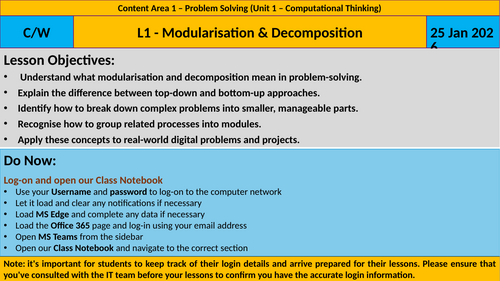
This resource for Content Area 1: Problem Solving (Unit 1: Computational Thinking) provides a comprehensive lesson on Modularisation & Decomposition. It is designed to help students understand how to analyse complex problems and solve them through structured algorithmic thinking.
Resource Overview
This lesson focuses on breaking down large problems into manageable parts and grouping related processes into functional units. It uses relatable real-world analogies, such as planning a dinner or building a login system, to make abstract concepts accessible.
Key Learning Objectives
- Define modularisation and decomposition in the context of problem-solving.
- Distinguish between top-down and bottom-up approaches.
- Identify how to break complex problems into smaller, manageable parts (decomposition).
- Recognise how to group related processes into modules.
- Apply these computational thinking concepts to digital projects and real-world scenarios.
What’s Included?
- Lesson Content: Detailed explanations of core concepts including the “Problem Domain,” modularity, and both top-down and bottom-up strategies.
- Visual Aids: Clear diagrams illustrating the decomposition of tasks and modular structures.
- Practice Tasks:
-
- “Do Now” Activity: An introductory visual puzzle to engage students in logical thinking.
-
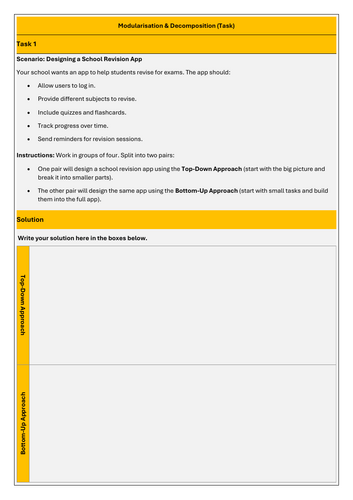
- Decomposition Exercises: Practical tasks where students decompose everyday scenarios like making a sandwich, planning a school trip, or designing a game.
-
- Fill-in-the-Blanks: A task to reinforce key vocabulary and concepts.
- End-of-Lesson Questions: Ten open-ended questions designed to test comprehension and critical thinking, complete with model answers.
Something went wrong, please try again later.
This resource hasn't been reviewed yet
To ensure quality for our reviews, only customers who have purchased this resource can review it
Report this resourceto let us know if it violates our terms and conditions.
Our customer service team will review your report and will be in touch.
£4.99