pptx, 180.35 KB
pptx, 180.35 KB

Animated velocity-time graphs PowerPoint for Edexcel GCSE Physics and Combined Science: gradient, area and distance. Foundation and Higher.

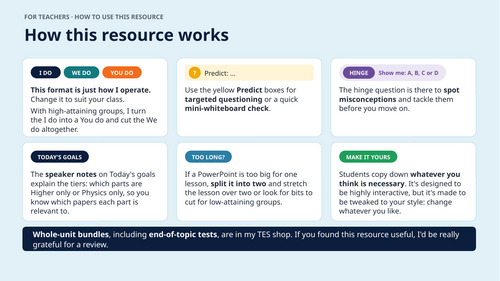
This PowerPoint is Lesson 5 of 12 in Topic 2, Motion and Forces, written for KS4 classes taking Edexcel GCSE Physics (1PH0) or Combined Science (1SC0), and it takes about 60 minutes. Every slide reveals on click, so lines, gradient triangles and shaded areas appear one step at a time. The deck is fully editable.

What the lesson covers

Spec 2.10a: reading a velocity-time graph, including sloping up, flat, sloping down and on the axis
Spec 2.7 and 2.10: telling a distance-time graph from a velocity-time graph, and why you read the axes first
Spec 2.10a: comparing accelerations from the steepness of the line
Spec 2.10b: acceleration = gradient, and a negative gradient as deceleration
Spec 2.10c: distance travelled = area under the graph, splitting it into rectangles and triangles

What’s inside the 29 slides

A retrieval starter on v² − u² = 2ax from Lesson 4
A recap of the area of rectangles and triangles, the maths this lesson depends on
Three concept blocks, each with a hinge question and an I do / We do / You do sequence of Edexcel-style exam questions
Model answers worked on the graph itself, so students see where every value is read from
An exam-answer slide on “describe the motion” answers: a word and a value read from the graph
A full journey question where students draw the graph and then find the distance
Mini-whiteboard quick-fire checks, a summary slide and an exit ticket

Common mistakes covered

After Lesson 2, many students read a velocity-time graph as if it were a distance-time graph, so a flat line becomes “stopped”. The lesson puts the two graphs side by side early on and keeps going back to the axis labels. For the area method, lines are dropped from each corner of the graph so students remember the ½ for triangles.

Part of a complete unit

This is Lesson 5 of 12 in my Edexcel GCSE Physics Motion and Forces unit. Velocity-time graphs return in Lesson 6 (forces and the skydiver) and Lesson 12 (the emergency stop), so this lesson pays off later.

Previous lesson: Equations of Motion v² − u² = 2ax Lesson | Edexcel GCSE https://www.tes.com/teaching-resource/resource-13690651

Next lesson: Newton’s First Law & Resultant Force Lesson | Edexcel GCSE https://www.tes.com/teaching-resource/resource-13690659

The full unit: all 12 lessons, a revision lesson and two end of topic tests in the Motion and Forces Unit bundle https://www.tes.com/teaching-resource/motion-and-forces-unit-edexcel-gcse-physics-13695559

Last updated: November 2026

Get this resource as part of a bundle and save up to 40%

A bundle is a package of resources grouped together to teach a particular topic, or a series of lessons, in one place.

Bundle

Motion and Forces Unit | Edexcel GCSE Physics

Complete Motion and Forces unit for Edexcel GCSE Physics and Combined Science Topic 2: 12 animated lessons, a revision lesson and two end of topic tests. This bundle is written for KS4 classes taking Edexcel GCSE Physics (1PH0) or Combined Science (1SC0), Foundation and Higher. It covers every specification point in Topic 2 (2.1–2.33P) across 13 lessons and a test. Higher-only and Physics-only content is labelled throughout, so one set of resources works for every group you teach. **What's included** Scalars and Vectors (spec 2.1–2.6, 2.12) Distance-Time Graphs and Measuring Speed (2.7, 2.11) Acceleration (2.8, 2.13) Equations of Motion: v² − u² = 2ax (2.9) Velocity-Time Graphs (2.10) Resultant Force and Newton's First Law (2.14) Newton's Second Law, Weight and Mass (2.15–2.18, 2.22) Core Practical: Force, Mass and Acceleration (2.19) Circular Motion, Higher only (2.20–2.21) Newton's Third Law and Momentum (2.23–2.25) Force, Momentum and Crash Safety (2.26, 2.31) Reaction Times and Stopping Distances (2.27–2.30, 2.32P–2.33P) Motion and Forces Revision Lesson Two parallel end of topic tests (Papers A and B), 60 marks each, with mark schemes in Word and PDF **What every lesson includes** Each of the 13 lessons is an animated, click-to-reveal PowerPoint of 27–35 slides, fully editable, with: A retrieval starter Three or four concept blocks with hinge questions and I do / We do / You do sequences of Edexcel-style exam questions Model answers that build line by line, with "thinking aloud" prompts Exam-answer slides that show exactly what examiners reward Mini-whiteboard quick-fire checks, a summary slide and an exit ticket **Why buy the bundle** Every lesson uses the same structure, so students learn the routine once and spend their time on the content. The lessons build on each other: the acceleration equation from Lesson 3 returns in the core practical, crash safety and stopping distances. Retrieval starters revisit the previous lesson, so knowledge sticks. Levelled 6-mark questions appear throughout, on the skydiver, the core practical method, momentum and crash safety. The unit ends with a revision lesson and two parallel tests. Each test has four labelled routes (Combined Foundation, Combined Higher, Physics Foundation and Physics Higher), so mixed classes can sit the same paper. Use Paper B for resits after feedback. **Ideal for** Teaching Topic 2 for the first time, or rebuilding a scheme of work Departments that want one consistent lesson structure across several teachers Mixed classes with Combined Science and Physics students, or Foundation and Higher together **Save 40%** Lesson 1 is free, and the other 13 resources cost £47.00 bought separately. The bundle gives you the whole Edexcel GCSE Physics Motion and Forces unit for £27.99. If you buy it, I'd be grateful for a review. It helps other teachers find the resources. Last updated: November 2026

£27.99

Reviews

Something went wrong, please try again later.

This resource hasn't been reviewed yet

To ensure quality for our reviews, only customers who have purchased this resource can review it

Report this resourceto let us know if it violates our terms and conditions.
Our customer service team will review your report and will be in touch.