


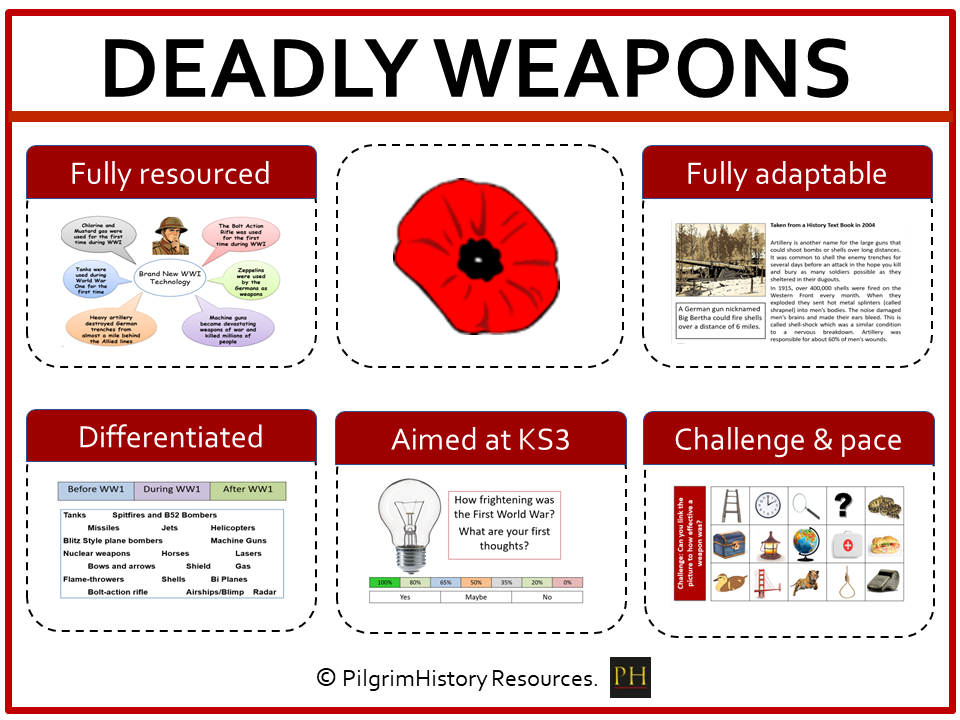

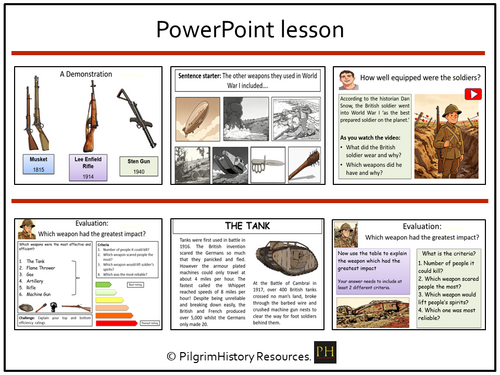
The aim of this lesson is to investigate how deadly and effective the new weapons of the First World War were and how developments in military technology changed warfare on the Western Front.
Students investigate whether soldiers were as well equipped as might be expected at the beginning of the twentieth century, focusing on the experience and equipment of the British Tommy. They explore weapons used before, during and after the war, identifying examples of continuity and change.
The lesson examines key weapons including machine guns, artillery, tanks, poison gas, rifles and grenades. Students consider how each weapon worked, its advantages and limitations, and how effective it was against the enemy.
Using visual sources, discussion and historical interpretation, students assess how far new weapons changed warfare and contributed to the huge casualties of the conflict. They also examine Dan Snow’s claim that the British soldier entered the First World War “as the best prepared soldier on the planet”, using evidence to judge how accurate this interpretation is.
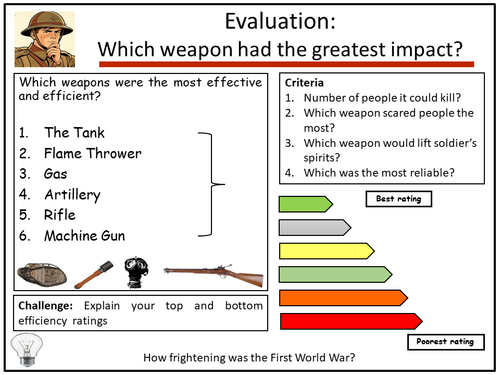
Students rate the effectiveness and killing power of different weapons and analyse the equipment carried by soldiers in the trenches. They then distinguish between deadliness and effectiveness, considering whether increasingly powerful weapons necessarily made armies more effective.
The lesson concludes with a visual plenary linking images to different weapons, allowing students to retrieve key knowledge and demonstrate their understanding of technological change during the First World War.
The lesson is enquiry-based, with a key question introduced at the start and revisited throughout as students develop their understanding and reach a reasoned judgement.
Included within this lesson:
Fully editable PowerPoint
Development of weapons before, during and after World War 1
The British Tommy and his equipment
Rating the effectiveness and killing power of weapons
Advantages and limitations of new technology
Continuity and change activities
Retrieval practice
Differentiated materials for mixed-ability classes
Suggested teaching strategies
Please leave a review if you find this resource useful. Your feedback will be gratefully appreciated.
Something went wrong, please try again later.
Great resource
Report this resourceto let us know if it violates our terms and conditions.
Our customer service team will review your report and will be in touch.
£3.50