GCSE EDUQAS MEDIA, COMPONENT 1 REVISION GUIDE (ALL FORMS COVERED IN BOTH SECTION A AND B)Quick View
BarberJake

GCSE EDUQAS MEDIA, COMPONENT 1 REVISION GUIDE (ALL FORMS COVERED IN BOTH SECTION A AND B)

(5)
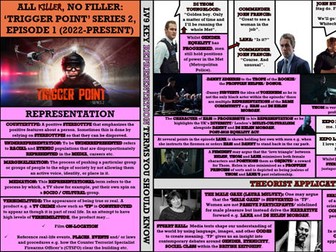
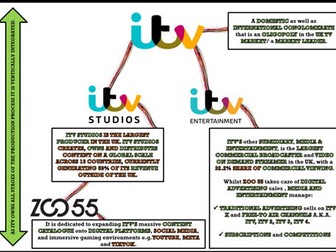
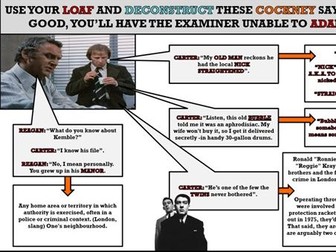
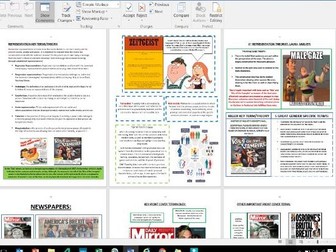
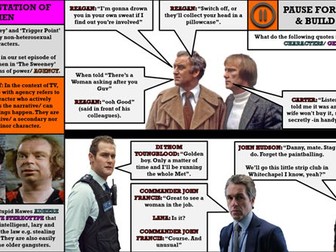
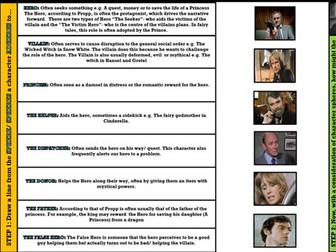
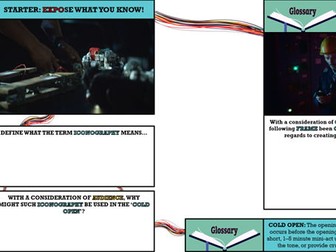
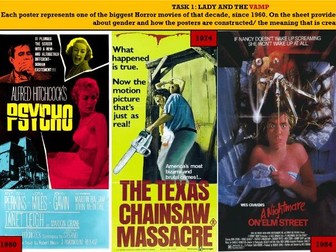
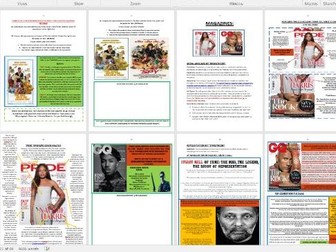
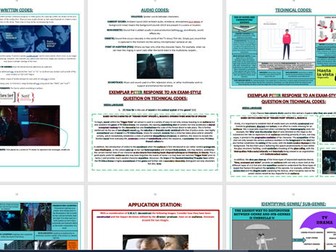
This 89 page Revision Guide covers all of the COMPONENT 1, SEC A and B texts in the GCSE EDUQAS Exam. The guide has been a year and a half in the making and consists of insights I have found teaching the EDUQAS specification this year. Moreover, the guide was created based on student feedback, areas of weakness I observed from that of my students during lessons/ mocks and content designed to stretch learners above the Grade 7. The guide is split into 3 easy to navigate sections: User Guide, Exam Breakdown, All 4 Rail terms broken down in a nutshell, all 5 contexts explained and ideal timings for the exam. All Section A forms; ‘Quality Street’, ‘This Girl Can’, ‘TMWTGG’ , ‘Spectre’, ‘Pride’, ‘GQ’, ‘The Sun’ and ‘The Guardian’. All section B forms including ‘Spectre’, ‘The Sun’, ‘Pokemon Go’ and ‘The Archers’ The guide includes the following: -A* Exemplars written by me based upon EDUQAS SAM’s questions, questions I have written myself and key areas of concern raised by the survey and students. -A coloured key consisting of two boxes; Green- TOP TIP FOR THE EXAM/ EXAMINER and Blue- KILLER FACT OR THEORY FOR THE EXAM and a glossary for each form and each assigned RAIL Term. -For those of you who have purchased my resources from the TES before or are familiar with my Power Points, the guide is a vibrant and visual revision aide. The guide consists of slides/ resources taken from my Power Points and lessons. -Each Form is studied in depth and against all of RAIL, based upon what Section/ Sections of the exam it pops up in. For example, the Newspaper Unit appears in SEC A (Media Language and Representation) and SEC B (AUD and IND). -There are a variety of tasks assigned to each form (which can be done in the boxes/pages provided in the booklet) which prompt students to apply newfound knowledge as well as ass retained knowledge of terms or theories they have learned about earlier in the guide. These tasks range from writing PEE exemplars based on an Exam style question to brainstorms, opinion/debate tasks and key considerations for the exam. These are ideal for H/W or Revision tasks and can be linked to tasks in class. -An in-depth glossary at the start of each form on all of the RAIL elements. This changes each time, for each form. PLEASE CONSULT THE SAMPLE PAGES IF UNSURE WHETHER OR NOT THIS RESOURCE IS FOR YOU. Read less
2027 EDUQAS GCSE MEDIA EXAMS ONWARDS: RADIO INDUSTRY AND CONTEXTS ' DESERT ISLAND DISCS'Quick View
BarberJake

2027 EDUQAS GCSE MEDIA EXAMS ONWARDS: RADIO INDUSTRY AND CONTEXTS ' DESERT ISLAND DISCS'

(0)
This 5 lesson power point begins a 10 lesson unit on BBC Radio 4 and ‘Desert Island Discs’. This 5 lesson resource focuses on Industry and contexts within the Radio industry/ the BBC and includes: -Exam breakdown advice, timings and colour-coding explained (all glossary terms are coloured to match their RAIL/ CHEPS focus). -Listening to the set episode of ‘DID’ and conducting a listenership breakdown/ the stduents own Castaway Desert Island compilation (there are sections throughout the lesson which afford an opportunity to hear from castaway students). **-I have filled out my own Exemplar castaway list and have provided a blank one for you to compile your own- this is great for personal companionship with students. -A breakdown of what falls under Industry. -Commercial V Niche radio. -National and Regional radio and the differing BBC Radio channels. -DAB, AM and FM radio. -What is a podcast? (Auio/visual video to support). -Creation of key facts sheet for BBC Sounds. -A visual infographic breakdown of convergenec in ‘DID’. -OFCOM, self-regulation and independent regulation. -Walled Garden radio at the BBC. -What is a PSB and commercial radio channel? -Subsidaries, conglomerates, diversification and for-profit. A visual infographic designed to explain vertical integration and it’s relevance to BBC Radio, in-house production and BBC studios. Pro’s and con’s of Vertical integration. The Roy Stepped/ scaffolded deconstruction and answering of the following adapated 2024 past questions which are tackled after content is covered: -3 (a) Name the organisation that produces ‘Desert Island Discs’. [1] 3 (b) . Name the organisation that regulates the radio industry in the UK. [1] 3 © Briefly explain the different types of funding for radio in the UK. [5] 3 (d) Explain how the radio industry uses technology to promote its products. Refer to Desert Island Discs to support your points. [10] IMPORTANT: This includes printable resources sheets within the power point as well as embedded videos and support information/ advice in the notes sections, regarding best in-class delivery. It also includes a pritable Starter task to be conducted suring the listening phase of the set episode. The resource also includes a printable homework pack with a responsive highlighting sheet for teachers included. . Support and suggested teaching delivery is also noted in the notes section alongside sources/ references). Whilst I have embedded a variety of videos, due to blocks on school accounts/ restrictions, if they do not **work, please see the links in the notes section of each slide. NOTE: I am following EDUQAS Teaching Model 1 in my teaching/ SOW and my school is providing Media Studies GCSE as a Three- Year Course. If you liked this resource and found it useful, it would be greatly appreciated if you could feedback or rate my resource as I am constantly trying to adapt and refine my resources to improve the learning of my students. Many thanks.
'NHS 111' REPRESENTATION AND CONTEXTSQuick View
BarberJake

'NHS 111' REPRESENTATION AND CONTEXTS

(0)
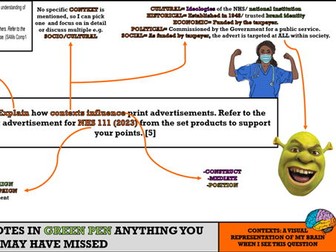
FOR 2027 EXAMS ONWARDS! This 4 lesson resource concludes the print advertising unit for the ‘NHS 111 GET TO THE HELP YOU NEED’ advert. This resource includes: -Starter to assess students knowledge of Media Language and Representation terms and application to the advert with support green pen slide after. -Retained learning on the following terms; mediation, progressive, regressive, construction, underrepresentation, tokenism, marginalisation, hegemonic/ maligned mass, ideology, male gaze and selection and combination. This task is supported with etimological help and highlighting of key parts of the word. -1975 Sex Discrimination Act and 2010 Equality Act -A break down of contexts, what to focus on for each and an application to the ‘NHS 111’ advert. -The myth of the absentee black father and the current situation of the NHS (both with embedded audio/visual video for context). -The BAME community and the impact of Covid. -A visual example of selection and combination applied to the ‘NHS 111’ advert before students apply to two unseen examples. -How does the Father challenge DOMINANT IDEOLOGIES/ SOCIETAL NORMS? (with green pen additional points) -Via the use of MISE-EN-SCENE and SHARED CONCEPTUAL ROADMAP theory (HALL), how is the child’s gender CONSTRUCTED to the AUDIENCE? (with green pen additional points) -The NHS often picks ‘normal’ people/ non-celebrities in their campaigns? Note down the impact this has on the message of the campaign. For a LV9 response, consider VERISIMILITUDE in your response (with green pen additional points). -(a) Explain how contexts influence print advertisements. Refer to the print advertisement for NHS 111 (2023) from the set products to support your points. [5] IMPORTANT: This resource includes a resource sheet as well as printable resources sheets within the power point as well as embedded videos. The resource also includes a printable homework double-sided sheet also. Support and suggested teaching delivery is also noted in the notes section alongside sources/ references). Whilst I have embedded a variety of videos, due to blocks on school accounts/ restrictions, if they do not **work, please see the links in the notes section of each slide. NOTE: I am following EDUQAS Teaching Model 1 in my teaching/ SOW and my school is providing Media Studies GCSE as a Three- Year Course. If you liked this resource and found it useful, it would be greatly appreciated if you could feedback or rate my resource as I am constantly trying to adapt and refine my resources to improve the learning of my students. Many thanks.
COMPONENT 1 REVISION GUIDE (ALL FORMS COVERED IN BOTH SECTION A AND B)Quick View
BarberJake

COMPONENT 1 REVISION GUIDE (ALL FORMS COVERED IN BOTH SECTION A AND B)

(3)
This 74 page Revision Guide covers all of the COMPONENT 1, SEC A and B texts. The guide has been a year in the making and consists of insights I have found teaching the EDUQAS specification this year, is structured on a survey conducted by 30 teachers teaching the EDUQAS course around the country (what they would like from a revision guide/ areas of weakness in their students) and on that of my own students suggestions based upon their key worries. The guide is split into 3 easy to navigate sections: User Guide, Exam Breakdown, All 4 Rail terms broken down in a nutshell, all 5 contexts explained and ideal timings for the exam. All Section A forms; ‘Tide’, ‘Kiss of the Vampire’, ‘WaterAid’ , ‘The TImes’, ‘Daily Mirror’, ‘Dream’ and ‘Riptide’. All section B forms (Including ‘Tide’, ‘Kiss of the Vampire’ and ‘WaterAid’ (AUD) and ‘The Times’ and ‘Daily MIrror’ (AUD & IND), ‘Straight Outta Compton’, ‘I, Daniel Blake’, ‘Assassin’s Creed III: Liberation’ and 'Late NIght Woman’s Hour’ The guide includes the following: -A* Exemplars written by me based upon EDUQAS SAM’s questions, questions I have written myself and key areas of concern raised by the survey and students. -A coloured key consisting of two boxes; Green- TOP TIP FOR THE EXAM/ EXAMINER and Blue- KILLER FACT OR THEORY FOR THE EXAM and a glossary for each form and each assigned RAIL Term. -For those of you who have purchased my resources from the TES before or are familiar with my Power Points, the guide is a vibrant and visual revision aide. The guide consists of slides/ resources taken from my Power Points and lessons. -Each Form is studied in depth and against all of RAIL, based upon what Section/ Sections of the exam it pops up in. For example, the Newspaper Unit appears in SEC A (Media Language and Representation) and SEC B (AUD and IND). -There are a variety of tasks assigned to each form (which can be done in the boxes/pages provided in the booklet) which prompt students to apply newfound knowledge as well as ass retained knowledge of terms or theories they have learned about earlier in the guide. These tasks range from writing PEE exemplars based on an Exam style question to brainstorms, opinion/debate tasks and key considerations for the exam. These are ideal for H/W or Revision tasks and can be linked to tasks in class. PLEASE CONSULT THE SAMPLE PAGES IF UNSURE WHETHER OR NOT THIS RESOURCE IS FOR YOU. **IMPORTANT! I am teaching the two-year linear EDUQAS A-Level. However, this can also be used and adapted as you see fit for AS teaching in Year 12. Moreover, I am teaching ‘Riptide’ by Vance Joy and ‘Dream’ in the Music Video UNit and NOT ‘Formation’ by Beyonce. There is however, much cross over between the two videos and the guide can easily be altered dependent on your preferences.
'NHS 111' MEDIA LANGUAGE AND CONTEXTSQuick View
BarberJake

'NHS 111' MEDIA LANGUAGE AND CONTEXTS

(0)
FOR 2027 EXAMS ONWARDS! This 5 lesson resource begins the print advertising unit for the ‘NHS 111GET TO THE HELP YOU NEED’ advert. This resource includes: -A breakdown/ reminder of the COMP 1 paper and content/ timings. -Discovery learning task on the NHS with guided talking points. -The history of the NHS with video resource. -Multi-Channel campaign. ROUTEMASTER: WHAT IS THE ROUTE ORIGIN OF THE ABOVE PHRASE OR WORD? (DONE TO ENCOURAGE ETYMOLOGY) for the words Public Service Campaign, Denotation and Connotation. What is Media Languag? A visual checklist and SWAT (Symbolic Written Audio Technical) retained learning task. Look at the following posters from the same campaign our ‘NHS 111’ poster is taken from. What meaning do you think is being constructed via symbolic codes -Guided learning task/ scaffoling of the NHS set text against theories/ terms such as; direct mode of address, narrative theories, mise-en-scene etc. (With additional support/ stretch). -In depth breakdown of unseen NHS advert against the following question: Explore how the COVID-19 NHS advertisement uses the following elements of media language to create meanings: (a). images (b). text/ written language ©. layout and design before being applied to that of the NHS advert with a slightly different question: Explore how the advertisement the NHS uses the following elements of media language to create meanings: (a). images (b). text/ written language ©. narrative Exemplar first paragraph written by me for studnets to model on, before studnets complete their own response under timed conditions. IMPORTANT: This resource includes a resource sheet as well as printable resources sheets within the power point as well as embedded videos. The resource also includes a printable Forenite-ly homework pack also. Support nad suggested teaching delivery is also noted in the notes alongside sources/ references). Whilst I have embedded a variety of videos, due to blocks on school accounts/ restrictions, if they do not **work, please see the links in the notes section of each slide. NOTE: I am following EDUQAS Teaching Model 1 in my teaching/ SOW and my school is providing Media Studies GCSE as a Three- Year Course. If you liked this resource and found it useful, it would be greatly appreciated if you could feedback or rate my resource as I am constantly trying to adapt and refine my resources to improve the learning of my students. Many thanks.
YEAR 12 (MEDIA EDUQAS LINEAR): Component 1, Section b: Audience in Advertising and marketingQuick View
BarberJake

YEAR 12 (MEDIA EDUQAS LINEAR): Component 1, Section b: Audience in Advertising and marketing

(3)
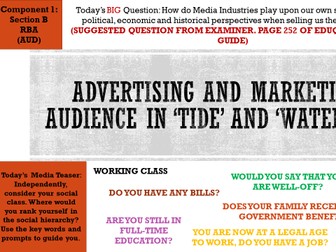
LESSON 1-2 (Double): This lesson looks at Audience in the 'Tide', and 'Water Aid' adverts. This double lesson explores: -Demographics -ABC1/C2DE -Cultivation Theory (George Gerbner) -Active and Passive Audiences -How audiences are broken down into the sub-categories of Age, Occupation, Gender, Region and Ethnicity. This will be uploaded as a series of lessons on Component 1, Section B and will be part of a group of resources with different theories/terms as headings under each Exam Component (Both Section A and B). This lesson is therefore Ideal for those wanting to Team Teach or teach Component 1, Sections A and B at differing times. HOMEWORK RESOURCE INCLUDED. NOTE: I am following EDUQAS Teaching Model 1 in my teaching/ SOW and my school is only providing Media Studies at A-Level, as a Two- Year Course. Moreover, each lesson has a task whereby students RAG (Red, Amber, Green) what they have learnt in the lesson against an Examiner checklist (Differentiation, peer assessment).
YEAR 12 (MEDIA EDUQAS LINEAR): Component 1, Section A: Representation in Advertising and marketingQuick View
BarberJake

YEAR 12 (MEDIA EDUQAS LINEAR): Component 1, Section A: Representation in Advertising and marketing

(3)
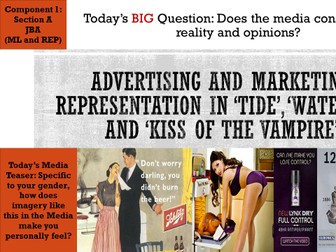
LESSON 1-3 (TRIPLE): This TRIPLE lesson looks at representation in the ‘Tide’, ‘Kiss of the Vampire’ and ‘Water Aid’ adverts. This double lesson explores: -Mediation -Representation of gender -Progressive and Regressive representations -Socio/cultural, historical, political and economic contexts within represnetation -Stuart Hall’s encoding/decoding model -Stuart Hall’s dominated, negotiated and oppositional theory This will be uploaded as a series of lessons on Component 1, Section A and will be part of a group of resources with different theories/terms as headings under each Exam Component. This lesson is therefore Ideal for those wanting to Team Teach or teach Component 1, Sections A and B at differing times. HOMEWORK RESOURCE INCLUDED. NOTE: I am following EDUQAS Teaching Model 1 in my teaching/ SOW and my school is only providing Media Studies at A-Level, as a Two- Year Course. Moreover, each lesson has a task whereby students RAG (Red, Amber, Green) what they have learnt in the lesson against an Examiner checklist (Differentiation, peer assessment).
COMPONENT 1, SECTION B MASTERY EDUQAS A-LEVEL SHEETS: RADIO 'LATE NIGHT WOMAN'S HOUR' (AUDIENCE)Quick View
BarberJake

COMPONENT 1, SECTION B MASTERY EDUQAS A-LEVEL SHEETS: RADIO 'LATE NIGHT WOMAN'S HOUR' (AUDIENCE)

(2)
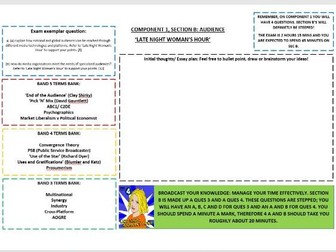
This resource is part of a set of resources designed to assess students and revisit content at various points throughout the entirety of the A- Level Linear course. Each resource comprises of a task or mock questions taken from the SAMS. The resource includes: -2 Stepped questions/ key focus -Banded terms glossary (3-5) for stretch and challenge -Marking criteria with indicative content -2 differentiated help sheets with key slides from my power points to aide students as a last result (they are encouraged not to use these if possible). I have trialled these packs and my students love them commenting that they are great for revision and revisiting content in a supported way, that they may not have visited in a year or so. I have set these as cover, revision in private study, as a whole lesson task or for H/W. Content often stretches on these sheets from between 2-3 lessons and I usually get my students to swap work when complete with a peer for peer assessment. The resource is self-contained and can be issued with no other prompt. This lesson focuses on the question: (A) Explain how national and global audiences can be reached through different media technologies and platforms. Refer to ‘Late Night Woman’s Hour’ to support your points. [8] (B) How do media organisations meet the needs of specialised audiences? Refer to ‘Late Night Woman’s Hour’ to support your points. [12]
YEAR 12 (MEDIA EDUQAS LINEAR): COMP1, SEC B: GAMING, AUDIENCE AND GAMING CULTURE (ACIII: LIBERATION)Quick View
BarberJake

YEAR 12 (MEDIA EDUQAS LINEAR): COMP1, SEC B: GAMING, AUDIENCE AND GAMING CULTURE (ACIII: LIBERATION)

(2)
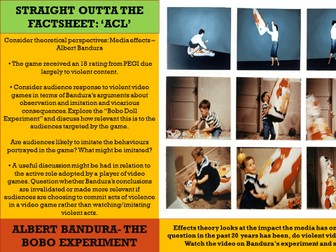
LESSON 32- 37, IN THE SERIES OF SECTION B LESSONS= This five lesson power point continues and concludes the Assassins Creed III: Liberation unit and focuses on Industry, Audience, Gaming Culture and Circulation. The FIVE lesson looks at: -Information on the 15 Most Popular Gaming franchises of all time, of which Assassin’s Creed is one. -Assessing retained learning of the Top Five Audience theories to use in the Exam (Based on the Fact Sheets) -Henry Jenkins (PARTICIPATORY MEDIA, FANDOM AND CONVERGENCE THEORY) -Prosumerism -Fan culture, fiction and Cosplay -Exam style question: To what extent are games such as Assassins Creed popularised and marketed by fandom? Discuss using examples from your study of the text. -Psychographics -Exploration into the PS Vita (advantages and advancements in gaming gratification) -Multi-platform releases -Gaming infographics task where students acquire and condense outstanding facts for the exam not in the fact sheets -Traditional gaming habits versus modern ones -DISCUSSION POINT: WITH THIS NOTION OF ‘ON THE GO’, DO YOU THINK GAMERS ARE PASSIVE OR ACTIVE AUDIENCES? -DLC’S -What are the pro’s and con’s to DLC’s and additional content? -George Gerbner’s Cultivation Theory -Moral Panics around gaming -Folk Devils -ALBERT BANDURA- THE BOBO EXPERIMENT (Effects theory) -TASK 5: Audience consolidation= You will now have 90 MINUTES to apply all of the above theories to ACL. I will provide you with an A3 sheet. You will create a revision resource on audience as I believe this has a high likelihood of coming up on this years exam. Before you start however, read through pages 115-119 of the EDUQAS revision guide. Once you are finished, placed in your folder, under the ACL section. **THIS LESSON INCLUDES A CONSOLIDATION H/W TASK/ DESIGN OF A REVISION RESOURCE, ALL LINKS AND PRINTABLE RESOURCE SHEETS WITHIN THE POWER POINT ** This will be uploaded as a series of lessons on Component 1, Section B and will be part of a group of resources with different theories/terms as headings under each Exam Component. This lesson is therefore Ideal for those wanting to Team Teach or teach Component 1, Sections A and B at differing times. NOTE: I am following EDUQAS Teaching Model 1 in my teaching/ SOW and my school is only providing Media Studies at A-Level, as a Two- Year Course. Moreover, each lesson has a task whereby students RAG (Red, Amber, Green) what they have learnt in the lesson against an Examiner checklist (Differentiation, peer assessment). If you liked this resource and found it useful, it would be greatly appreciated if you could feedback or rate my resource as I am constantly trying to adapt and refine my resources to improve the learning of my students. Many thanks.
COMPONENT 2: TV IN THE GLOBAL AGE, 'THE BRIDGE' (MEDIA LANGUAGE AND GENRE)Quick View
BarberJake

COMPONENT 2: TV IN THE GLOBAL AGE, 'THE BRIDGE' (MEDIA LANGUAGE AND GENRE)

(1)
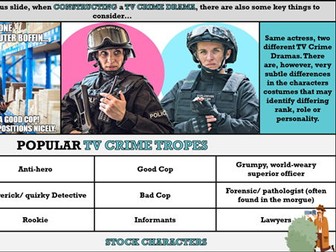
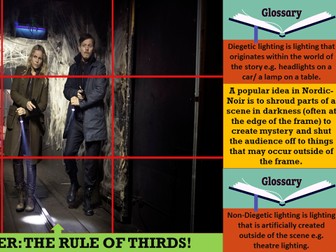
‘THE BRIDGE’ Lesson 5-8= This Quad lesson is part of a tailored unit to help students understand the differences between writing for Component 1 and 2. I have designed the ‘Life on Mars’ and ‘The Bridge’ lessons separately so as to focus on all of RAIL (Representation, Audience, Industry and Language (Media) respectively. 'The Bridge lessons will follow exactly the same format as the ‘Life On Mars’ series of lessons and will include 4 Power Points, one on each of the RAIL terms. There will also be a lesson on Narrative and Post-Modernism where both forms will be combined into one lesson due the difficulty students often have with such concepts. It is my intention to teach my students the RAIL term for ‘Life On Mars’ and then 'The Bridge to aid their compare and contrasting. This Quad lesson features: -Examiner expectations -Context and reading material around characters/ their names to aid in student identification -A brief outline of the show and the various remakes of the show. -Iconography and Steve Campsall’s opinions -Teaching the students RESIST -Hybridity, intertextuality and genre/sub-genre -A break down of what Nordic Noir is and it’s conventions/ historical influence -Reoccurring themes -To what extent does ‘The Bridge’ adhere to the codes and conventions of the sub-genre of Nordic Noir? (ACTIVITY) -To what extent is Saga conventional of the Nordic Noir Tradition/ crime sub-genre? (ACTIVITY) -Revisiting key theory and looking at the 5 key theories the examine mentions with regards to Media Lang and TV (Differentiated, scaffolded group task) -Application of key examiner theories to that of an unseen clip/ writing task -Chiaroscuro lighting -Pathetic Fallacy -Symmetrical Framing -Diegetic and non-diegetic lighting -Positioning and Ideology -Analysis of ‘The Killing’ with that of ‘The Bridge’ **THIS LESSON INCLUDES 2 H/W TASKS (ONE REQUIRES THE EDUQAS REVISION GUIDE/ THE OTHER I HAVE PROVIDED A SHEET FOR), ALL LINKS, PRINTABLE RESOURCES AND PRINTABLE RESOURCE SHEETS WITHIN THE POWER POINT NOTE: I am following EDUQAS Teaching Model 1 in my teaching/ SOW and my school is only providing Media Studies at A-Level, as a Two- Year Course. Moreover, each lesson has a task whereby students RAG (Red, Amber, Green) what they have learnt in the lesson against an Examiner checklist (Differentiation, peer assessment). If you liked this resource and found it useful, it would be greatly appreciated if you could feedback or rate my resource as I am constantly trying to adapt and refine my resources to improve the learning of my students. Many thanks.
YEAR 12: LESSON 5-6 GENRE, CODES AND CONVENTIONS (NEW LINEAR EDUQAS A-LEVEL 2017 ONWARD)Quick View
BarberJake

YEAR 12: LESSON 5-6 GENRE, CODES AND CONVENTIONS (NEW LINEAR EDUQAS A-LEVEL 2017 ONWARD)

(2)
YEAR 12: LESSON 5-6 GENRE, CODES AND CONVENTIONS= This Double lesson focuses on codes (written, symbolic and technical), conventions, genre, sub-genre, hybrids and Levi-Strauss theory of Structuralism. The lesson is based around the EDUQAS Examiner forms 'Kiss of the Vampire' and the 'Tide' print advert. More difficult aspects of the lesson e.g. Structuralism are reinforced by audio/visual stimuli. This resource also includes a homework task and an analytical lesson resource task. NOTE: I am following EDUQAS Teaching Model 1 in my teaching/ SOW and my school is only providing Media Studies at A-Level, as a Two- Year Course. Moreover, each lesson has a task whereby students RAG (Red, Amber, Green) what they have learnt in the lesson against an Examiner checklist (Differentiation, peer assessment).
TEACHER EXEMPLAR EDUQAS 2025 GCSE COMPONENT 1 PAPERQuick View
BarberJake

TEACHER EXEMPLAR EDUQAS 2025 GCSE COMPONENT 1 PAPER

(0)
This is an exemplar Component1 paper written for for the official 2025 Summer GCSE exam paper. This is a great resource for; peer assessment, scaffolding and giving to studnets pre/post-mock, having written it themselves. Each response has key terms/ theories colour-coded as follows: PINK- Represnetation AUDIENCE- Yellow GREEN- Industry BLUE- Media Langugae ORANGE- Contexts If you liked this resource and found it useful, it would be greatly appreciated if you could feedback or rate my resource as I am constantly trying to adapt and refine my resources to improve the learning of my students. Many thanks.
EDUQAS GCSE REVISION LUNCH, SESSION 1: ML AND REP IN 'QUALITY STREET' AND 'THIS GIRL CAN'Quick View
BarberJake

EDUQAS GCSE REVISION LUNCH, SESSION 1: ML AND REP IN 'QUALITY STREET' AND 'THIS GIRL CAN'

(1)
This is the first of 10 thirty minute sessions designed to cover all of the vital parts of Component 1 and 2. These have been taught by me and my team during lunchtimes, in the weeks building up to the exam. The content was created to be taught: -Fast -Embed knowledge of RAIL and Contexts -Provide students with a digital as well as print version in which they can take notes throughout the session. If you liked this resource and found it useful, it would be greatly appreciated if you could feedback or rate my resource as I am constantly trying to adapt and refine my resources to improve the learning of my students. Many thanks.
EDUQAS AS MEDIA, YEAR 12- ADVERTISING & MARKETING, 'WATERAID': MEDIA LANG & NARRATIVE (COMP 1 SEC A)Quick View
BarberJake

EDUQAS AS MEDIA, YEAR 12- ADVERTISING & MARKETING, 'WATERAID': MEDIA LANG & NARRATIVE (COMP 1 SEC A)

(2)
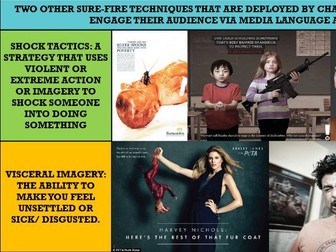
Having moved from a school that teaches the Linear A-Level, to that of a school that teaches AS in Year 12 and A2 in Year 13, I have designed and updated my previous lessons substantially with the following objectives in mind: 1.To compartmentalize and differentiate between the 9 theorists needed in Year 12 and the whole 19 at A2 (Year 13). 2.Provide my students and you with a variety of options e.g. the option to purchase my resources as AS or A2 having uploaded all of my Linear lessons previously. 3.Sizeable tweaks have been added base don having taught the new EDUQAS spec now for the past two years at A Level. 4.Where as before my lessons were numbered numerically from the first unit through to the last, this series of resources is designed to as self contained units making it easier to swap out and reintroduce content to assess retained learning. LESSON 1-3, MEDIA LANGUAGE AND NARRATIVE IN ‘WATERAID’. This TRIPLE lesson covers/includes: -Written,technical, symbolic and audio codes. -How Charity adverts engage and evoke emotion within audiences. -Group Task whereby each group focuses on one of the following and an analysis of WaterAid; Conventions Technical Codes, Written Codes, Symbolic Codes, Audio Codes, Rowland Barthes -Shock tactics -Visceral imagery -Does WaterAid adhere to or subvert the codes and conventions of Charity adverts? -Rowland Barthes and Claude Levi-Strauss tasks. -Todorov’s 5 stages of narrative theory -How does the Wateraid advert and the Barnado’s ‘Believe in me’ advert subvert conventional narrative and plot techniques employed in other charity campaigns? You may use your Wateraid factsheets to help you and must support your answer with media language terminology. PRINTABLE POWER POINT TASK SLIDES, NOTES/ANSWERS ON HOW TO DELIVER INCLUDED IN NOTES SECTION AS WELL AS LINKS TO RESOURCES/AUDIO/VISUAL. PART OF THE H/W INCLUDED IS A MASTERY SHEET 10 MARKER QUESTION. **H/W= This Power Point includes a three-part H/W as per my school’s policy for students to sit two hours piece of work that includes a ‘REVISE, TASK, PREPARE FOR NEXT LESSON’. All resources/links are included. Moreover, one of this lessons tasks requires the AS EDUQAS REVISION GUIDE. NOTE: I am following EDUQAS Teaching Model 1 in my teaching/ SOW and my school is only providing Media Studies at a AS/A2 Two- Year Course. If you liked this resource and found it useful, it would be greatly appreciated if you could feedback or rate my resource as I am constantly trying to adapt and refine my resources to improve the learning of my students. Many thanks. **
2025 ONWARDS UPDATED GCSE EDUQAS MEDIA, COMP 1 REVISION GUIDE (ALL FORMS COVERED IN SECTION A & B)Quick View
BarberJake

2025 ONWARDS UPDATED GCSE EDUQAS MEDIA, COMP 1 REVISION GUIDE (ALL FORMS COVERED IN SECTION A & B)

(1)
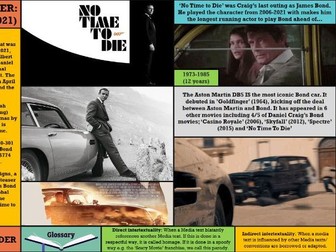
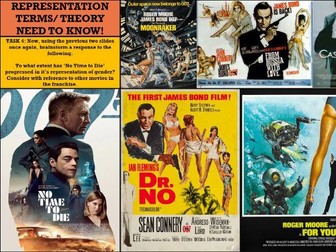
**IMPORTANT: THIS VARIES FROM THE 2023-2024 COMP 1 GUIDE WHICH CAN BE FOUND HERE: https://www.tes.com/teaching-resource/-12886069 AS IT INCLUDES ‘VOGUE’ (WHICH COMES ONTO THE EXAM IN 2025) INSTEAD OF ‘PRIDE’. ** This 126 page revision guide is designed for the EDUQAS GCSE Component 1 exam (2023-24). If you purchased my previous version of this guide, it has been completely overhauled with new content added and the document made more user friendly. More importantly, new texts which will be assessed in the 2024 exam season for the first time ‘No Time To Die’, ‘GQ’ (Raheem Sterling cover), have been added. This guide can be used for; independent revision purposes, as support alongside lessons (especially if delivering my purchased resources) or to set H/W tasks. The guide includes: -Colour coded to help students match terms with which part of RAIL/ Contexts it falls under. -Top tips/ timings for the exam. -Has a variety of Application Station tasks whereby students get the opportunity to apply what they have learned. -Has a variety of exemplars with key terms/ contexts/ theories highlighted. -An in-depth tariff bank on how to write every question in the exam from a 1 marker-25 marker, with whole or partial exemplars written by me. The guide’s contents page looks as follows: PAGES 3= USER GUIDE AND REVISION ADVICE PAGE 4-5= EXAM BREAKDOWN PAGES 6-7 = RAIL KEY TERMS BROKEN DOWN PAGE 8= CONTEXTS SECTION A FORM BREAKDOWN= PAGE 9 ADVERTISING AND MARKETING= ‘QUALITY STREET’ AND ‘THIS GIRL CAN’ PAGES 10-14= MEDIA LANGUAGE PAGES 15-21= REPRESENTATION FILM= ‘THE MAN WITH THE GOLDEN GUN’ AND ‘NTTD’ PAGES 22-30= MEDIA LANGUAGE PAGES 31-37= REPRESENTATION MAGAZINES= ‘GQ’ AND ‘VOGUE’ PAGES 38-43= MEDIA LANGUAGE PAGES 44-48 = REPRESENTATION NEWSPAPERS= ‘THE GUARDIAN’ AND ‘THE SUN’ PAGES 49-54= MEDIA LANGUAGE PAGES 55-60= REPRESENTATION SECTION B FORM BREAKDOWN= PAGE 61 FILM= ‘NTTD’ PAGES 62-74= INDUSTRY VIDEO GAMES= ‘FORTNITE PAGES 75-86= INDUSTRY PAGES 87-97 = AUDIENCE RADIO= ‘THE ARCHERS PAGES 98-100 = INDUSTRY PAGES 101-103= AUDIENCE NEWSPAPERS= ‘THE SUN’ PAGES 104-112 = INDUSTRY PAGES 113-120 = AUDIENCE TARIFF BANK: WRITE THE PERFECT COMPONENT 1 EXAM FROM START TO FINISH WITH EXEMPLAR RESPONSES: PAGES 121-126 NOTE: I am following EDUQAS Teaching Model 1 in my teaching/ SOW and my school is only providing Media Studies at GCSEl, as a three-year Course. Moreover, some of the tasks in lesson and for H/W are dependent upon owning the EDUQAS GCSE Revision Guide. If you liked this resource and found it useful, it would be greatly appreciated if you could feedback or rate my resource as I am constantly trying to adapt and refine my resources to improve the learning of my students. Many thanks.
2025 UPDATE: SECTION B, FILM INDUSTRY 'I, DANIEL BLAKE' MARKETING AND PROMOTIONQuick View
BarberJake

2025 UPDATE: SECTION B, FILM INDUSTRY 'I, DANIEL BLAKE' MARKETING AND PROMOTION

(0)
Lesson 5-7: This TRIPLE lesson concludes the 7-lesson unit on ‘I, Daniel Blake’. This lesson covers: -Marketing and promotion -An article/ task on marketing social realism in ‘I, Daniel Blake’ -The 150% rule in the film industry complete with an example and application task on ‘I, Daniel Blake’. -Viral marketing -Social movement -Grassroots marketing campaigns -Exhibition and distribution (Cannes, Palm D’Or) -‘I, Daniel Blake’ premiere -Disruptive Display Advertising -e-One and Trinity Mirror PLC campaign -e-One and Zenith synergy -‘I, Daniel Blake’ as a Social and political movement -Press Junkets -Inter-titles and task on the breakdown of the trailer -Internalisation -Application and consolidation task n past exam question: 34. Explain the ways in which social and political contexts may influence independent films. Refer to I, Daniel Blake to support your points. [12] **IMPORTANT: This resource includes printable power point/Word worksheets and notes in the notes section to support and guide teachers/ learning. Whilst I have embedded a variety of videos, due to blocks on school accounts/ restrictions, if they do not **work, please see the links in the notes section of each slide. The power point also includes theoretical framework slides at the end of the power point to aid differentiation/ scaffolding etc. NOTE: I am following EDUQAS Teaching Model 1 in my teaching/ SOW and my school operates a two year A-Level; AS (YEAR 12) AND A2 (YEAR 13). Moreover, some of the tasks in lesson and for H/W are dependent upon owning the EDUQAS AS/ A2 Revision Guides/ Mark Dixon’s ‘Media Theory for A Level: The Essential Revision Guide’ If you liked these resources and found them useful, it would be greatly appreciated if you could feedback or rate my resource as I am constantly trying to adapt and refine my resources to improve the learning of my students. Many thanks.
EDUQAS 2024 ONWARDS: A2 COMPONENT 2, MEDIA LANGUAGE IN 'PEAKY BLINDERS'Quick View
BarberJake

EDUQAS 2024 ONWARDS: A2 COMPONENT 2, MEDIA LANGUAGE IN 'PEAKY BLINDERS'

(1)
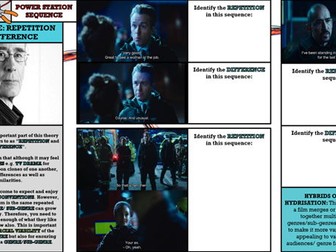
**IMPORTANT! IF YOU PURCHASED AND DOWNLOADED THIS RESOURCE BEFORE 6/3/23, PLEASE DOWNLOAD AGAIN. EDITS HAVE BEEN MADE TO THE H/W SLIDE WITH A FRAMEWORK H/W SHEET ADDED, AT NO EXTRA COST TO SUPPORT YOUR LEARNERS. IN ADDITION, QUESTION STRUCTURES ON BOTH PAPERS HAVE BEEN ALTERED AS PER 2023 CHANGES ** LESSON 1-5, MEDIA LANGUAGE IN THE SERIES: This unit explores TV in the Global Age. It is part of a series of lessons that run alongside the study of the foreign language text ‘The Bridge’. This set text becomes live as of the 2024 Exam season. This resource includes: -RESISTS, hybridisation, gere/ sub-genre -Long form TV Drama -Socio/cultural impact of ‘Peaky Blinders’ -The Hays code and the impact of the Western/ Gangster genres -In depth tailored tasks on all 5 of the Media Language Frameworks (Barthes, Claude-Levis Strauss, Neale, Todorov and Baudrillard) -Mise-en-scene -Motif, direct/indirect intertextuality and homage. -Embed/ comprehension tasks -The creation of a revision resource and exploration of an adapted Past Component 2 question: Option 1: Peaky Blinders and The Bridge Steve Neale argues that genres may be dominated by repetition, but they are also marked by difference, variation and change. Evaluate this theory of genre. Use the set episodes of Peaky Blinders and The Bridge to support your answer. [30] The resource includes printable slides and all worksheets needed. The 5 period lesson also requires the first period be dedicated to the viewing of the set episode, as the introductory task/ resource sheet is based on the viewing of the set episode. NOTE: I am following EDUQAS Teaching Model 1 in my teaching/ SOW and my school is providing Media Studies as an AS/A2 . Moreover, each lesson has a task whereby students RAG (Red, Amber, Green) what they have learnt in the lesson against an Examiner checklist (Differentiation, peer assessment). If you liked this resource and found it useful, it would be greatly appreciated if you could feedback or rate my resource as I am constantly trying to adapt and refine my resources to improve the learning of my students. Many thanks.
COMPONENT 2: TV IN THE GLOBAL AGE, 'LIFE ON MARS' (REPRESENTATION AND CONTEXTS)Quick View
BarberJake

COMPONENT 2: TV IN THE GLOBAL AGE, 'LIFE ON MARS' (REPRESENTATION AND CONTEXTS)

(1)
‘Life On Mars’ Lesson 14-16= This Triple lesson is part of a tailored unit to help students understand the differences between writing for Component 1 and 2. I have designed the ‘Life on Mars’ and ‘The Bridge’ lessons separately so as to focus on all of RAIL (Representation, Audience, Industry and Language (Media) respectively. 'The Bridge lessons will follow exactly the same format as the ‘Life On Mars’ series of lessons and will include 4 Power Points, one on each of the RAIL terms. 'The BRidge lessons will also be uploaded onto the TES as and when they are planned. It is my intention to teach my students the RAIL term for ‘Life On Mars’ and then 'The Bridge to aid their compare and contrasting. This Triple lesson features: Character Assassination: Assessment and visual analysis of Gene, Sam, Annie and Ray against teh following terms: -Archetype -Countertype -Regressive -Progressive -Marginalised -Tokenism -Context and audio/ visual clip on WPC’s (Women Police Constables) -Equal Pay Act of 1970 and the SEx Discrimination Act of 1973 -The Glass Ceiling -100 years of teh Woman’s right movement (9 min documentary) -Feminism/ Femininity -Masculinist/ Masculinity -Post-Feminism -Toxic Masculinity What theoretical Framework theorists could we apply to the differences between Annie in 1973 and Maya in 2006? What do you notice between the representation of both women in the two selected clips? Discuss after viewing. -Application and discovery learning tasks around the theories of bell hook’s and Liesbet Van Zoonen. This iss then reinforced by teacher slides going through the theory. -Case Study comparative texts analysis ‘The Sweeney’ and ‘Juliet Bravo’ with clips -“Television screens are literally flooded daily with tales of male violence, especially male violence against women.  It is glamorized, made entertaining and sexually titillating” bell hooks. Is this apparent in the set episode of ‘Life on Mars’. Discuss. -Timed essay response: Compared with the past, David Gauntlett argues that in the media today ‘we no longer get singular, straightforward messages about ideal types of male and female identities.’ Evaluate the validity of this claim with reference to the set EPSIODES of ‘LIFE ON MARS’ and ‘THE BRIDGE’ and the historical contexts in which they are produced. [30] You will start breaking this question down with ‘Life On Mars’ today. You will then complete your brainstorm when we look at ‘The Bridge’. You will then be ready to answer this question.
2023-2024 UPDATED GCSE EDUQAS MEDIA, COMPONENT 1 REVISION GUIDE (ALL FORMS COVERED IN SECTION A & B)Quick View
BarberJake

2023-2024 UPDATED GCSE EDUQAS MEDIA, COMPONENT 1 REVISION GUIDE (ALL FORMS COVERED IN SECTION A & B)

(1)
This 126 page revision guide is designed for the EDUQAS GCSE Component 1 exam (2023-24). If you purchased my previous version of this guide, it has been completely overhauled with new content added and the document made more user friendly. More importantly, new texts which will be assessed in the 2024 exam season for the first time ‘No Time To Die’, ‘GQ’ (Raheem Sterling cover), have been added. This guide can be used for; independent revision purposes, as support alongside lessons (especially if delivering my purchased resources) or to set H/W tasks. The guide includes: -Colour coded to help students match terms with which part of RAIL/ Contexts it falls under. -Top tips/ timings for the exam. -Has a variety of Application Station tasks whereby students get the opportunity to apply what they have learned. -Has a variety of exemplars with key terms/ contexts/ theories highlighted. -An in-depth tariff bank on how to write every question in the exam from a 1 marker-25 marker, with whole or partial exemplars written by me. The guide’s contents page looks as follows: PAGES 3= USER GUIDE AND REVISION ADVICE PAGE 4-5= EXAM BREAKDOWN PAGES 6-7 = RAIL KEY TERMS BROKEN DOWN PAGE 8= CONTEXTS SECTION A FORM BREAKDOWN= PAGE 9 ADVERTISING AND MARKETING= ‘QUALITY STREET’ AND ‘THIS GIRL CAN’ PAGES 10-14= MEDIA LANGUAGE PAGES 15-21= REPRESENTATION FILM= ‘THE MAN WITH THE GOLDEN GUN’ AND ‘NTTD’ PAGES 22-30= MEDIA LANGUAGE PAGES 31-37= REPRESENTATION MAGAZINES= ‘GQ’ AND ‘PRIDE’ PAGES 38-43= MEDIA LANGUAGE PAGES 44-48 = REPRESENTATION NEWSPAPERS= ‘THE GUARDIAN’ AND ‘THE SUN’ PAGES 49-54= MEDIA LANGUAGE PAGES 55-60= REPRESENTATION SECTION B FORM BREAKDOWN= PAGE 61 FILM= ‘NTTD’ PAGES 62-74= INDUSTRY VIDEO GAMES= ‘FORTNITE PAGES 75-86= INDUSTRY PAGES 87-97 = AUDIENCE RADIO= ‘THE ARCHERS PAGES 98-100 = INDUSTRY PAGES 101-103= AUDIENCE NEWSPAPERS= ‘THE SUN’ PAGES 104-112 = INDUSTRY PAGES 113-120 = AUDIENCE TARIFF BANK: WRITE THE PERFECT COMPONENT 1 EXAM FROM START TO FINISH WITH EXEMPLAR RESPONSES: PAGES 121-126 NOTE: I am following EDUQAS Teaching Model 1 in my teaching/ SOW and my school is only providing Media Studies at GCSEl, as a three-year Course. Moreover, some of the tasks in lesson and for H/W are dependent upon owning the EDUQAS GCSE Revision Guide. If you liked this resource and found it useful, it would be greatly appreciated if you could feedback or rate my resource as I am constantly trying to adapt and refine my resources to improve the learning of my students. Many thanks.
YEAR 11 SINGLE TASTER LESSON FOR STUDENTS INTERESTED IN TAKING EDUQAS MEDIA STUDIESQuick View
BarberJake

YEAR 11 SINGLE TASTER LESSON FOR STUDENTS INTERESTED IN TAKING EDUQAS MEDIA STUDIES

(1)
This single lesson is designed to expose students in Year 11 to what a study of the Media consists of as well as outlining the EDUQAS specification. The lesson is fun and engaging and consists of tasks that can easily be extended if you were to need it as a Double Taster session. The lesson consists of: -A variety of tasks (Including a differentiated worksheet on an Intro to key terms such as contexts,representation and media language). -An explanation of the New EDUQAS specification and familiarisation with the structure of the course. -Teacher expectations and course outline (These can be altered easily to marry with your selected Examiner texts/ classroom rules etc.) -A focused look at Contexts (an Examiner expectation) and an application of these to 'Kiss of the Vampire' NOTE: I am following EDUQAS Teaching Model 1 in my teaching/ SOW. Moreover, each lesson has a task whereby students RAG (Red, Amber, Green) what they have learnt in the lesson against an Examiner checklist (Differentiation, peer assessment). (Each lesson is laid out as I teach my own class but I have added notes at the bottom of some of the slides e.g. on the Media Teaser, to aide teachers. All lessons are developed with differentiation, assessment/challenge as well as engagement entrenched heavily within all my resources. Moreover, constant reference is made throughout to the selected Examiner Media. If you liked this resource and found it useful, it would be greatly appreciated if you could feedback or rate my resource as I am constantly trying to adapt and refine my resources to improve the learning of my students. Many thanks.
COMPONENT 2: TV IN THE GLOBAL AGE, 'LIFE ON MARS' AND 'THE BRIDGE' INDUSTRY, REGULATION AND CONTEXTSQuick View
BarberJake

COMPONENT 2: TV IN THE GLOBAL AGE, 'LIFE ON MARS' AND 'THE BRIDGE' INDUSTRY, REGULATION AND CONTEXTS

(1)
LESSON 19-23 IN THE SERIES. This five- lesson resource is part of a tailored unit to help students understand the differences between writing for Component 1 and 2. I have designed the ‘Life on Mars’ and ‘The Bridge’ lessons separately so as to focus on all of RAIL (Representation, Audience, Industry and Language (Media) respectively, up until this point. However, due to time restraints and the crossover in Industrial features and audience between the two texts, I have decided to combine both texts in to two final lessons blocks, one for Industry and one for Audience. This five-lesson structure features: -Examiner Expectations -Assessment of retained knowledge on all industrial terms and the 3 Industrial theoretical framework theorists students need to know for the exam. -Idents -Ownership and funding of ‘The Bridge’ -Monopolies/ oligopolies/subsidaries/conglomerates/multi-nationals and synergy -Financing TV -An interview with the Director of ‘The BRidge’ and the importance of ‘Creative Europe’ funding -PSB V Commercial channels -Royal Charter, the BBC’s and BBC4’s remit and their mission statement / ideologies -Globalisation and Cultural Imperialism -TASK 3: So, in your opinion and with a consideration of ‘LOM’ and ‘The Bridge’, does the BBC both adhere to it’s mission statement to ‘Inform, Educate and Entertain’ as well as all 5 aspects of the Royal Charter? -Acquisitions -TASK 4: What are the advantages and disadvantages to buying in content/ programming from other institutions/countries? I have included some bits on this slide to aid you (with supporting quotes and information to generate discussion/debate). -Non-Linear Viewing -Audience Fragmentation and Water Cooler TV -On-Demand services -OFCOM and Scandi Regulation -TV Spots, marketing of both shows and a viewing of the differences in building hype. -IS THE BBC VERTICALLY OR HORIZONTALLY INTEGRATED? (With tailored support for students). -SAMS QUESTION WORK THROUGH- (b) Television production takes place within an economic context. Discuss the influence of economic factors on The Bridge. [15] This comes with support slides that detail theory of two of the three named framework theorists as well as two other Industry theories to impress the examiner; Pluralism and Market Liberalism THIS RESOURCE INCLUDES A WORKSHEET, A H/W TASK AND DEPENDENT ON HAVING THE EDUQAS YEAR 1 REVISION GUIDE AND AN EXTENSION H/W TASK (MEDIA PACK FOR ‘LIFE ON MARS’ NOTE: I am following EDUQAS Teaching Model 1 in my teaching/ SOW and my school is only providing Media Studies at A-Level, as a Two- Year Course. Moreover, each lesson has a task whereby students RAG (Red, Amber, Green) what they have learnt in the lesson against an Examiner checklist (Differentiation, peer assessment). If you liked this resource and found it useful, it would be greatly appreciated if you could feedback or rate my resource as I am constantly trying to adapt and refine my resources to improve the learning of my students. Many thanks.