Dijkstra's Algorithm Shortest Path | AQA A Level Computer Science 7517 | 20 Worksheets + AnswersQuick View
CSResources

Dijkstra's Algorithm Shortest Path | AQA A Level Computer Science 7517 | 20 Worksheets + Answers

(0)
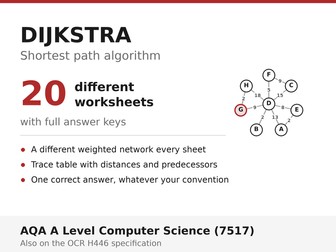
Dijkstra’s algorithm practice for AQA A Level Computer Science (7517): twenty different worksheets on the shortest path algorithm, each with a complete answer key. Every worksheet is built on a different weighted network. That is the point of the pack: you can set one sheet in class, a second for homework and a third for a resit without any two students ever holding the same questions, and without drawing new networks yourself at eleven o’clock at night. WHAT YOU GET 20 worksheets, 3 pages each, numbered 01 to 20 20 matching answer keys A contents table listing the number of vertices and the mark total of every sheet, so you can pick a six-vertex network for a ten-minute starter or a nine-vertex one for a full period WHAT IS ON EVERY SHEET Question 1 asks students to trace the algorithm: one row per vertex settled, recording every tentative distance and the vertex it was reached from, written as a subscript. Question 2 asks for the length of the shortest path and then for the path itself, read back off the completed table - the step most students never practise and most lose marks on. Question 3 asks why the distance to a settled vertex can never be improved by a later step, for a typical application of shortest path algorithms, and one further question that varies from sheet to sheet.
Graph Traversal BFS & DFS | AQA A Level Computer Science 7517 | 20 Worksheets + AnswersQuick View
CSResources

Graph Traversal BFS & DFS | AQA A Level Computer Science 7517 | 20 Worksheets + Answers

(0)
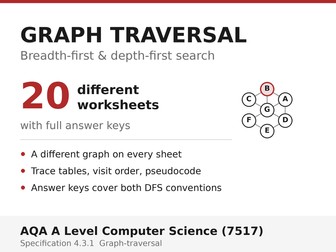
Graph traversal practice for AQA A Level Computer Science (7517): twenty different worksheets on breadth-first and depth-first search, each with a complete answer key. Every worksheet is built on a different graph. That is the point of the pack: you can set one sheet in class, a second for homework and a third for a resit without any two students ever holding the same questions, and without having to invent new graphs yourself at eleven o’clock at night. WHAT YOU GET 20 worksheets, 3 pages each, numbered 01 to 20 20 matching answer keys, 2 pages each A contents table listing the size and mark total of every sheet, so you can pick a short one for a cover lesson or a longer one for a full period WHAT IS ON EVERY SHEET Question 1 asks students to complete a trace table for a breadth-first traversal: the node removed from the queue, the state of the queue after each step, and the running visit order. Question 2 does the same for depth-first search, including the backtracking steps that most students forget. Question 3 shows a piece of pseudocode and asks which traversal it implements, and for a typical application of it. The first row of each trace table is completed for students, which removes any doubt about where the trace begins. Mark totals are printed at the top of each sheet and beside every question. WRITTEN FOR AQA, NOT ADAPTED FROM SOMEWHERE ELSE The pseudocode uses the conventions that appear in real 7517 question papers: the arrow assignment, SUBROUTINE and ENDSUBROUTINE, OUTPUT, FOR EACH … IN, and adjacency written as ConnectedNodes[N]. Helper subroutines are declared in prose before the code, exactly as AQA does. Question 3 asks for an application of the traversal rather than its time complexity, because that is what specification 4.3.1 actually requires. THE ANSWER KEYS DO SOMETHING UNUSUAL Textbooks disagree about how depth-first search is traced. These sheets use the alphabetically-first convention that mark schemes normally show, and state it plainly on the worksheet. But each answer key also lists the visit orders produced by the other two conventions in common use, with a note telling you to credit them in full. Whichever version your department teaches, you can mark with these keys without arguing with them. FORMAT PDF, A4, print-ready. You do not need to edit these: there are twenty genuinely different versions, so you already have a fresh sheet for every class, every resit and every homework. Licensed for the purchasing teacher and their own classes.
FREE Dijkstra's Algorithm Sample | AQA A Level Computer Science 7517 | 2 Worksheets + AnswersQuick View
CSResources

FREE Dijkstra's Algorithm Sample | AQA A Level Computer Science 7517 | 2 Worksheets + Answers

(0)
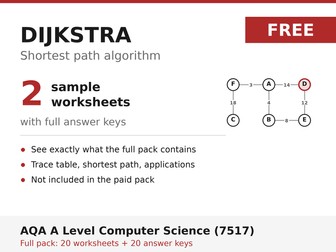
Two free sample worksheets on Dijkstra’s shortest path algorithm for AQA A Level Computer Science (7517), with full answer keys, so you can see exactly what the full pack contains before buying anything. Each sheet is built on its own weighted network. Question 1 is the trace table, one row per vertex settled, with tentative distances and the vertex each one was reached from. Question 2 asks for the length of the shortest path and for the path itself, read back off the completed table. Question 3 asks why a settled distance never changes, and for an application. These networks were generated so that the answer is never arguable: at every step exactly one unvisited vertex has the smallest tentative distance, and the shortest path to the target is unique. Whatever tie-breaking convention your department teaches, the answer key agrees with it. These two sheets are not in the paid pack - they are extra, so nothing is wasted if you buy it afterwards. The full pack contains 20 worksheets and 20 answer keys, every one built on a different network, which is what makes it usable for a whole class, a resit and a homework without any two students holding the same questions. Search Tes for “AQA A Level Computer Science Dijkstra shortest path” to find it.
FREE Graph Traversal BFS & DFS Sample | AQA A Level Computer Science 7517 | 2 Worksheets + AnswersQuick View
CSResources

FREE Graph Traversal BFS & DFS Sample | AQA A Level Computer Science 7517 | 2 Worksheets + Answers

(0)
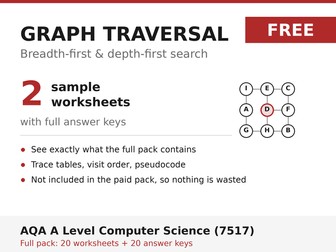
Two free sample worksheets on graph traversal for AQA A Level Computer Science (7517), with full answer keys, so you can see exactly what the full pack contains before buying anything. Each sheet is built on its own graph. Question 1 is a breadth-first trace table, question 2 a depth-first trace table including the backtracking steps, and question 3 asks students to identify a traversal from pseudocode written in the style of real 7517 papers. These two sheets are not in the paid pack : they are extra, so nothing is wasted if you buy it afterwards. The full pack contains 20 worksheets and 20 answer keys, every one built on a different graph, which is what makes it usable for a whole class, a resit and a homework without any two students holding the same questions. Search Tes for “AQA graph traversal worksheets” to find it.
FREE Searching Algorithms Sample | AQA A Level Computer Science 7517 | 2 Worksheets + AnswersQuick View
CSResources

FREE Searching Algorithms Sample | AQA A Level Computer Science 7517 | 2 Worksheets + Answers

(0)
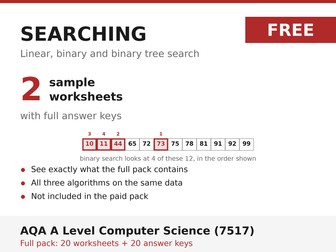
Two free sample worksheets on searching algorithms for AQA A Level Computer Science (7517), with full answer keys, so you can see exactly what the full pack contains before buying anything. Each sheet runs linear search, binary search and binary tree search on the same values, looking for the same target, so the three counts can be compared directly. The midpoint rule is printed on the sheet - (Bottom + Top) DIV 2, rounded down - so the trace has exactly one correct answer. The last question asks for the time complexity of all three algorithms and for the largest number of comparisons a binary search could need on a list of several thousand items: the specification asks students to trace AND to analyse, and both are on the sheet. These two sheets are not in the paid pack - they are extra, so nothing is wasted if you buy it afterwards. The full pack contains 20 worksheets and 20 answer keys, every one built on a different list. Search Tes for “AQA A Level Computer Science searching algorithms” to find it. If these are useful, a review is genuinely appreciated - it is the only way other teachers find resources like this.
Searching Algorithms: Linear, Binary & Binary Tree | AQA A Level Computer Science 7517 | 20 WorksheeQuick View
CSResources

Searching Algorithms: Linear, Binary & Binary Tree | AQA A Level Computer Science 7517 | 20 Workshee

(0)
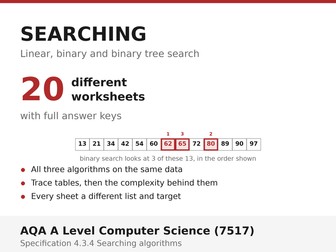
Searching algorithms practice for AQA A Level Computer Science (7517): twenty different worksheets on linear search, binary search and binary tree search, each with a complete answer key. Every sheet runs all three algorithms on the same values, looking for the same target: the unsorted list, the same list sorted, and the binary search tree built from it. A student finishes the sheet having counted, say, twelve comparisons against four and five - and question 4 then asks them to explain the gap they have just measured, rather than to recite O(n) and O(log n) from memory. WHAT YOU GET 20 worksheets, 4 pages each, numbered 01 to 20 20 matching answer keys A contents table giving the number of values, the mark total and the comparison counts of every sheet, so you can set one where the contrast is stark or one where it is narrower WHAT IS ON EVERY SHEET Question 1 traces a linear search of an unsorted list and asks for the number of comparisons. Question 2 traces a binary search of the same values sorted, against the pseudocode printed on the sheet, in a table with Bottom, Top, Midpoint and the value there. Question 3 traces a binary tree search of the same values. Question 4 asks for the time complexity of all three, for an explanation of the gap between the first two counts, and for the largest number of comparisons a binary search could need on a list of several thousand items. The first row of every trace table is completed, so there is no doubt about where a trace begins. Sheets run from 19 to 20 marks. THE MIDPOINT RULE IS PRINTED ON THE SHEET On an even number of items there is no middle item, and a trace question that does not say which way to round has two correct answers. Every worksheet states the rule in its conventions and again in the pseudocode: Midpoint is (Bottom + Top) DIV 2, integer division, rounded down. Whatever your department teaches, the trace the sheet asks for is the one determined by what the student is looking at. WRITTEN FOR AQA The specification asks students to “know and be able to trace and analyse the complexity of the linear search algorithm”, and the same for binary search and binary tree search - AQA 7517, section 4.3.4, printed in the header of every page. Both verbs are on the sheet: three traces, then the complexity of each with a reason, in the specification’s own terms. The pseudocode follows AQA’s own written conventions: DIV for integer division, LEN for the length of an array, arrays indexed from 0, and the not- equal and less-than-or-equal symbols as AQA writes them. FORMAT PDF, A4, print-ready. Twenty genuinely different versions, so you already have a fresh sheet for every class, every resit and every homework. Licensed for the purchasing teacher and their own classes.
Binary Tree Traversal | AQA A Level Computer Science 7517 | 20 Worksheets + AnswersQuick View
CSResources

Binary Tree Traversal | AQA A Level Computer Science 7517 | 20 Worksheets + Answers

(0)
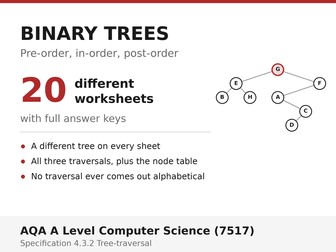
Binary tree traversal practice for AQA A Level Computer Science (7517): twenty different worksheets on pre-order, in-order and post-order traversal, each with a complete answer key. Every worksheet is built on a different binary tree, and no two trees in the pack have the same shape. You can set one sheet in class, a second for homework and a third for a resit without ever setting the same questions twice, and without drawing new trees yourself at eleven o’clock at night. WHAT YOU GET 20 worksheets, 3 pages each, numbered 01 to 20 20 matching answer keys A contents table listing the number of nodes, the mark total and the traversal shown in question 3 for every sheet, so you can pick a seven-node tree for a ten-minute starter or a twelve-node one for a full period WHAT IS ON EVERY SHEET Question 1 asks for all three traversals of the same tree, which is the point: pre-order, in-order and post-order only make sense against each other. Question 2 is answered from a table of nodes rather than from the diagram - Index, Left, Data, Right, with -1 for a missing child - and asks for a named child, the leaves and the depth. Question 3 shows a recursive subroutine and asks which traversal it performs, what it is used for, what stops the recursion, and what the same subroutine would output if it were called on a subtree. Mark totals are printed at the top of each sheet and beside every question. Sheets run from 17 to 20 marks, on trees of seven to twelve nodes.
FREE Binary Tree Traversal Sample | AQA A Level Computer Science 7517 | 2 Worksheets + AnswersQuick View
CSResources

FREE Binary Tree Traversal Sample | AQA A Level Computer Science 7517 | 2 Worksheets + Answers

(0)
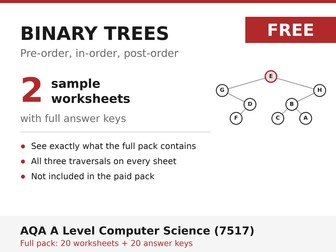
Two free sample worksheets on binary tree traversal for AQA A Level Computer Science (7517), with full answer keys, so you can see exactly what the full pack contains before buying anything. Each sheet gives a binary tree as a diagram and as a table of nodes - Index, Left, Data, Right, with -1 for a missing child, the way AQA writes trees in its own papers. Question 1 asks for all three traversals, question 2 for the structure, and question 3 shows a recursive subroutine and asks which traversal it performs and what stops it calling itself. Neither tree has a traversal that comes out in alphabetical order, and no two of the three traversals are the same, so a student cannot arrive at a correct answer without actually walking the tree. These two sheets are not in the paid pack - they are extra, so nothing is wasted if you buy it afterwards. The full pack contains 20 worksheets and 20 answer keys, every one built on a different tree, and no two trees have the same shape. Search Tes for “AQA A Level Computer Science binary tree traversal” to find it. If these are useful, a review is genuinely appreciated - it is the only way other teachers find resources like this.