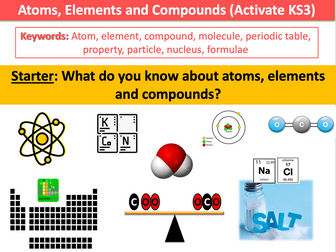
Perfect lesson resource for KS3 Chemistry! A fully differentiated and resourced two part lesson that assists students in learning about atoms, elements, compounds and chemical formulae.
In part 1: Students will state what an element is and recall chemical symbols, describe what atoms are, and compare the properties of one atom of an element to the properties of many atoms.
In part 2: Students will describe the difference between an element and compound, write the chemical names for some simple compounds, write and interpret chemical formulae.
The resource includes a detailed and engaging lesson PowerPoint with differentiated activities, worksheets, quizzes and class practical/demos for students to complete. This resource has been created for the delivery of the Activate KS3 Science course. Also great for GCSE Science.
Included:
57 slides in total for the lesson PPT, Worksheet included
KS3 new for the Activate 1 unit ‘Atoms, Elements and Compounds’.
Full lessons ready to use straight ‘out of the box’. You’ll struggle to find a set of as many planned lessons this cheap and of similar quality.
Similar structure to my other power points following the input - activity - review phasing
Plenary sections for progress checking
Clear learning objectives and outcomes
Modern and engaging layout
Little adaptation needed
Lesson meet full criteria for this unit
Lessons designed to take up an hour of teaching
LESSONS:
L1 Atoms
L2 Elements
L3 Periodic Table
L4 Compounds
L5 Chemical Formulae
(BONUS LESSON) Interpreting Element Squares
Found in same powerpoint as L5
Please leave constructive feedback :D
This lesson is the first lesson in the “Atomic Structure” topic. This topic is designed to act as a “bridging topic” between KS3 and KS4 chemistry.
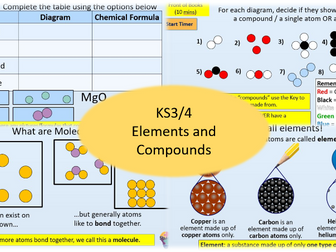
In this lesson students will learn what elements, compounds, atoms and molecules are, and how to identify them from particle diagrams and chemical formulas. This lesson creates a strong basis of chemical literacy that is vital for success at GCSE chemistry and beyond.
This lesson contains:
Lesson powerpoint - including teacher notes and answers in “notes” section
Student led lesson worksheet
Teacher answer sheet
Lesson resources contain:
Interactive powerpoint including teacher delivery notes and answers throughout
AFL activities and student quizzes
2 plenary task options
Explicit teaching and practice of scientific vocabulary
Objectives:
Students will be able to…
Know what an “element” and a “compound” is
Describe the difference between an element and a compound
Know what an “atom” and a “molecule”
Describe the difference between an atom and a molecule
This lesson contains a student led lesson sheet, with the focus being on students learning through doing and practicing skills and identifying patterns and reasons themselves. Resources and slides ask students the key questions and develops ideas and concepts from the ground up and address common issues, mistakes and misconceptions.
This lesson contains AFL tasks which require mini-whiteboards and molymods, but can be adapted if these are not available.
Atoms, Elements and Compounds
AQA GCSE Chemistry 9-1 (1.1.1 on the specification)
Define an element and a compound
Describe what the periodic table is
Explain how compounds can be formed
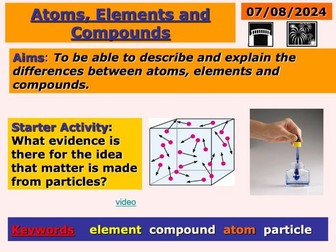
This resource is a PowerPoint to support teaching Atoms, Elements and Compounds.
Included in the resource:
Opening slide with title, keywords, learning objectives and lead on topics
Starter slide with opening question
Information slides on elements and compounds to support teaching
Plenary questions slides to consolidate learning
Designed to be delivered to Year 9 class but can be adapted for different year groups / abilities.
Recaps on atomic structure.
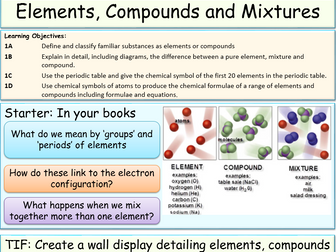
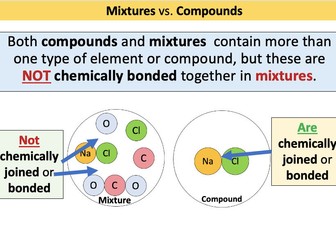
Defines elements, compounds and mixtures with examples.
Worksheet included to test the students understanding.
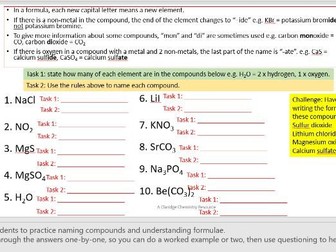
Rules for naming compounds given. Activity for students to complete word equations and name compounds.
Exam style questions for plenary. Higher ability level attached.
This fully resourced lesson on atoms, elements, and compounds is designed to help GCSE students develop their understanding of the link between atoms, elements, and compounds through clear explanations and engaging activities.
This is the 1st in a series of lessons and covers the content from the AQA GCSE 4.1.1(.1) A simple model of the atom, symbols, relative atomic mass, electronic charge and isotopes topic and OUP Kerboodle GCSE Chemistry Scheme C1.1 Atoms lesson.
All resources are included, making it easy to run the lesson straight away. All text is editable, so you can adjust the depth, pace, or challenge to suit your class and the time you have available.
Presentation contains (52 slides):
● Lesson prep and materials guide: Clear guidance for preparing the lesson.
● Student worksheets/handouts: All the printable materials needed for the lesson.
● Do Now activity: Starter activity to refresh students’ memory and introduce the upcoming lesson.
● Clear lesson aim, objectives & success criteria: Provides students with a clear understanding of what they’ll learn and how to show their understanding.
● Warm-up slides: Thought-provoking prompts and questions to introduce the topic.
● Information slides: Differentiated content catering to a range of learning styles and abilities.
● Engaging group activities: Differentiated activities that encourage students to collaborate, participate actively, and deepen their understanding of the topic.
● Questions with answers: Questions with three difficulty levels to cater to different learning styles and abilities. Answers are provided, making them perfect for self-assessment and creating clear, effective notes.
● Homework activities: Differentiated homework tasks to cater to various learning styles and abilities. These activities are designed to reinforce key concepts from the lesson while promoting independent learning.
Aimed at a mixed ability GCSE class, with three levels of demand to cater to different learning styles and levels:
● Level 1: Low demand
● Level 2: Standard demand
● Level 3: High demand
This lesson is also available as a:
● Cover lesson worksheet: Perfect for unplanned absences, this version provides everything a cover teacher needs to deliver a smooth and engaging lesson.
Atoms, elements, and compounds Cover lesson
● Digital worksheet: Perfect for absent students, distance learning, or independent study, this digital version allows students to catch up on missed work at their own pace.
Atoms, elements, and compounds Distance learning
If you require more assistance, please contact me at-
info@cmgsciencelessons.com
A comprehensive lesson to start 9-1 GCSE chemistry / trilogy course. This lesson introduces elements, compounds and mixtures. Students explore identifying elemental symbols, naming compounds and the start of atomic structure.
Everything you need in one resource, including printable “worksheet” slides, notes on delivery and answers that reveal one at a time for easy questioning and self-assessment.
Yellow challenge boxes are included to stretch the more able students in your class.
There is a choice of starter and an entertaining plenary task to get your students engaged!
Full lessons for the CIE (Cambridge) IGCSE Chemistry course 0620, examined from 2023. Unit 2.1 - Atoms, Elements and Compounds.
These were made on Google Slides, so if the videos do not work, there should be a link in the notes sections. It may also affect animations. If you purchase these lessons and want the Google Slides links please message me with the payment.
There are notes to aid teachers (and feel free to email me if anything is unclear).
There are worksheets as hidden slides (all to print to A4, unless stated otherwise).
Includes starters, practicals and plenaries.
I have been teaching for 15 years and have developed a chemistry department from scratch, which was rated outstanding by Ofsted. Currently Head of Science in an international school.
I also have resources for the Chemistry International Baccalaureate and AQA/OCR A-level. Please message me if there is anything you are looking for (including practical ideas) that you cannot find.
Most resources were developed by myself, however there may be some pictures/slides from elsewhere over the years.
Perfect for KS3 Chemistry! This bundle has been created for the new Oxford SMART Activate 1 KS3 Science course. It comes complete with the following fully differentiated and resourced lessons:
2.1 Elements
2.2 Atoms
2.3 Compounds
2.4 Chemical formulae
Perfect for KS3 Chemistry and lessons can easily be adapted for GCSE Science if needed. This bundle includes engaging and detailed PowerPoint Presentations with differentiated activities, worksheets, class practical/demo activities, and quizzes for students to complete.
Enjoy the resource and feel free to leave a review. Thank you.
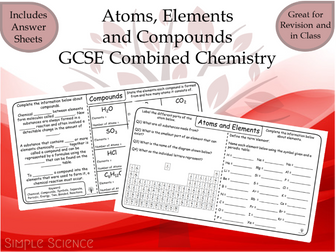
This resource contains 3 worksheets that can be used in class or as homework to enable your students to practice what they have learnt in the classroom.
This pack includes:
Atoms
Elements
Compounds
We have worksheets for the following topics in Chemistry Paper 1:
Atomic Structure and The Periodic Table
Atoms, Elements and Compounds
Separation Techniques
RAM and Electronic Structure
The Periodic Table and Metals
Groups 0 & 1
Group 7
Bonding, Structure, and The Properties of Matter
Ionic Bonding
Covalent and Metallic Bonding
Structure and Bonding of Carbon
Quantitative Chemistry
Balancing Equations
% Mass
Ar and Mr
Amount of Substances in Equations
The Mole
Moles to Balance Equations
Limiting Reactants
Concentration of Solutions
Percentage Yield
Atom Economgy
Chemical Changes
Metal Oxides and Reactivity Series
Displacement Reactions
Extraction of Metals and Reduction
Ionic Equations
Reactions of Metals with Acids
Neutralisation
pH Scale, Neuralisation, and Strong & Weak Acids
Electrolysis
Energy Changes
Energy Transfers and Reaction Profiles
Energy Changes of Reactions
More worksheets will be added in the future.
Please rate and review this resource. Thank you!
An 18 slide powerpoint to be used in a typical 1 hour lesson for KS3 students as the first lesson teaching the topic of Atomic Structure.
Topic - Atomic Structure
Lesson Title - Atoms, Elements and Compounds
Also comes with worksheet for students to complete as plenary / homework on naming compounds and writing formulae. Answer sheet also included.
Comprehension and additional task exercises pages 56 and 57 from Next Page Science KS3 Complete. Accompanying PowerPoint and word searches available for free from the website.
This exercise covers:
• John Dalton as the scientist who developed the idea of atoms
• Definition of an element, compound and molecule
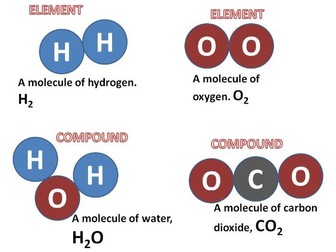
• Pictorial examples of elements, compounds and molecules
• An exercise recognising the differences between compounds and elements
• Amazing WHAT? facts
Visual KS3 Science lesson of atoms, elements, compounds, and mixtures with a variety of tasks.
Works brilliantly for all abilitites, and is very visual for low prior attaining/EAL students.
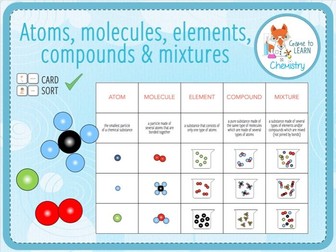
Card Sort on definitions and examples of atoms, molecules, elements, compounds & mixtures.
Great as starter, plenary or revision activity.
Card Sort: 25 cards per set
Including shuffled version
This ready-to-use cover lesson, based on my atoms, elements, and compounds lesson, allows GCSE students to work independently and develop their understanding of the link between atoms, elements, and compounds through clear explanations and engaging activities. Ideal for unexpected staff absences.
This lesson is the 1st in a series of lessons and covers the content from the AQA GCSE 4.1.1(.1) A simple model of the atom, symbols, relative atomic mass, electronic charge and isotopes topic and OUP Kerboodle GCSE Chemistry Scheme C1.1 Atoms lesson.
Resource includes:
● Teacher guide (Page 1): Clear instructions on what to print (answer sheet & student worksheet) and any additional resources needed (e.g., graph paper, coloured pencils).
● Answer sheet (Page 2): Provides answers to all student worksheet questions, allowing cover teachers to assist students.
● Student worksheet (Pages 3 & 4 - back-to-back):
○ Clear instructions and explanations guide students through the learning objectives independently.
○ Engaging activities and thought-provoking questions promote active learning and understanding.
○ Fully editable - easily adapt the resource to fit the specific needs of your students and the time available.
Benefits:
● Minimal prep: Saves valuable time by providing a complete and ready-to-use lesson resource.
● Independent learning: Allows students to work independently, minimising disruption.
● Fully editable: Easily modify the resource to fit the specific needs of your students.
● Answers: Detailed answer sheets provide guidance for the cover teacher.
If you require more assistance, please contact me at-
info@cmgsciencelessons.com
A KS3 lesson looking at the difference between atoms, elements, compounds and mixtures, how to represent elements as symbols and interpreting the numbers of atoms and elements in a chemical compound. The lesson features:
-An engaging starter task using a video to ascertain students prior ideas around what elements are (Daniel Radcliffe singing 'the elements song')
-Key term and definition match
- Quick multiple choice questions to assess student understanding
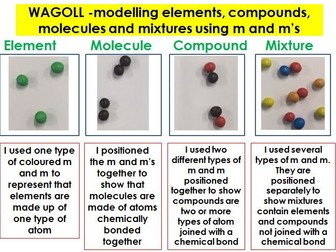
- A task using sweets to model atoms, elements, compounds and mixtures including an opportunity for students to explain their arrangements
- A worksheet requiring students to recognise atoms, elements, compounds and mixtures
-An activity to help students recognise element symbols on the periodic table
An activity to practice recognising numbers of atoms and elements in chemical formulae
Updated with new chemistry resources: elements and compounds worksheets, formulae activities, etc, etc.
Numeracy task (“all matters”) to help students to figure out the composition of gases in the air - independent and student-led (with extension task). Easy to differentiate further.
Summary task of “atoms, elements and compounds” with answers.
Word cloud for students to annotate, draw diagrams for, summarise their learning… use for spelling tests, make questions using the words, play Taboo, word splat, mind map, etc…
A PPT which covers a series of lessons about the atom, elements compounds and mixtures. Resources for activities are attached. This is for use with my top set yr8, feel free to adapt as you wish. One of the resources has been taken from TES 'materials and their uses&' I thought it was good so wanted to use it in my lessons.
A brief power point that clearly illustrates the differences between Atoms, Elements, Molecules and Compounds. It also has a useful exercise for naming compounds


 Quick View