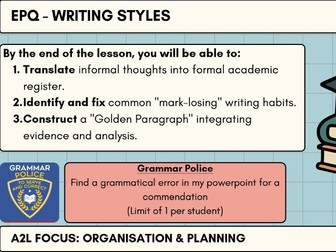
This group of resources includes:
A learning mat with a step by step guide on how to construct a sophisticated academic paragraph and include sentence stems and key vocabulary
A writing template to help students structure their paragraphs
A checklist students can stick in their books to peer/self-assess their writing.
Works for any exam board.
This is a writing lesson for adult ESL students focusing on sentence and paragraph structure. It is designed for students who are intermediate level and above who need to write academic essays for IELTS or other academic purposes. Although it focuses on the requirements of the IELTS exam the stratergies are applicable to any type of academic writing.
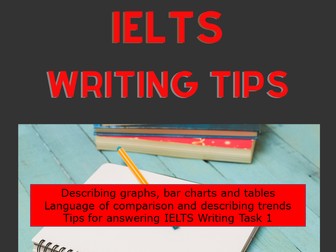
The focus of this package is on 3 keys elements of the IELTS writing Task 1
The structure of the writing
Language for describing trends in data – graphs, tables etc.
Language for comparison
This package contains:
Lesson notes/an explanation of:
Requirements of Writing Task 1 in IELTS
Structure of paragraphs
Extensive list of vocabulary to describe trends in data
Language of comparison
PLUS
5 Activities based on the above lessons ranging from guided to progressively open-ended.
4 hours seminar - active lesson
Suitable for non-native English speakers
Introduction to Academic writing (Pre-Bachelors)
Re-cap and test - what did we learn, what is academic writing
Pop quiz - four types of writing
Features & Styles of writing
Paragraphs, Sentences, Titles etc
Types of research sources (good and bad)
Fake News test
Peer review of Introduction
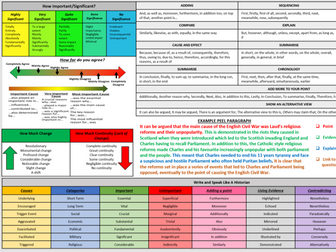
Students often find the more formal academic style of writing used in history difficult to use. These quilts aim to support these students and to encourage MA and HA to stretch and improve their writing styles.
There are 3 versions included - two aimed at KS3, two aimed at GCSE students, and one all-in-one version.
Easy to print and include in exercise books, or to laminate and use in class.
Sections in the writing quilts include:
Terms for how important/signficant
How far do you agree terminology
How important a cause is
Language to use while discussing or debating e.g. how to disagree, how to ask questions
Terminology for how much change/continuity
Example PEEL paragraph support
Terms for comparing, summarising, explaining, contrasting, etc.
Terms to use for judging, while using evidence, categorising.
How to quote from sources or texts
80 words to use other than ‘said’
How to use an interpretation
An explanation of how sources are useful or limited
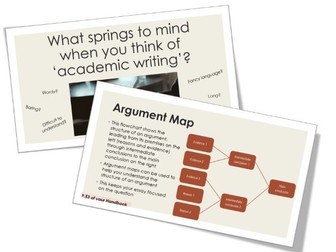
A lesson to support students with academic writing - tips on what makes a good piece of academic writing, sentence starters for different parts of the essay, and an activity to help with making an argument
Works alongside the EPQ Handbook
This bundle contains 4 resources on academic writing & English skills, focusing on:
Essay writing for cause & effect
Researching tips and source integration for academic essays
Annotated biblographies & referencing
Writing & structuring an essay - a step-by-step guide
**The bundle covers the basics of essay writing, researching, and referencing. It is a perfect tool for teachers who want to teach academic / essay writing and critical thinking skills. **
This bundle contains a set of resources to help teachers support students with their academic writing skills at college and university for any course/subject.
It includes a set of tutorials on essay writing techniques including how to be critical, paraphrase and answer different styles of essay questions. These are supplemented by handouts for students summarising what’s involved in academic writing, explaining the university grading system and tips for writing a first class essay. Students are also provided with a model first class essay to provide them with an example of sound academic writing.
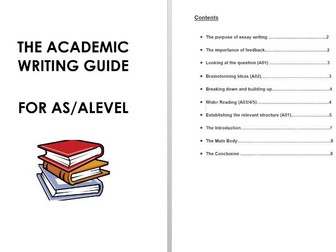
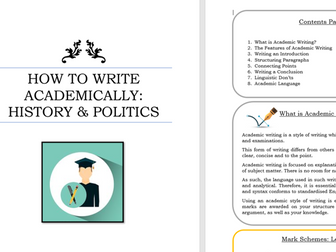
A guide to academic writing that I put together to help A level History and Politics students to understand how to write essay responses.
The booklet gives general guidance on the features and format of academic writing and also gives model paragraph to show demonstrate academic writing in practice.
The examples are aimed at the Edexcel courses for A level History and A level Politics. However, example could be adapted to fit with other specifications.
Just a document that I give to ALevel Literature/Language students on how to write academically. Students often struggle with adapting their critical writing style from GCSE to A Level. This guide gives them guidance.
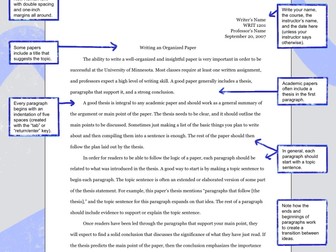
This editable PowerPoint lesson (17 slides in PPT format) covers the notion of academic argument, audience awareness, and the structure of a 5-paragraph essay (an introduction, three body paragraphs with well-developed topic sentences and key details that support the main idea, and a conclusion). It introduces the idea that English academic writing is direct in nature and should use formal language. Students will evaluate two model essays. They will also use a graphic organizer to brainstorm ideas for an essay of their own where they will have to argue an opinion.
The Zip Folder contains the PPT file, as well as the terms of use with a link to a copy of the resource in google drive.
These resources are for lead practitioners, humanities teachers and literacy coordinators to improve the standard of written accuracy and academic writing in students' work within subjects or whole school. Could be applied from KS2-KS5. This resource has been used within a successful History Department where academic writing is emphasised from Y7 through till Y11. It has also been highlighted in whole school CPD.
This workbook is designed to go along with our complete Academic Writing Skills Course, which is available here 25 hour writing course.
Please note that if you purchase the complete course, the workbook is included, and you do not need to buy it here.
The workbook is capable of standing alone as a study guide, as you will see from the preview file, which contains the first ten pages of the 46 page book.
The downloadable zip file on purchase will get your the Word File, and two pdf files. One pdf is perfect for printing, and the other one is interactive, allowing students to write straight into the workbook without the need to waste paper on printing.
Also included is suggested answers for the relevant exercises
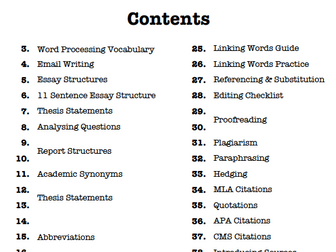
The workbook allows students to complete exercises practicing the following skills that they will need for university. Structuring essays, analyzing different types of questions, writing thesis statements, three different ways to take notes, how to research for information and cite it correctly in all four major styles (MLA, APA, CMS and Harvard). Students will also improving their writing skills, and how to draft and edit their work, and in addition how to avoid plagiarism by understanding the concept and paraphrase correctly.
CPD I delivered to develop academic essay writing at GCSE style, covering an umbrella plan, a thesis introduction and paragraph structuring.
Has typed examples linked to Macbeth but can be applied to any text.
It also introduces the writing formula I use with both my high and low ability Year 11s.
I hope it can help!
If you have questions, please let me know.
Videos explaining what is considered ‘academic writing’, particularly useful for TEFL teaching. Analyses the five sections of an essay the title, introduction, paragraph 1, paragraph 2 and the conclusion and offers support on essay organisation.
**Video 1 - The Key Features of Academic Writing **
Find out more about what is considered ‘academic writing’
Video 2 - Essay Organisation
It’s important to think about how you organise your ideas in your essay because good organisation can make your essay easier to understand and ensures that you answer the hidden question in the essay title. This Video explores ideas for an essay based on title: ‘Discuss the reasons why people choose to live in Reading’.
Video 3 - Analysis of the Five Different Essay Sections
Analysis of five different sections: the title, introduction, paragraph 1, paragraph 2 and the conclusion. Video outlines these sections and explores the content that goes into each. These parts form the building blocks of any essay.
These video clips have been made available by the University of Reading and come from our successful A Beginner’s Guide to Writing in English for Academic Writing. A free online course from the University of Reading available on the FutureLearn platform.
Visit futurelearn.com site and search ‘A Beginner’s Guide to Writing in English for Academic Writing’ for the full course (free without certificates option available).
The University of Reading Recruitment and Outreach team offers a huge range of free events, programmes and activities for students to give them all the information they need about higher education and to enhance their subject knowledge and experience. Visit our website for more details.
This useful handout can be stuck in to books as a useful reference for academic language and vocabulary. This is really useful in training students on how to upgrade their tone and language.