A Level Maths Mechanics Lift Elevator ProblemsQuick View
Elsie99

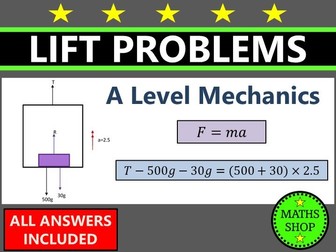
A Level Maths Mechanics Lift Elevator Problems

(1)
A Level Maths Mechanics Lift Elevator Problems. These worksheets contain a set of lift (elevator) problems. There are two worksheets containing a total of 13 questions. These questions are perfect for practising mechanics skills using F=ma. They are suitable for Year 12 A Level maths students and for revision in Year 13. Model answers are now included for ALL questions and can be used by the students to get them started, or can be used as a demonstration on the board. These questions can be used for: a class lesson a revision session homework All questions have answers so that they can be easily marked by you or the students themselves. The document is 20 pages in total, with 2 pages to print for students. This resource can be printed in black and white or colour. You may also like: Solving Trig Equations Quadratic Inequalities, Quadratic Equations and Quadratic Simultaneous Equations Large Data Set Edexcel Please visit Maths Shop to see more of my resources.
Resolving forces - worksheet to teach and practise this skill (Mechanics 1)Quick View
MathsWorksheetMaster

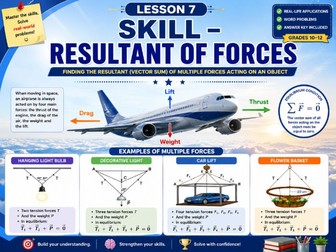
Resolving forces - worksheet to teach and practise this skill (Mechanics 1)

(2)
I found it time-consuming tryingto teach my classes how to resolve forces by drawing diagrams on the board and asking them to copy them down - it seemed to take ages and they didn't get to work through that many examples themselves. So I created this worksheet with ready-made diagrams with all the forces and a blank copy of diagram for students to add on the resolved forces. I no longer dread teaching this skill and my classes get a lot more done in the lesson time. The worksheet starts with an introductory explanation and a worked example. There are then over 20 questions for students to attempt. Fully worked solutions are included.
Advanced Higher Mechanics Notes (Linear and Parabolic Motion)Quick View
Educ84Math

Advanced Higher Mechanics Notes (Linear and Parabolic Motion)

(1)
Notes for the Linear and Parabolic Motion Unit for the new Advanced Higher Mechanics course. Notes broken down into 4 topics: Rectilinear Motion; Relative Motion in 2D and 3D; Projectile Motion; Forces and Newton's Laws. Definitions, theorems and worked examples included.
AS Mechanics Revision PPTQuick View
finbutler999

AS Mechanics Revision PPT

(0)
A 59 slide PPT that I put together in order to review the AS Mechanics content for the new Edexcel Maths A-Level. It covers all areas with key points highlighted and plenty of practice problems. Feedback is always appreciated.
Kinetics (Advanced)Quick View
paulbold

Kinetics (Advanced)

(0)
Good for Cover lesson or as Prep ("homework") or to supplement pupil notes. Covers reaction mechanisms and rate expressions.
AS level Mechanics (new A level)Quick View
MathsWorksheetMaster

AS level Mechanics (new A level)

5 Resources
This bundle contains all the resources you need to teach and assess the mechanics content of the AS part of the new A level. For each topic there is a booklet with notes, examples and exercises, and then another resource that can be used as a homework or a test. Solutions to all the exercises are included, together with worked solutions to all the homeworks/tests.
Mechanics- Motion- Revision WorksheetQuick View
DrKKNaga

Mechanics- Motion- Revision Worksheet

(0)
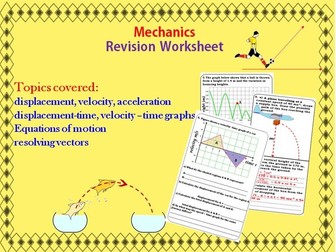
Hi, This is a revision worksheet for the topic Mechanics- Motion- based on Edexcel AS Physics Unit 1. Questions cover displacement, velocity, acceleration, displacement-time, velocity- time graphs, equations of motion and resolving vectors. Answers for reference are also provided at the end of the product. Teachers can use this worksheet after the completion of topic or to assess students’ understanding or to revise the topic. This product can be used by private candidates as the answers given will certainly guide them. Kindly share your feedback! Thanks in advance!
MechanicsQuick View
thniomar16

Mechanics

(0)
وصف المقرر :Course Description 1 – عزم القصور الذاتى 2- السرعة الزاوية والعجلة الزاوية والحركة فى دائرة 3- الحر��ة المقيدة المستوية للجسيمات 4- الشغل ومعادلة الطاقة فى المجال المحافظ 5- المدارات المركزية
Mechanics 1 PowerPoint PackQuick View
Hatchtag_Resources

Mechanics 1 PowerPoint Pack

(1)
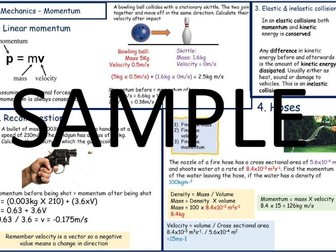
A complete set of PowerPoint resources specifically aimed at the (Edexcel) Mathematics IAL (2018) course but also suitable for the IB Diploma. The files contain fully editable teaching / revision notes, examples, animations and hyperlinks to facilitate navigation. Try the free sample before you buy: https://www.tes.com/teaching-resource/resource-11976109 Topics covered are mathematical models in mechanics, vectors in mechanics, kinematics of a particle moving in a straight line, dynamics of a particle moving in a straight line or plane, statics of a particle, moments. Files are updated on a regular basis and feedback is welcome. Follow me on Twitter and Pinterest @hatchtag73.
The Antikythera MechanismQuick View
jadeloerar

The Antikythera Mechanism

(0)
This worksheet delves into the fascinating story of the Antikythera Mechanism, an ancient Greek device that revolutionized our understanding of early technology. Through critical reasoning questions and comprehension exercises, students will explore how this incredible artifact challenged previous notions of ancient Greek capabilities, showcasing their advanced understanding of mechanics and astronomy. The worksheet encourages deep engagement with the text, helping students think critically about historical technological advancements and their impact on modern science. This resource is ideal for educators looking to foster critical thinking in their classrooms. By guiding students through key concepts related to the Antikythera Mechanism, educators can prompt thoughtful discussions on the evolution of technology, the concept of progress, and the surprises history holds. The worksheet’s focus on analysis and inference helps students develop essential skills for academic success, making it a valuable tool for history or science teachers aiming to integrate complex historical topics into their curriculum.
Mechanics 1 (Edexcel) RevisionQuick View
supergenau

Mechanics 1 (Edexcel) Revision

(49)
Here is my power point trying to structure questions for M1 from past papers. I have split the paper into 6 sections and tried to group questions together. For use by giving to pupils and leaving them to it, or working through topics as a class. Every question from 2006-2018. Also works extremely well on iPads.
A Level Mechanics- Connected ParticlesQuick View
tonyg111160

A Level Mechanics- Connected Particles

(0)
A presentation I use to help students come to terms with connected particles problems. The presentation starts with basic principles and builds to more complex problems. Several examples are included. Please add a review if you find this useful.
Halogenoalkanes Scribble Notes (Advanced)Quick View
liezelpienaar

Halogenoalkanes Scribble Notes (Advanced)

(0)
Help your Chemistry students with note taking and keep them engaged. This 5 page activity on Halogenoalkanes can be used to summarize key concepts. These pages are great to engage your students. They can color and scribble whilst taking notes. Covers: ⚛ Nucleophilic Substitution Reactions ⚛ SN1 Mechanism ⚛ SN2 Mechanism ⚛ Elimination Reactions
Quotation MechanicsQuick View
hanialange

Quotation Mechanics

(0)
English Resource for Analytical Writing: Designed to align with the British curriculum for students aged 11-18. Focus on Dual Learning: Combines mastering linguistic devices with practical examples to enhance understanding. Conscious Crafting of Academic Writing: Encourages students to purposefully construct well-structured, insightful analytical pieces. Enhanced Vocabulary Repertoire: Provides exposure to advanced vocabulary, fostering sophistication in expression. Part of a Series: Complements other resources in the series, each targeting specific aspects of English mastery.
Price MechanismQuick View
TeacherCentral

Price Mechanism

(0)
Edexcel Economics A Pearson Edexcel Level 3 Advanced GCE in Economics A (9EC0) Part 2 of 3 Lesson 27 - Functions of the price mechanism **FREE Lesson From this Unit: **https://www.tes.com/teaching-resource/-12801039 This SoW is designed in detail to be clearly differentiated and engaging. Using the latest researched teaching and learning techniques, such as Retrieval Practice and Dual Coding. This SoW allows you to move pupils through content efficiently. Each SoW is sequenced clearly and in line with the Edexcel Specification. A colour scheme also runs throughout to ease both your delivery and students’ comprehension. Each theme is broken down in three parts, due to Tes’ limitation on Bundle sizes, with the first lesson of each bundle being free, so that you can see if these resources are for you. We provided an email address that is monitored daily, if you have any questions or issues with this purchase (teachercentralltd@gmail.com). Below is a break down of the Bundle Theme 1 (Part 2 of 3): Lesson 21 - Price Elasticity of Supply Lesson 22 - Price Elasticity of Supply Revision Lesson 23 - Price Elasticity of Demand Revision revision Lesson 24 - Price Elasticity of Demand exam question technique 10 marker Lesson 25 - Recap on demand and elasticities Lesson 26 - Consumer and Producer Surplus Lesson 27 - Functions of the price mechanism Lesson 28 - Revision Demand and Supply Lesson 29 - Assessment 2 Lesson 30 - Subsidies Lesson 31 - Taxes Lesson 32 - Behavioural Economics Lesson 33 - Subsidies and Taxes Revision Lesson 34 - Elasticities Revision Lesson 35 - Elasticities quiz (FREE) Lesson 36 - Exam Technique 1 (5 markers and analysis) Lesson 37 - Exam Technique (8 markers and Evaluation) Lesson 38 - Exam Technique (5, 8, 10, 12 and 15 markers) Lesson 39 - Negative Externalities Lesson 40 - Positive Externalities END Any questions please do feel free to get in contact: teachercentralltd@gmail.com Tes Teaching Store: https://www.tes.com/teaching-resources/shop/TeacherCentral Best FREE Resources (Teacher Central) https://www.tes.com/teaching-resource/britain-losing-and-gaining-an-empire-12973075 https://www.tes.com/teaching-resource/financial-literacy-12898983 https://www.tes.com/teaching-resource/romeo-and-juliet-12908635 https://www.tes.com/teaching-resource/shakespeare-12908634 https://www.tes.com/teaching-resource/macbeth-gcse-12863697 https://www.tes.com/teaching-resource/animal-farm-free-sow-12942163 (FREE SoW) https://www.tes.com/teaching-resource/slavery-sow-12843084 (FREE SoW) https://www.tes.com/teaching-resource/russia-1917-91-from-lenin-to-yeltsin-12834552 https://www.tes.com/teaching-resources/shop/TeacherCentral?sortBy=lowestPrice&p=5
Advanced Kinetics A Level Chemistry cambridge OCR  and edexcelQuick View
mathaijackson

Advanced Kinetics A Level Chemistry cambridge OCR and edexcel

(0)
A powerpoint document which covers Advanced Kinetics (Rate of reactions) chapters from the OCR A Level Chemistry, Cambridge chemistry and edexcel AL Specification. tHIS DOCUMENT IS GOOD FOR LEARNERS AND TEACHERS teaching the above systems. OBJECTIVES COVERED 1 explain and use the terms rate equation, order of reaction, overall order of reaction, rate constant, half-life, rate-determining step and intermediate 2 (a) understand and use rate equations of the form rate = k [A]m[B]n (for which m and n are 0, 1 or 2) (b) deduce the order of a reaction from concentration-time graphs or from experimental data relating to the initial rates method and half-life method © interpret experimental data in graphical form, including concentration-time and rate-concentration graphs (d) calculate an initial rate using concentration data (e) construct a rate equation 3 (a) show understanding that the half-life of a first-order reaction is independent of concentration (b) use the half-life of a first-order reaction in calculations 4 calculate the numerical value of a rate constant, for example by: (a) using the initial rates and the rate equation (b) using the half-life, t1/2, and the equation k = 0.693/t1/2 5 for a multi-step reaction: (a) suggest a reaction mechanism that is consistent with the rate equation and the equation for the overall reaction (b) predict the order that would result from a given reaction mechanism and rate-determining step © deduce a rate equation using a given reaction mechanism and rate-determining step for a given reaction (d) SN1 AND SN2 MECHANISMS
Mechanics 3Quick View
Omega

Mechanics 3

(0)
Notes and Examples for Mechanics 3 Old Specification