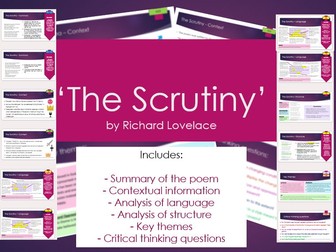
A lesson covering ‘The Scrutiny’ by Richard Lovelace. This is one of the poems from the AQA A-Level Literature ‘Love Through the Ages’ Poetry anthology. The PowerPoint includes:
A summary of the poem
Contextual information
Analysis of language
Analysis of structure
Key themes
Critical thinking questions
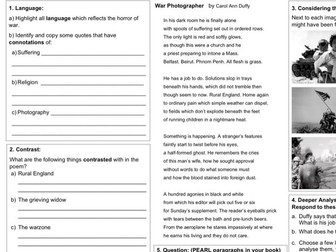
Worksheet for War Photographer
Perfect for KS4 studying AQA Power and Conflict
Useful for revision, cover lessons, homework, independent learning, working from home.
Fully editable word document and PDF included
Saves you time and effort putting this together yourself.
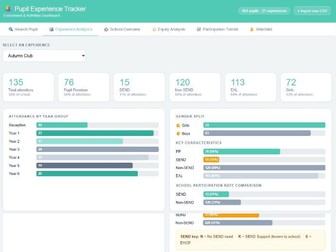
A GDPR-compliant HTML tool for tracking pupil enrichment experiences. Import a CSV, instantly see participation rates, equity gaps, and Ofsted-ready analytics — no login, no server, no data stored.
Tracking pupil engagement in wider opportunities, enrichment and other experiences can be extremely difficult and it can be even more difficult to find useful and meaningful information about pupil groups. This tool allow you to complete a very basic spreadsheet which then does all of the analysis and tracking for you. It tells you information at pupil, class, and a whole-school level and breaks down attendance by pupil groups, giving you insight into engagement of vulnerable pupil groups.
This tool works entirely in the browser, covers PP, SEND, EAL and gender breakdowns across six tabs — individual pupil profiles, experience analytics with representation vs school average, whole-school overview, equity gap analysis, participation trends heatmap, and a watchlist flagging pupils with zero experiences and activities where disadvantaged groups are under-represented. No setup, no IT department needed — just a CSV and a browser.
To help you get started, two Excel spreadsheets (.xlsx) have been provided: a blank template for you to enter your own pupil data, and an example file pre-populated with fictional data so you can explore the app straight away. Before either file can be used by the app, it must first be saved in CSV format. To do this, open the spreadsheet in Excel, go to File > Save As, and choose CSV (Comma delimited) (*.csv) from the file type dropdown. Make sure to save the CSV to a location you can easily find, as you will need to select it when loading data into the app. Note that Excel may warn you that some features will be lost when saving as CSV — this is expected and you can safely click Yes to continue.
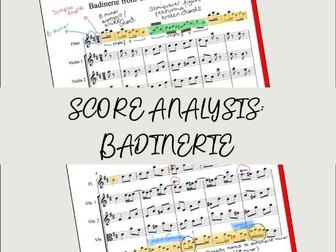
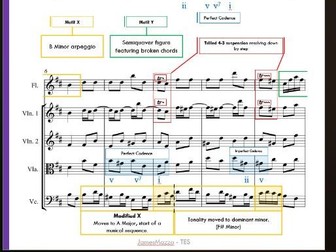
Fully annotated score for Bach’s Badinerie. Perfect for EDUQAS GCSE Music. Use as a teaching aid or revision resource.
*Please note: This is resource contains a hand annotated score for Badinerie only. *
This resource can be purchased alongside exam questions for both Badinerie and Africa in the full EDUQAS GCSE Music exam pack. Find the annotated score for Badinerie AND Africa in the Teacher’s Answer Book. Get the full pack here: https://www.tes.com/teaching-resource/gcse-music-exam-question-booklet-13194540
Enjoyed this resource? Your feedback helps to improve and create new materials. Thank you for taking the time to leave a review!
A clear, student-friendly analysis of Badinerie by J.S. Bach, created for the Eduqas GCSE Music set work.
The resource includes:
An introduction and background information
A MAD T SHIRTS overview of the main musical elements
A detailed, bar-by-bar annotated score
This resource can be used for whole-class teaching, guided score analysis, independent revision or exam preparation. The annotations are colour-coded to help students identify important musical features clearly.
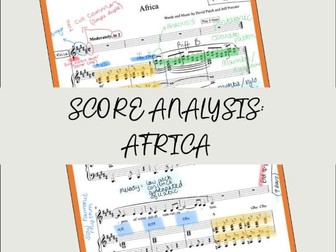
Fully annotated score for Toto’s Africa. Perfect for EDUQAS GCSE Music. Use as a teaching aid or revision resource.
*Please note: This is resource contains a hand annotated score for Africa only. *
This resource can be purchased alongside exam questions for both Africa and Badinerie in the full EDUQAS GCSE Music exam pack. Find the annotated score for Africa AND Badinerie in the Teacher’s Answer Book. Get the full pack here: https://www.tes.com/teaching-resource/gcse-music-exam-question-booklet-13194540
Enjoyed this resource? Your feedback helps to improve and create new materials. Thank you for taking the time to leave a review!
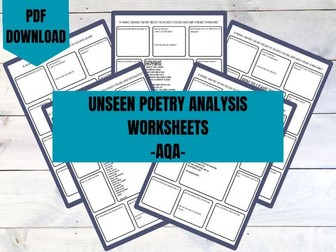
6 worksheets which are designed to walk through unseen poetry. These would be ideal for an easy cover lesson for a normal lesson with extra input from the teacher
These five unseen poetry revision worksheets are designed to help students prepare for the GCSE English Literature exam, specifically targeting the analysis required for the 24 mark question. Each worksheet focuses on key aspects of poetry analysis, including language, structure, and tone, which are essential for crafting a thorough and insightful response.
Language Analysis Focus: Students will examine the poet’s choice of language, including imagery, word choice, and figurative language. Through guided questions, students will explore how specific words or phrases create meaning, convey emotions, and contribute to the overall impact of the poem.
Structure and Form Analysis: These worksheets help students understand how the structure of a poem (such as stanza length, rhyme scheme, or line breaks) influences its meaning and tone. The activities encourage students to consider how the poem’s form complements the themes and feelings expressed by the poet.
Tone and Mood Exploration: Through focused questions, students will explore the tone of the poem—whether it is serious, ironic, joyful, melancholic, etc.—and how the poet uses language and structure to establish and maintain this tone. This section will help students identify the emotional atmosphere of the poem and how it affects the reader’s interpretation.
Comprehensive Poem Analysis: Each worksheet includes a complete poem for students to analyze. The questions guide them through breaking down the poem’s key elements (language, structure, tone), allowing students to practice the skills they will need in the exam to write coherent and focused responses.
These revision worksheets are an excellent resource for students aiming to strengthen their analytical skills in preparation for GCSE English Literature exams, particularly for the unseen poetry section (24 mark question). By focusing on key elements of poetry, students will build confidence in analyzing unfamiliar texts under exam conditions.
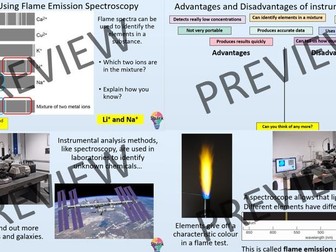
A lesson covering instrumental analysis and flame emission spectroscopy for the AQA Triple Chemistry GCSE specficiation. Applicable to both higher and foundation candidates.
Lesson Objectives
Know what instrumental techniques are
Describe advantages and disadvantages of instrumental techniques over other analysis techniques (e.g. flame tests)
Interpret flame emission spectra to identify unknown elements in a mixture
Lesson Resources include:
Lesson powerpoint - including starter, example spectra, spectra analysis example and advantages/disadvantages task
Exam questions covering instrumental analysis, flame spectra analysis, and ion identification questions with full mark schemes.
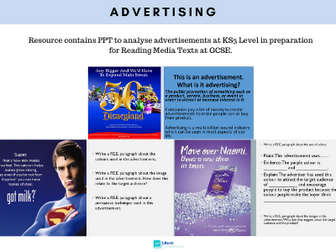
This PPT provides different scaffolded activities for pupils who are analysing advertisements, focusing on presentational devices such as colour, image and layout. It also has focused analysis of language used in advertisments and a task to create and evaluate an advertisment.
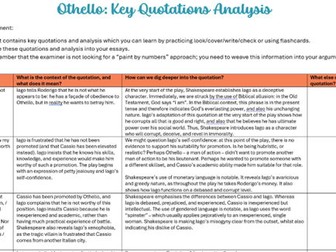
The attached document tells the story of “Othello” in 60 quotations. Each quotation is accompanied by a brief explanation of the context, and information about how students can dig deeper into Shakespeare’s language, staging and characterisation.
This was initially created for students revising for AQA A Level Lit B (Tragedy).
Based upon the Pearson Edexcel LIFT 2.0 qualification, this complete lesson focuses on understanding and analysing how tone, language and structure create an effect on the reader. With chunked tasks that use a variety of skills, such as making inferences, developing word-level connotations, predicting, identifying writer’s methods and analysis, this lesson builds towards an exam-style question. Modelling and sentence starters are provided.
This lesson uses The Pedestrian by Ray Bradbury as a stimulus text, so this lesson could be used as well as part of a dystopian scheme of work.
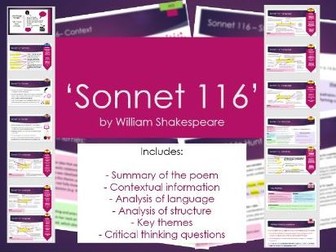
A lesson covering ‘Sonnet 116’ by William Shakespeare. This is one of the poems from the AQA A-Level Literature ‘Love Through the Ages’ Poetry anthology. The PowerPoint includes:
A summary of the poem
Contextual information
Analysis of language
Analysis of structure
Key themes
Critical thinking questions
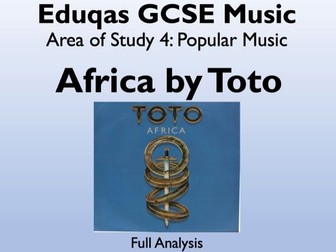
The most thorough and detailed analysis of Africa by Toto available, the only analysis written in connection with the Full Score, enabling both teacher and student to understand the song fully.
It has been written in an engaging and approachable manner, with full, detailed explanations of the song’s harmony, structure and individual instruments’ roles, using musical examples not available anywhere else.
This is the only analysis you will need in order to get inside one of the greatest songs ever written.
This analysis references the full score, transcribed by Patrick Johns, available on Sheet Music Plus. (For copyright reasons, it can’t be sold on TES).
This is a PowerPoint version of the full, accurate, detailed analysis of Africa by Toto, available on TES as a PDF.
It covers all aspects of the song Africa, part of the Eduqas GCSE Music syllabus.
Harmony, arrangement, voicings, structure - everything is explained in accessible detail, with bespoke musical examples unavailable elsewhere (except the PDF, of course!).
Written in conjunction with the Ten Sample Listening Tests (available on TES) and the Full Score (available on Sheet Music Plus, for copyright reasons).
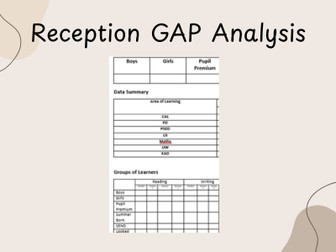
A sheet to analyse the Reception cohort data term upon term.
Three main columns - percentage of children scoring 1-3 points, 4-8 pounts, 9 points. Columns split down for Baseline, end of Autumn, Spring and Summer term results.
I have also used the table as a way of recording 3 year baseline and also end of year results. Very useful for OFSTED/SLT discussions.
How to write an answer commenting on the effects of language used in a passage. This is aimed at students writing the CIE IGCSE First Language English exam, specifically Paper 2 Question 2.
Activities and Shakespeare tasks linked to the witches in Macbeth, the murder of the king, and the context of King James and superstition: Act 1, Scenes 1, 3, 5, 6 and 7.


 Quick View