These lessons have been rated as Outstanding in an outstanding school that always seeks Mastery and Understanding.
Vertically Opposite Angles and Missing Angles
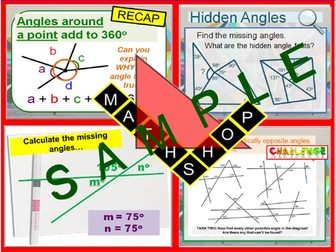
1 Power Point Presentation.
Presentation contains 15 Slides
Contains questions for students to engage and explore.
Contains questions for checking understanding / assessing.
Contains Tasks.
Mini White Board or Question and Answer questions for you to assess whole class / group.
Challenge included.
Slides are interactive and have been made so students see angle rules quickly, power point animations have been used so students can see rules quickly.
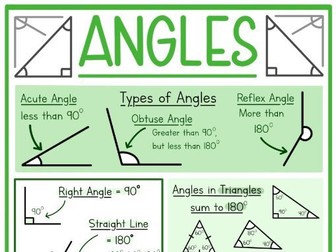
A classroom poster covering the main angle rules students are expected to know in KS3. It outlines types of angles, basic angle rules and angles on parallel lines.
Suitable for both Key stage 3 and 4. This lesson and worksheet is designed to help pupils revise angles in parallel lines. The lesson is fully differentiated featuring a starter, main and plenary for pupils to work through. There are numerous examples, practice problems and challenges for pupils to complete.
The worksheet is fully differentiated (mild, medium spicy, hot and challenge) allowing pupils to work at different levels simultaneously. The worksheet also features a section for pupils to self-assess their understanding and set a target for next lesson
A good way to round off the topic of angles with this colouring sheet. Pupils are able to self assess by seeing if their answer is in the colouring area.
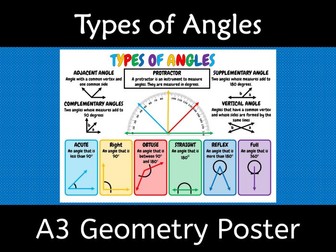
This high quality poster is ideal for your classroom wall, bulletin board or math display. It makes a great anchor for students (and teacher) to refer to. I have included 4 designs with different colored tittles to fit your room decor.
Angle definitions and examples on the poster are:
Acute, Right, Obtuse, Straight, reflex, Full, Adjacent, Complementary, supplementary and vertical.
Enjoy.
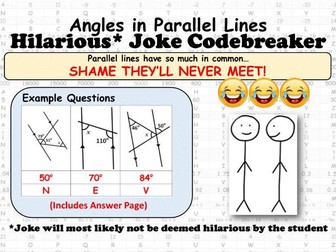
Maths codebreakers are an engaging way for students to practice skills and address any misconceptions. Students have to answer typical maths questions with their answer corresponding to a letter of the alphabet. If answered correctly, the answer reveals the punchline to a hilarious* joke.
This resource contains 1x codebreaker worksheet where students have to find missing angles in parallel lines by spotting corresponding, alternate and co-interior angles. Latter questions include scalene and isosceles triangles.
Suitable for KS3 and Foundation revision.
*the joke is terrible
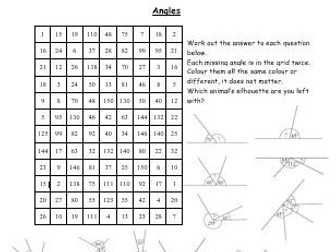
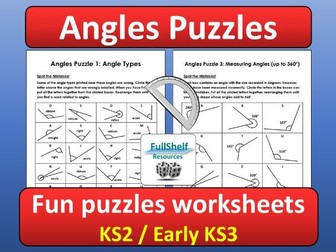
Angles revision activities (puzzles worksheets) for Key Stage 2 Maths, ideal for early finishers challenges, starters and homework. Especially suits Year 5 and Year 6 (and KS3 for revision) and contains 5 fun Hidden Word Puzzles. All puzzles are in PDF format. Fast finishers love being challenged by them plus they make great collaborative starters!
Angle Types / Names / Classifying Angles (Acute, Right, Straight, Obtuse and Reflex)
Measuring Angles up to 180 degrees
Measuring Angles up to 360 degrees
Angles Between the 8 Compass Points
Calculating Missing Angles - Vertically Opposite Angles, Adjacent Angles and Angles Around a Point
Solutions included
PDF format
Engaging alternative to standard worksheets
Great for individuals or pairs / groups
To save on printing, you could laminate for completion with a whiteboard pen and use again, or place in dry-wipe sleeves
Spotting common errors may help students remember to check their own work and help them avoid common errors themselves.
SAVE BY GETTING THIS IN:
Angles BUNDLE, which also contains:
Angles Activities
Angles Board Game
YOU MIGHT ALSO LIKE:
Angles and Symmetry BUNDLE
PUZZLES FOR MORE TOPICS…
Area
Converting Units of Measure
Decimals
Division
Fractions
Multiplication
Negative Numbers
Percentages
Rounding
Shape
Time
BUY ALL 12 PACKS FOR A BIG SAVING!
Maths Hidden Word Puzzles MEGA BUNDLE
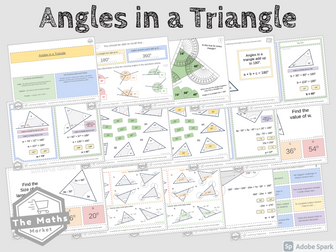
This lesson covers the full range of attainments for missing angles in a triangle. It starts by recapping prior knowledge on angles on a straight line and around a point before moving onto the basics of angles in a triangle. This lesson allows the topic to be differentiated for a variety of attainment levels and could easily be adapted to meet the need of higher or lower attaining groups through missing out specific examples.
The lesson does not look at the specific angle properties of isosceles and equilateral triangles, however, I do have a lesson on this available. This lesson spends time really allowing students to build an understanding of angles in a triangle and build change though the interleaving of previous learning on angles and through the involvement of forming and solving a variety of equations.
The lesson includes;
Starter
Introduction to the topic in small chunks
Opportunities to practice basic skills through a collaborative activity.
Clear modelling through “I do” and “You Do” examples.
Multiple choice questions to draw out misconceptions.
Differentiated worksheet.
A challenge question.
The lesson includes the solutions and is fully animated which will make it perfect for delivering live remote lessons.
This is a single sheet consisting of 20 questions in 7 main types on the double angle formulae.
This is an excellent sheet for a classwork, homework or revision sheet and covers everything that a student could need to fully practice and understand this area of Trigonometry.
Answers are included.
Please leave feedback, particularly if you like my work - thank you.
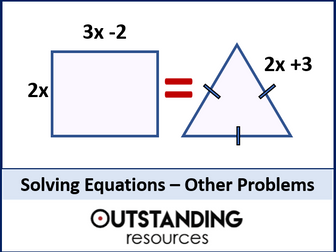
This is a whole lesson looking at Forming and Solving Equations in different situations. The lesson looks at the entire range of questions and problems and comes with two excellent sets of questions. The first worksheet is easier, looking at questions that would be appropriate for the foundation tier also, involving problems with perimeters and angles. The second is far harder involving volume, surface area and other problems. This lesson is ready to go with no prep required and is great for home learning. 18 slide presentation + extra resources.
The lesson comes with:
+ a starter
+ learning objectives (differentiated)
+ keywords (important as always)
+ Excellent teaching slides
+ lots of examples to follow
+ MWB activities (for AFL)
+ worksheets x2 (with answers)
+ plenary
ALL LESSONS on Algebra in one MEGA BIG Bundle:
Algebra: All Lessons
For any issues, please email outstandingresourceshelp@gmail.com
and we will aim to respond within 48 hours.
Lessons are flat-packed (with limited editing) to maintain copyright protection.
We would greatly appreciate it if you could leave a rating and feedback.
Thank you for your support, your purchase, and for taking the time to provide feedback!
#mathslessons #maths #secondarymaths #mathscentres #teachingideas #algebra #teacherslife #teachingkids #teachingmaths #mathsactivities #homeschooling #tesresources #teaching #mathsisfun #teachershare #teachertips #teachers #KS3 #KS4 #KS5 #igcse #learning #gcsemaths
A simple recap sheet on angles. Covering angles on a striaght line/around a point, angles in a triangle/quadrilateral, opposite angles, parallel lines and interior/exterior angles. Answers included on last page.
Used for bottom set year 9's/10's.
Some of these questions can be found in my other angles in polygons worksheet.
This worksheet just covers things a bit quicker with less repetition for those classes who are either revisiting this topic or are just more able.
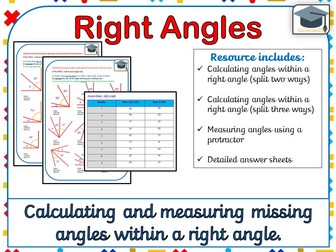
This is a differentiated worksheet to help children master opposite angles. Answers are included.
Children are challenged to:
- name the type of angle a ‘missing angle’ is.
- calculate its size in degrees
- measure it accurately using a protractor.
All angles are correctly sized.
There are two sheets, an Expected Standard sheet and a more challenging Greater Depth sheet (2016+ Curriculum). On each sheet there are nine missing angles, meaning that children have 27 things to do in order to complete one activity sheet.
Please rate and/or comment. All feedback is valuable.
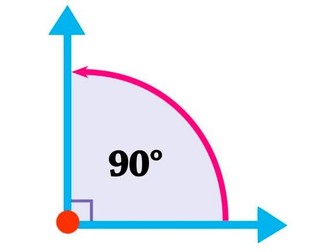
Right angles worksheet.
Task: Can your student’s identify right angles and angles more/less than a right angle?
Ideal for 7+ (depending on ability).
Answers provided.
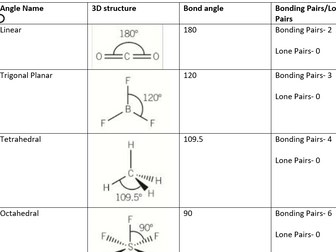
This worksheet is made for students to practice the bond angles and shapes for A level Chemistry. Different sheets have different ‘missing information’ which they will need to remember to complete, this also comes with the answers too. There are different work sheets so the information that is missing alters on the sheet to ensure a mixture of testing levels are available.
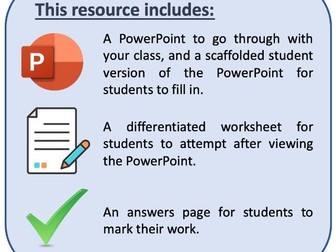
This resource includes:
A PowerPoint that can be used with a class,
A scaffolded student version of the PowerPoint with gaps for the students to fill in,
A differentiated worksheet with answers included.
This resource is suitable for Year 9 and 10 students and is linked to the Australian curriculum. This resource focuses on understanding the four similarity laws (SSS, SAS, RHS and AAA), writing similarity statements and filling out similarity tables.
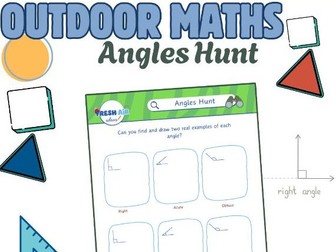
Perfect for Key Stage 2 (KS2), this worksheet blends outdoor learning with core Geometry concepts, focusing on angles: acute, obtuse, and right angles.
Preparation
Print the Outdoor Maths Angles Hunt worksheet for each child or pair. Review the characteristics of the target angles:
Right Angle: 90 degrees
Acute Angle: Less than 90 degrees
Obtuse Angle: Greater than 90 degrees
The Hunt
Take your class to a designated outdoor learning space—a playground, school garden, or field. Provide them with the worksheet and, optionally, an angle measurer or right-angle checker (made of card or plastic).
Find and Draw: The children’s task is to find a real-life example of each type of angle in the outdoor environment.
Examples
Right Angle Example: The corner of a window frame, a door frame, or a paving slab.
Acute Angle Example: The point of a leaf, the angle between two branches of a small tree, or the tip of a gate support.
Obtuse Angle Example: The wide-open angle of a slide support where it meets the ground, or the angle between a partially open gate and the fence.
Record
They then draw a sketch of the object/location and clearly mark the angle they found in the corresponding box on their worksheet. They should be encouraged to use the correct notation for the right angle.
Discussion
Conclude the lesson with a group discussion. Have students share their most interesting angle finds and explain how they classified them (e.g., “I know it’s acute because it’s smaller than the corner of my book”). This reinforces the definitions and encourages peer learning.
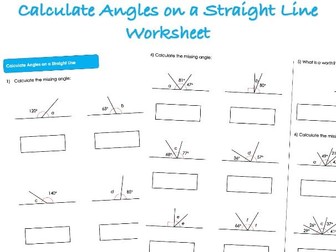
A worksheet that provides a variety of questions linked to being able to calculate missing angles on a straight line (including finding them with a range of angles provided as well as using knowledge of right-angles and algebra to find missing angles). This is based on the Year 5 objective based on White Rose Maths but can easily be used in other year groups.
Included as part of the worksheet are 6 different questions that provide variation to check pupils understanding of being able to calculate missing angles on a straight line.
Answers are also included for all questions.
This worksheet can easily be used as a worksheet when teaching the objective or used for recap/ revision or even to be sent home as homework.
This crossnumber, gives across and down clues, where students need to find missing angles using the angle rules. Angles on a straight line, angles at a point, angles in a triangle and vertically opposite angles. Used this with all sets across the years as both a recap and practising a new concept.


 Quick View