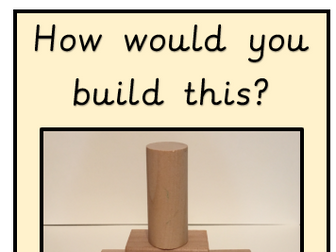
A set of three different types of construction cards- perfect for making into booklets/sticking to a display within the construction area to give the children’s building projects more purpose.
Set 1: Landmarks around the world e.g. Eiffel Tower, Burj Khalifa, Taj Mahal
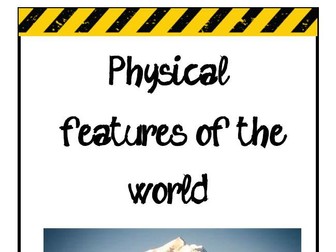
Set 2: Physical features of the world e.g. theme park, farm, train station
Set 3: Natural features of the world e.g. waterfall, volcano, cave
The resource is fully editable so you can change the font or add in/remove cards as appropriate.
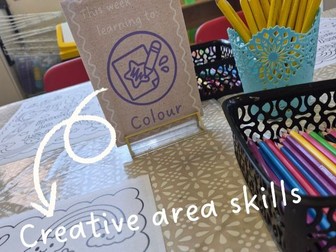
A poster displaying key creative skills with accompanying image.
Each one then has its own matching poster to display for the skill the activity is focusing on.
Each poster is displayed with ‘This week I am learning to’ or ‘I am learning to’ option
Featuring ALL construction resources available in my shop including the two new items: constructiion area heading cards and also the KS1 History construction area cards (both new for Summer 2023).
The bundle also includes:
design sheets, labels and work in progress siigns
construction are lettering
religious buildings construction cards
seasons construction cards
UK geography construction cards
Human, physical features and famous landmarks cards.
If all of these were to be purchased individually it would cost £14- bundle price of £10 saving nearly 30%!
This bundle contains ALL of the construction area resources you can find in my TES shop at a discounted price of just £7. If you were to purchase all of these items separately they would be £9.
The bundle includes:
construction lettering
religious buildings from around the world set
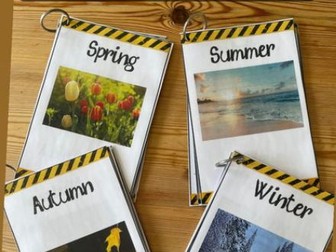
seasons bundle- spring, summer, autumn, winter (4 sets)
UK geography bundle- containing landmarks for Scotland, England, Wales and Northern Ireland each as an individual pack (4 sets)
Landmark bundle- featuring general human and physical features of the world and famous landmarks around the world (3 sets)
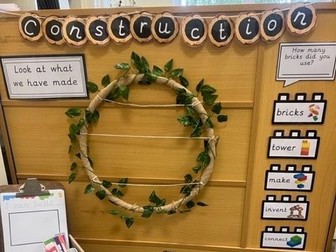
Construction area resource bundle including construction area labels, signs and design sheets
This is a bundle of resources to set up a construction area. All resources come as a PDF of editable. This resource pack includes:
Labels for resources (editable and non editable ones)
Lego bricks vocabulary
Lego writing template paper
Wooden building blocks inspiration book
Includes a multi-page document covering every area of the EYFS curriculum and how to implement this in your classroom.
Includes environment and resources tips, teaching tips and assessment tips.
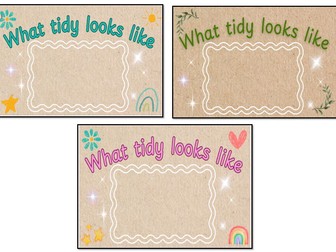
The perfect addition to each area of learning to remind the children of the expectations of keeping the area organised and neat after play. 3 bright and engaging designs that come in the resource.
A worksheet originally created for a low ability year 7 set, but could be used for key stage 2 pupils learning about area and perimeter for the first time.
Differentiated lesson looking at compound area and area of circles. The lesson goes through how to find compound area and leads onto area of circles. From here there is a differentiated worksheet that students can complete looking at these elements. There is also a challenge section which looks at more complex area.
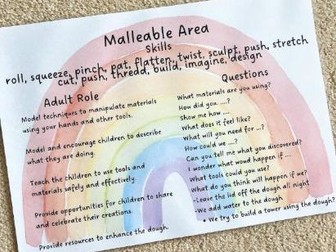
EYFS and KS1 - Rainbow Provision Area Skills Adult Role
Skills, Adult role and questions for each area in Early Years
-Mark marking / writing
Phonics
Reading
Small World
Construction
Maths
Creative
Malleable
Role play
Home corner
Investigation
Music
Sensory
Funky fingers
Sand
Water
Mud Kitchen
Trikes
Natural garden
Very engaging and interactive lesson.
This contains 1 PowerPoint.
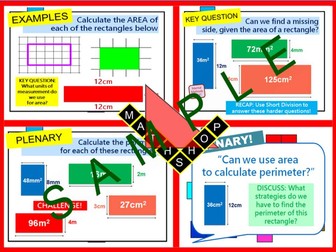
PowerPoint 1 - Lesson on Area of Rectangles. 11 colourful interactive slides. Lots of questions to assess understanding and check for misconception. Discussion points to make students understand and master the topic.
Tasks included in the PowerPoint which can be printed.
Worksheets - 3 Worksheets based on Working out Area, includes extension of working out missing area given length.
Enough for minimum of 1 Lesson about 60 Minutes worth of resources.
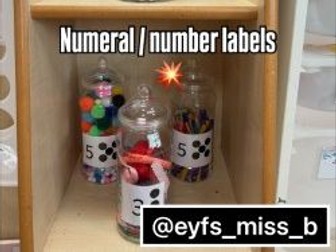
Numerals with associated number dots labels
To be used in the creative area to allow children to see how many of a resource they can use.
Encourages subitising, numeral recogniton and counting skills.
See @eyfs_miss_b for more details! :)
A clear PowerPoint presentation that show clearly how a formula is obtained to find the area of a rectangle and then the area of a triangle. Pupils are taken through the process step-by-step to ensure understanding.
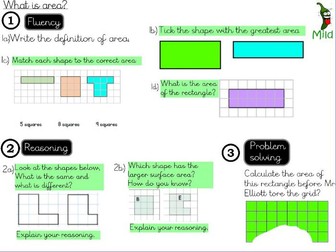
This is a whole lesson based on the unit of Area and this lesson focuses on the objective of “ What is area?". This resource is tailored for year 4 and includes the teacher input ( learning journey) and differentiated worksheets; Mild ( LA) , Spicy ( MA), Hot (HA) and a depth activity to deepen the children’s understanding of the concept being learned.
This document is useful for teachers who have adapted Mastery Maths or Singaporean Maths and need guidance in the approach or those who are looking for variation in fluency, reasoning and problem solving or simply those who don’t want to plan it themselves but want high quality resources and quality first teaching. =)
All of the documents that are uploaded as an Activinspire file are interactive and all of the concrete/pictorial manipulative can be used, moved and manipulated.
This document can be downloaded on Activinspire and it is also available as a PDF for those who do not have Activinspire.
Thank you for taking the time to review my resources. =)
I hope this helps you with your teaching and if it does please could you be kind enough to leave some positive feedback. =)
Kind regards,
@MasteryMaths01
Area: These area cootie catchers are a great way for students to have fun while they practice calculating the area of different shapes. How to Play and Assembly Instructions are included.
There are 2 cootie catchers in this product, each one having 8 problems for a total of 16 problems. These problems have students find the area of squares, rectangles, triangles, circles, semicircles, and irregular shapes. Answers for all problems are included.
*** Enjoy this Lesson? Do a search for my other Cootie Catchers: ***
♦ Grades 1-3:
Addition
Arrays
Balancing Equations
Coins
Estimating Sums
Expanded Form
Fact Families
Greater Than Less Than
Long Division
Missing Addends
Multiplication Word Problems
Number Bonds Word Problems
Skip Counting
Subtraction
Telling Time
♦ Grades 3-5:
Balancing Equations
Capacity
Comparing Decimals
Decimals
Elapsed Time
Expanded Form
Exponents
Fact Families
Factors & Multiples
Fractions
Fractions on a Number Line
Greater Than Less Than
Greatest Common Factors
Least Common Multiple
Long Division
Mean, Median, Mode, & Range
Metric Measurement
Mixed Numbers
Multiplication
Number Patterns
Order of Operations
Percents
Place Value
Prime & Composite Numbers
Prime Factorization
Probability
Properties of Mult.
Rounding
Word Problems
♦ Grades 6-8:
Customary Measurements
Fractions: Add & Sub, Decimals, & Percents
Fractions: Equivalent & Reducing Fractions
Greater Than Less Than
Improper Fractions & Mixed Numbers
Integers
Operations with Fractions
Rational Numbers
Ratios
Simple Interest
♦ Geometry:
3D Shapes
Angle Pair Relationships
Area of a Circle & Composite Figures
Circumference of a Circle
Missing Angles
Perimeter
Polygons
Pythagorean Theorem
Quadrilaterals
Surface Area of Rectangular Prisms
Volume & Surface Area of Cylinders
Volume of Cones, Rectangular Prisms, & Triangular Prisms
♦ Algebra:
Absolute Value
Combining Like Terms
Distributive Property
Equations
Evaluating Expressions
Inequalities
Linear Equations
Polynomials
Proportions
Quadratic Equations
Scientific Notation
Simplifying Expressions
Slope
System of Equations
Two Step & Multi Step Equations
Writing Expressions
Area in inches
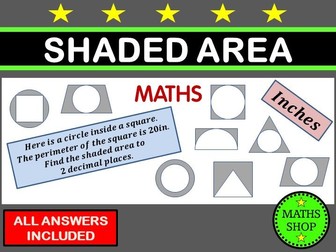
Area of 2D Shapes - Find the shaded area (inches)
This resource uses inches. For centimetres, please click here
There are 8 worksheets, which can be used individually or as a pack for lessons, revision or homework.
The worksheets are suitable for both Key Stages 3 and 4.
They are perfect for GCSE 9-1 revision for both foundation and higher tier.
They involve multiple steps to solve and are good for practising problem-solving skills.
Calculators should be used.
The questions involve:
• Areas of 2D shapes
• Circle Area
• Pythagoras
• Rounding to 2 decimal places
• Perimeter
• Radius and Diameter
The 2D shapes included are:
• Square
• Rectangle
• Circle
• Semi-Circle
• Parallelogram
• Trapezium
• Equilateral Triangle
All answers are included, as well as the stages of working out to allow for easy marking.
This document is 15 pages in total, with 8 pages to print for students.
It can be printed in colour or black and white.
To view my other resources, please go to Maths Shop


 Quick View