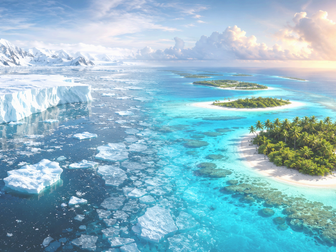
Documentary topic: Oceans
25 question and answer sheet to accompany the BBC documentary The Blue Planet, Episode One, Introduction. This documentary introduces the idea of life being sustained in the oceans by nutrient cycling.
The worksheet has 25 questions that cover the full documentary and comes with a detailed answer sheet for teachers (including time stamps). There is also a worksheet to follow up the documentary that gets pupils using both atlases and inference skills. This worksheet is designed to sit alongside a coasts/ocean unit of learning, but equally makes an excellent cover activity.
Topics include:
Nutrient Cycling
Ocean Currents
Wave Formation
Ocean location activity
Downloaded materials include all sheets PDF formats.
This is a full GCSE scheme of work for a project based on The Blue Planet.
It covers all four assessment objectives and explains to students how they can achieve different grades. It guides them through their presentation and gives examples of different levels of work.
The project includes slides for entry tasks / starters / plenaries etc and has a full range of artists’ work to show. The lessons are planned out as I used them, however you can easily remove or change etc. any slides you want to.
There are 87 slides in total.
This project could easily be adapted for Natural Forms, Pollution or similar themes. It explores:
AO1 - research. It shows examples of excellent research design sheets and sketchbooks
AO2 - experimentation. It includes a wide range of experiments and ideas for students.
AO3 - annotations and design ideas. There are a range of examples of how to annotate work and various ideas for final pieces.
AO4 - final designs. It clearly explains to students what they need to do to reach different grades and marks for their final pieces.
You can read more about this GCSE Art full scheme of work here.
Learning Outcomes:
• To recognise the characteristics of the world’s oceans
• To identify the layers of the ocean
• To recognise the adaptation of marine species to their
environment
• To investigate a marine area and the impact of tourism
• To identify the impacts of overfishing and the dangers of plastic in the ocean on marine life.
Vocabulary:
Algae
Anemone
Bioluminescent
Coral
Environmentalist
Mariana Trench
Midnight zone
Plankton
Sunlight zone1
The Abyss
Trenches
Twilight zone
This lesson is part of a wide scheme of work called ‘Oceans’.
This is Lesson 9 - How has Blue Planet demonstrated the human impact?
The lesson has a learning objective and three check points.
The lesson has a ‘Do Now’ that refers back to the previous lesson.
The lesson has ‘green pen’ answers for students to feedback their work.
Documentary topic: Oceans
25 question and answer sheet to accompany the BBC documentary The Blue Planet, Episode Two, The Deep. This documentary introduces the concept of the deep oceans and how life can be sustained in those dark deserts.
The worksheet has 25 questions that cover the full documentary and comes with a detailed answer sheet for teachers (including time stamps). There is also a worksheet to follow up the documentary that gets pupils to use a range of skills (explaining, drawing & creative writing). This worksheet is designed to sit alongside a coasts/ocean unit of learning, but equally makes an excellent cover activity.
Topics include:
Changes in the Deep Ocean
Adaptations to the Deep Ocean
Features of the Deep Ocean
Downloaded materials include all sheets PDF formats.
The pack includes five engaging activities to be used before, while and after watching the final Blue Planet episode of the series. There is a key vocabulary activity to prepare students for the language in the show, a set of 22 comprehension questions to check understanding, and an animal matching task, a set of discussion questions, and a poster making task to develop ideas on these issues.
The answer sheets are also provided. The pack is 10 pages in total.
It makes an excellent addition to any science or English curriculum.
This resource is designed to accompany the BBC documentary Blue Planet 2. I could be used for any of the episodes and aims to link learning from various areas in geography.
This package includes 7 sets of instructional resources for all 7 episodes of Blue Planet II: One Ocean, The Deep, Coral Reefs, Big Blue, Green Seas, Coasts, Our Blue Planet. It is 50 pages!
You get 3 instructional resources for each “Blue Planet II Episode”
One Ocean: 21 question worksheet, 44 word Word Search and 44 word Word Jumble
The Deep: 24 question worksheet, 52 word Word Search and 52 word Word Jumble
Coral Reefs: 20 question worksheet, 41 word Word Search and 41 word Word Jumble
Big Blue: 20 question worksheet, 35 word Word Search and 35 word Word Jumble
Green Seas: 20 question worksheet, 43 word Word Search and 43 word Word Jumble
Coasts: 21 question worksheet, 41 word Word Search and 41 word Word Jumble
Our Blue Planet: question worksheet, 24 word Word Search and 57 word Word Jumble
The questions are answered about every 2-3 minutes. You can have kids answer odds or evens to prevent answer sharing or to spread out the amount of time between questions.
The questions are often word for word from the video and made for students to quickly answer without being too distracted from the video. I guarantee students will hang off every word looking for the answer!
Arguably the materials are appropriate for grade 5,6,7,8,9,10,11,12.
You will get a zip file that includes everything if both word and pdf format.
There is also a Dropbox Link included for all the videos in “mkv” format and the resources in doc/pdf format.
Check out my other Blue Planet 2 resources.
Check our my Planet Earth 2 resources.
Question sheet for Blue Planet II: Episode 7, Our Blue Planet. This mainly covers human impacts on the oceans.
This includes both question and answer sheet. Set out on A3 in Word format. Covers whole episode.
The pack includes three engaging activities to be used before, while and after watching the incredible Blue Planet episode. There is a key vocabulary activity to prepare students for the language in the show, a set of comprehension questions, and an animal matching task. The pack is 8 pages in total.
The answer sheets are also provided.
It makes an excellent addition to any science or English curriculum.
The pack includes 32 pages of activities to be used before, while and after watching the Blue Planet episodes. There are key vocabulary activies to prepare students for the language in the show, sets of comprehension questions to check understanding, animal matching tasks, discussion questions, a poster making task to develop ideas on these issues, and answer sheets for all activities.
The Blue Planet 2 series can be bought, downloaded , or streamed from numerous places. The videos should be paused throughout each episode to allow time for students to complete the corresponding questions and activities.
It makes an excellent addition to any science or English curriculum.
Complete Two-Part Changing Planet Unit - Frozen Planet & Blue Planet - KS3 Geography
This fully resourced KS3 Geography unit explores our Changing Planet through two connected sections, taking students on a journey from the frozen polar regions to the world’s oceans.
The unit is designed to run across two half-terms, with each section forming a complete sequence of lessons and finishing with its own revision materials and end-of-half-term assessment. Although each section can be taught separately, they have been designed to connect: students build their understanding of climate change, melting ice and polar environments before exploring how these changes affect the global ocean, coastlines and marine ecosystems.
Lessons are clear, varied and visually engaging, combining geographical knowledge with data interpretation, decision-making, discussion, problem-solving and extended writing. The complete pack includes PowerPoints, ready-to-print worksheets, embedded videos, individual and collaborative activities, revision checklists, assessments and mark schemes.
Section A: Frozen Planet
Topics include:
Changing Planet Introduction
Warming World
Climate Change
Polar Worlds
Polar Food Webs
Animal Adaptations
Melting Ice
On Thin Ice
Optional after half-term assessment: People of the Arctic & Land of No One
Section B: Blue Planet
Topics include:
Blue Planet
Rising Seas
Coral Kingdoms
Mangrove Guardians
Plastic Ocean
Protecting our Blue Plant
Optional after half-term assessment: Poster on protecting our oceans
The unit places a strong emphasis on connections. Students see how changes in the atmosphere affect the cryosphere and oceans, how melting land ice contributes to rising sea levels, how changing ocean conditions threaten ecosystems, and how actions by governments, communities, businesses and individuals can help protect vulnerable environments.
Whether you’re a specialist or non-specialist, the unit is designed to be flexible and straightforward to teach, saving planning time without compromising on geographical depth or challenge.
As a practising classroom teacher with nearly 25 years of experience, I only share resources I’ve used myself. All lessons have been tried and tested in the classroom.
If you find this unit useful, feel free to browse my shop for a wide range of Geography resources. I keep my prices affordable and offer bundles across a variety of topics and key stages.
A lot of care goes into creating these resources, so I’d really appreciate it if you could leave a review. Thank you for your support!
First upload October 2026
This is a catchy and simple to learn song that is a great way to end a Primary class or school assembly.
The message is that we all live in special world and we must look after it; not wasting paper or polluting the air.
Can we make a difference YES! YES! YES!
It has been tried and tested and comes with a piano score, lyric sheet and vibrant backing and vocal tracks.
Support pupils’ geographical understanding with this clear, child friendly vocabulary resource pack, designed for the Year 5 unit Our Blue Planet. This collection includes matching definition sheets, Widgit style symbol cards, and lesson specific vocabulary sets, making it ideal for retrieval practice, SEN scaffolding, and whole class teaching.
What’s included?
• Key vocabulary sheets for the whole unit
• Glossary of key vocabulary for the whole unit
• Lesson by lesson vocabulary cards covering oceans, water cycle, rivers, human impact and conservation
• Widgit style symbol cards for visual learners
• Simple, accurate definitions taken directly from the unit content
• Perfect for displays, knowledge organisers, and pupil book support
A comprehensive resource suitable for KS3 and KS4 students focusing on Ocean Conservation inspired by BBC’s Blue Planet II.
The project is currently being taught to a Y8 group, however it is structured to reflect a GCSE Art and Design project so could be taught to KS4 also.
The project should run for one term. The Powerpoint includes homeworks, starters, plenaries and an image pack at the end for visual resources for pupils.
Tasks include: Coloured pencil drawing, recycled plastic fish sculptures, creative pattern/mark making, oil pastel, collage and research into artists such as: Iain Macarthur, Ande Hall and contextual research into the charity Washed Ashore.
The project has proven to be a really successful issue-based scheme of work which pupils have thoroughly enjoyed studying. They have produced very successful and creative work in response to this theme and at least 2 lessons taught from this project have recently been graded Outstanding.
A 3-week, fully resourced primary literacy unit based on Poems from a Green and Blue Planet by Sabrina Mahfouz. KS2 Fiction. National-Curriculum-aligned grammar, WT/ARE/GD differentiation, and ready to teach.
What’s inside
This complete English unit gives you everything for three weeks of high-quality teaching.
15 lesson PowerPoints — illustrated cover slides, success criteria, vocabulary previews, modelled writing, “big questions” (Bloom’s-laddered), differentiation tiers, plenary, and reflection.
15 differentiated resource sheets — Working Towards, Age-Related Expectations, and Greater Depth, with sentence frames, word banks, and writing frames.
Complete teacher unit plan — unit overview, key themes, model texts, full session-by-session plans, key questions, assessment focus, and vocabulary focus.
Child-friendly mark scheme — “I can…” success criteria for the final writing piece, ready for self- and peer-assessment.
3 weekly exit tickets — 5 multiple-choice questions per week, with teacher answer keys.
Themes explored
Darkness and light, nature and environment, wonder and discovery.
Key vocabulary
Shimmer, luminous, shadows, silhouette, translucent, constellation, dusk, ethereal.
Format & compatibility
Editable PowerPoint (.pptx) and Word (.docx) files.
UK English spelling.
One printer-friendly A4 page per resource sheet.
Compatible with Literacy Tree, Write Stuff, and Power of Reading planning approaches.
Year groups & key stage
Year 4 (KS2).
15 sessions over 3 weeks (≈45–60 minutes per lesson).
Tags
KS2, Year 4, English, fiction, Sabrina Mahfouz, reading and writing, complete unit, differentiated, NC-aligned, lesson plans, resources, poems from a green and blue planet


 Quick View