Cell Structure and Specialised Cells - GCSE Biology WorksheetsQuick View
cal-w11

Cell Structure and Specialised Cells - GCSE Biology Worksheets

(0)
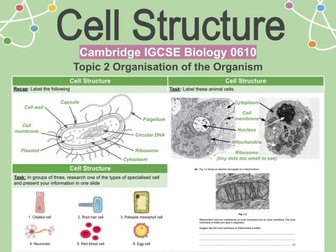
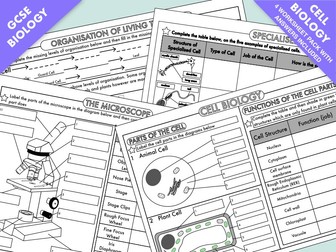
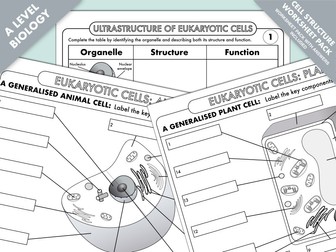
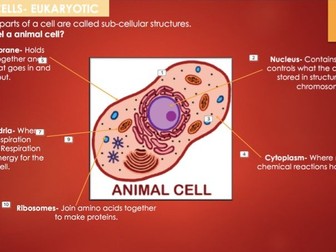
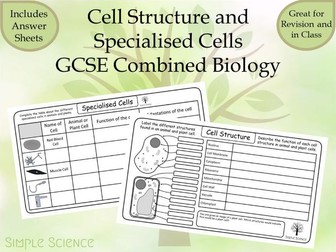
This resource contains 2 worksheets that can be used in class or as homework to enable your students to practice what they have learnt in the classroom. The diagrams are simple to aid students to visually see what may come up in their upcoming GCSE exams. These resources could used to check prior learning for your students so you can plan accordingly for future lessons. I hope your students find these useful either in the classroom or as revision. This pack includes: Animal and Plant Cell Structures Specialised Cells All worksheets include answers. We have worksheets for the following topics in Biology Paper 1: Cell Biology Cell Structure and Specialised Cell Microscopy Microscopy Required Practical Culturing Microorganisms – Triple Microbiology Required Practical – Triple Cell Division and Stem Cells Diffusion, Osmosis and Active Transport Osmosis Required Practical Organisation Organisation and The Digestive System Food Tests Required Practical Enzymes and Enzyme Activity Enzymes Required Practical The Circulatory System and Heart Disease The Respiratory system Plant Tissues and Organs Infection and Response Pathogens and Human Defences Vaccines, Antibiotics and Drug Development Monoclonal Antibodies – Triple Plant Diseases Detection and Defences – Triple Bioenergetics Photosynthesis Photosynthesis Required Practical Aerobic and Anaerobic Respiration Exercise and Metabolism Please take a small amount of time to review this resource to let other buyers know your thought about these worksheets. Thank you!
Chromosomes, Cell Cycle, MitosisQuick View
BrainJar

Chromosomes, Cell Cycle, Mitosis

(0)
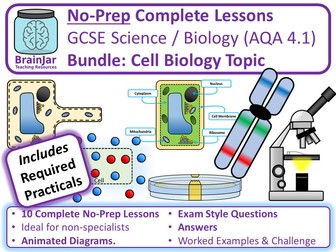
Complete No-Prep lesson with exam questions, tasks and answers on Chromosomes, Cell Cycle and Mitosis for AQA GCSE (9-1) Science / Biology. This lesson covers all of AQA GCSE Biology / Combined Science 4.1.2.1 and 4.1.2.2. As a Secondary Science teacher, Deputy Headteacher, writer and examiner for many years I make high quality no-prep lessons so busy teachers can teach outstanding lessons without spending hours planning. This high quality lesson includes explanations, different types of in-lesson assessment (all with answers) and unique exam questions. My lessons are designed to take learners on a journey that builds up their understanding step by step, while still going into a lot of depth. The preview video shows a representative sample of slides from the resource so that you get a good idea of what it includes before you buy. What’s Included: • Teaching notes • Starter / Do Now Activity • Explanation slides in “chunked” sections with animated diagrams. • Multiple questions in different question styles and difficulties - no need for worksheets. Each “chunked” explanation section typically includes a set of “learning check / quick questions” followed by a set of in-depth questions on the learning from that “chunk” of the lesson. All questions have answers. • Exam-style questions on the whole lesson at the end of the lesson- these are unique, based on real exam questions but not just copied from exam boards. • Answers for all questions • All easily editable to adapt to your teaching or to use in existing lessons. • Slightly humorous, at points, if you like that sort of thing. The lesson was written for AQA GCSE Science / Biology but is very likely to be applicable to other exam specifications. Please leave a rating / review and all other feedback gratefully received!
NEW AQA GCSE (2016) Chemistry - Chemical cells, batteries and fuel cellsQuick View
SWiftScience

NEW AQA GCSE (2016) Chemistry - Chemical cells, batteries and fuel cells

(0)
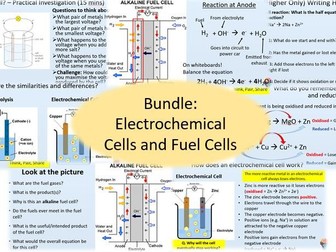
This lesson is designed for the NEW AQA Trilogy Chemistry GCSE, particularly the ‘Chemical changes and electrolysis’ SoW. For more lessons designed to meet specification points for the NEW AQA Trilogy specifications for Biology, Chemistry and Physics please see my shop: https://www.tes.com/teaching-resources/shop/SWiftScience The lesson begins with a diagram to show how chemical cells/batteries work by relying upon the differing reactivity of metals. Students will then watch a video and will need to answer a set of questions using the information provided in the video, students can then self-assess their work using the mark scheme provided in the PowerPoint. Students will now need to complete an investigation into the potential difference produced by different chemical cells by following the instructions on the practical sheet provided. Pupils will need to record the results of their investigation and write a conclusion on the practical worksheet. The next task is a ‘Quick Check’ to assess students understanding of what they have learnt so far this lesson, pupils will need to complete a set of questions and they can then self-assess their work using the answers provided in the PowerPoint. The last part of the lesson will focus on fuel cells, students will watch a video and using the information provided they will need to ask a set of questions. The answers to these questions are included in the PowerPoint, so students can check their work once this task is complete. Finally, students will be given a set of information on hydrogen fuel cells which they can read in pairs. Using this information pupils will need to produce a table to sum the advantages and disadvantages of using hydrogen fuel cells as an energy source. Students can then check their work against answers provided in the PowerPoint. The plenary task is for pupils to summarise what they have learnt this lesson in three sentences, using key words from the list provided. All resources are included at the end of the presentation. Thanks for looking, if you have any questions please let me know in the comments section and any feedback would be appreciated :)
Stem CellsQuick View
BrainJar

Stem Cells

(0)
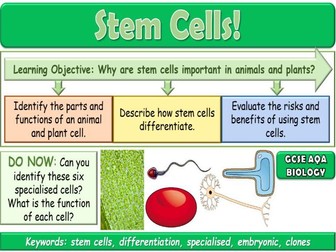
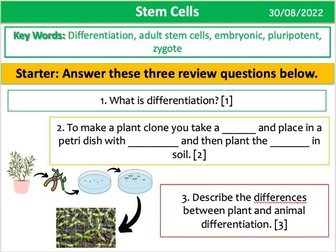
Complete No-Prep lesson with exam style questions, tasks and answers on Stem Cells for AQA GCSE (9-1) Science / Biology. This lesson covers all of AQA GCSE Biology and Combined Science Biology 4.1.2.3. As a Secondary Science teacher, Deputy Headteacher, writer and examiner for many years I make high quality no-prep lessons so busy teachers can teach outstanding lessons without spending hours planning. This high quality lesson includes explanations, different types of in-lesson assessment (all with answers) and unique exam-style questions. My lessons are designed to take learners on a journey that builds up their understanding step by step, while still going into a lot of depth. The preview video shows a representative sample of slides from the resource so that you get a good idea of what it includes before you buy. What’s Included: • Teaching notes • Starter / Do Now Activity • Explanation slides in “chunked” sections with animated diagrams. • Multiple questions in different question styles and difficulties - no need for worksheets. Each “chunked” explanation section typically includes a set of “learning check / quick questions” followed by a set of in-depth questions on the learning from that “chunk” of the lesson. All questions have answers. • Exam-style questions on the whole lesson at the end of the lesson- these are unique, based on real exam questions but not just copied from exam boards. • Answers for all questions • All easily editable to adapt to your teaching or to use in existing lessons. The lesson was written for AQA GCSE Science / Biology but is very likely to be applicable to other exam specifications. Please leave a rating / review and all other feedback gratefully received!
CellsQuick View
nextpagescience

Cells

(0)
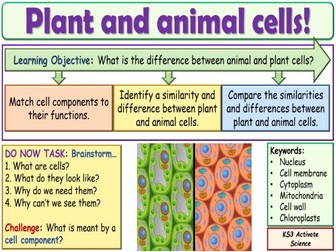
Comprehension and additional task exercises pages 6 and 7 from Next Page Science KS3 Complete. Accompanying PowerPoint and word searches available for free from the website. This exercise covers: • Differences between plant and animal cells • Organelles and their functions • Labelling diagrams of cells • Specialised cells and their functions • Levels of organisation (organ, organs systems etc) Amazing WHAT? facts.
Specialised CellsQuick View
BrainJar

Specialised Cells

(0)
Complete No-Prep lesson with exam questions, tasks and answers on Cell Specialisation and Differentiation for AQA GCSE (9-1) Science / Biology. This lesson covers all of AQA GCSE Biology / Combined Science 4.1.1.3 and 4.1.1.4 As a Secondary Science teacher, Deputy Headteacher, writer and examiner for many years I make high quality no-prep lessons so busy teachers can teach outstanding lessons without spending hours planning. This high quality lesson includes explanations, different types of in-lesson assessment (all with answers) and unique exam questions. My lessons are designed to take learners on a journey that builds up their understanding step by step, while still going into a lot of depth. The preview video shows a representative sample of slides from the resource so that you get a good idea of what it includes before you buy. What’s Included: • Teaching notes • Starter / Do Now Activity • Explanation slides in “chunked” sections with animated diagrams. • Multiple questions in different question styles and difficulties - no need for worksheets. Each “chunked” explanation section typically includes a set of “learning check / quick questions” followed by a set of in-depth questions on the learning from that “chunk” of the lesson. All questions have answers. • Exam-style questions on the whole lesson at the end of the lesson- these are unique, based on real exam questions but not just copied from exam boards. • Answers for all questions • All easily editable to adapt to your teaching or to use in existing lessons. • Slightly humorous, at points, if you like that sort of thing. The lesson was written for AQA GCSE Science / Biology but is very likely to be applicable to other exam specifications. Please leave a rating / review and all other feedback gratefully received!
Electrolysis and Fuel Cells GCSE ChemistryQuick View
ychebbout

Electrolysis and Fuel Cells GCSE Chemistry

(1)
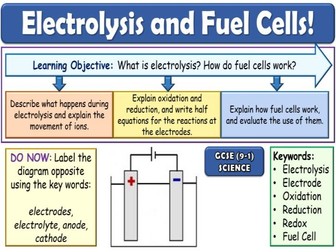
Perfect if you teach GCSE Chemistry Single Science, this fully differentiated and resourced lesson supports your students in learning about electrolysis and fuel cells. Covering the full GCSE Chemistry specification, this resource is adapted to cover all exam boards. Students will: Recall the properties of ionic compounds. Describe the process of electrolysis and explain the movement of ions. Explain oxidation and reduction reactions. Write half equations for the reactions at the electrodes. Compare and contrast molten and aqueous electrolysis, describe the method, and explain the products at the electrodes. Describe the electrolysis of copper sulphate solution using inert and non-inert electrodes. Explain how fuel cells work and evaluate the use of them. This lesson includes a detailed and engaging lesson PowerPoint with differentiated activities, exam style questions and progress quizzes for students to complete. Enjoy and feel free to leave a review. INCLUDED IN BUNDLE: 29 slide PowerPoint Presentation with key points, progress check questions, checkpoints, practice exam questions and quizzes.
Cell Division and Stem Cells - GCSE Biology WorksheetsQuick View
cal-w11

Cell Division and Stem Cells - GCSE Biology Worksheets

(0)
This resource contains 2 worksheets that can be used in class or as homework to enable your students to practice what they have learnt in the classroom. These resources could used to check prior learning for your students so you can plan accordingly for future lessons. I hope your students find these useful either in the classroom or as revision. This pack includes: Chromosomes and The Cell Cycle (mitosis) Stem Cells Students will be: Describing the steps in cell division (mitosis). Stating the number of chromosomes in normal body cells and defining a ‘gene’. Outlining what stem cells are and their uses. Evaluating the uses of stem cells for treatments of different diseases. All worksheets include answers. We also have worksheets for the following topics in Biology Paper 1: Cell Biology Cell Structure and Specialised Cell Microscopy Microscopy Required Practical Culturing Microorganisms – Triple Microbiology Required Practical – Triple Cell Division and Stem Cells Diffusion, Osmosis and Active Transport Osmosis Required Practical Organisation Organisation and The Digestive System Food Tests Required Practical Enzymes and Enzyme Activity Enzymes Required Practical The Circulatory System and Heart Disease The Respiratory system Plant Tissues and Organs Infection and Response Pathogens and Human Defences Vaccines, Antibiotics and Drug Development Monoclonal Antibodies – Triple Plant Diseases Detection and Defences – Triple Bioenergetics Photosynthesis Photosynthesis Required Practical Aerobic and Anaerobic Respiration Exercise and Metabolism Thank you!
Cells and Specialised Cells GCSE (9-1) BiologyQuick View
ychebbout

Cells and Specialised Cells GCSE (9-1) Biology

(0)
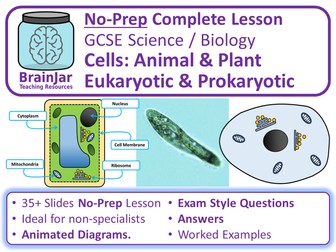
Perfect if you teach GCSE Biology Single or Combined Science, this fully differentiated and resourced lesson supports your students in learning about cells and specialised cells. Students will identify the sub-cellular structures of eukaryotes and prokaryotes, explain how the sub-cellular structures of eukaryotic and prokaryotic cells are related to their functions, and describe how specialsied cells are adapted to their function. This lesson includes a detailed and engaging lesson PowerPoint with differentiated activities, worksheets, exam style questions, progress check questions and quizzes for students to complete. This resource has been adapted to cover all exam boards. Enjoy and feel free to leave a review. INCLUDED IN BUNDLE: 26 slide PowerPoint Presentation with key points, progress checks and practice exam questions, worksheets included.
Eukaryotic and Prokaryotic CellsQuick View
OuttheBoxScience

Eukaryotic and Prokaryotic Cells

(0)
New for the AQA GCSE 1-9 Combined Trilogy Unit ‘B1 Cell Structure and Transport’. Full lessons ready to use straight ‘out of the box’. Lesson meets the full criteria for this unit Similar structure to my other power points following the input - activity - review phasing Plenary sections for progress checking Clear learning objectives and outcomes Modern and engaging layout Little adaptation needed Each lesson covers at least an hour of lesson time 48 ppt slides Please leave constructive feedback :D
Specialised CellsQuick View
OuttheBoxScience

Specialised Cells

(0)
KS3 new for the Activate 1 resource unit ‘Cells’. Full lesson ready to use straight ‘out of the box’ Get the second Plant and ANimal Cells lesson in this unit FREE at the shop https://www.tes.com/teaching-resource/plant-and-animal-cells-ks3-11992334 Similar structure to my other power points following the input - activity - review phasing Plenary sections for progress checking Clear learning objectives and outcomes Modern and engaging layout Little adaptation needed Differentiated activity Feedback welcome :D
Specialisation in Plant CellsQuick View
OuttheBoxScience

Specialisation in Plant Cells

(0)
New for the AQA GCSE 1-9 Combined Trilogy Unit ‘B1 Cell Structure and Transport’. Full lessons ready to use straight ‘out of the box’. Lesson meets the full criteria for this unit Similar structure to my other power points following the input - activity - review phasing Plenary sections for progress checking Clear learning objectives and outcomes Modern and engaging layout Little adaptation needed Each lesson covers at least an hour of lesson time 30 ppt slides Please leave constructive feedback :D
A Level Biology: Cell Membrane Structure WorksheetQuick View
beckystoke

A Level Biology: Cell Membrane Structure Worksheet

(6)
This worksheet allows A level Biology students to explore the structure of the fluid mosaic model of the plasma membrane of cells. Students will label the key components of the plasma membrane and identify the role of each key component in the membrane. This worksheet would lead well in to looking at how substances move across the membrane to enter and leave the cell. Great either to use as a worksheet when teaching this topic, or as a revision sheet or assessment at the end of the topic. Answer sheet provided; good to project on the board when going through the sheet with your students.
GCSE Biology: Cell Biology Worksheet Pack UPDATEDQuick View
beckystoke

GCSE Biology: Cell Biology Worksheet Pack UPDATED

(5)
This Biology GCSE resource pack covers the fundamentals required on the topic of Cell Biology. The worksheets encourage the pupils to work through them independently and are visually engaging to appeal to the students. Each worksheet should take approximately 10-15 minutes to complete. The resource pack is ideal for introduction to the topic or revision in preparation for the upcoming GCSE exams. The resource pack could be used at KS3 level too. The pack includes: Worksheet on cell structure and function (animal and plant cells) Worksheet on cell structure and function including rough ER (animal and plant cells) Worksheet on the parts of the microscope and their function Worksheet on calculating magnification, size of specimens and converting units Worksheet on specialised cells and their adaptations Worksheet on organisation of living things and revision crossword on cell biology in general All answer sheets are included, perfect for the non-specialist teaching Biology.
Cells, Tissues and Organ Systems Revision SpreadQuick View
jonathanmitchell

Cells, Tissues and Organ Systems Revision Spread

(0)
KS3 Science Edexcel Yr7 Revision Spread and Answer Sheet - Biology: Topic 7A Cells, Tissues and Organ Systems. This A4 revision spread condenses the Edexcel topic 7A onto one A4 sheet which can be printed off and filled in to aid revision and help summarize the topic. A full answer sheet is provided which can be used to mark the filled in revision spread and can also be used as a revision poster.
Science cover worksheet/cover work: CellsQuick View
Made_for_teachers

Science cover worksheet/cover work: Cells

(0)
This double sided worksheet, with handout, focuses on ‘Cells’. The five tasks introduce plant, animal and bacterial cell structures. This task is suitable for KS3 and KS4 students as part of their Science lesson/revision. The worksheet is differentiated - with it’s cut and stick tasks, includes specific scientific terminology relating to the topic; to help students with task completion. Task 1: Complete the missing sentences. Task 2: Draw an animal and plant cell, match the missing key terminology to their function; then label the parts of the cells. Task 3: Define the term bacteria. Task 4: Label a bacteria cell structure (cut and stick task - hand out provided) Task 5: Answer questions relating to the topic All answers have been included. This creates a smooth cover/specialist lesson; and enables students to complete this independently for revision or homework. This worksheet is tried and tested , with engaged students and happy cover teacher! Reliable subject included throughout!
Stem Cells AQA GCSE (9-1) BiologyQuick View
ychebbout

Stem Cells AQA GCSE (9-1) Biology

(0)
Perfect if you teach AQA GCSE Biology Combined Science or Single Science, this fully differentiated and resourced lesson supports your students in learning about 4.1 Cell biology, 4.1.2.3 Stem cells. This resource covers all the specification points and can easily be adapted to cover other exam boards. The resource includes a detailed and engaging PowerPoint Presentation with key points, differentiated activities, exam style questions and progress check questions/quizzes for students to complete. INCLUDED IN RESOURCE: 24 slide PowerPoint Presentation with key points, progress checks and quizzes. Enjoy and feel free to leave a review. For the full set of AQA Biology, Chemistry and Physics topic bundles please visit: https://www.tes.com/teaching-resources/shop/ychebbout
Cell specialisationQuick View
jm2450

Cell specialisation

(12)
Builds on knowledge of specialised cells from GCSE. Includes erythrocyte, neutrophil, ciliated epithelium, sperm, palisade cell, guard cell etc. Designed to be used for the OCR AS Biology course in combination with the course textbook. Includes a practice question and mark scheme on the adaptations of red blood cells
Cells - Cell Structure and OrganellesQuick View
Sci-Guy

Cells - Cell Structure and Organelles

(1)
By the end of this lesson students should be able to explain the role of a plant cell, and describe the difference between plant and animal cells. Students are to copy all blue text. Please check slide notes for any additional information.